
Title
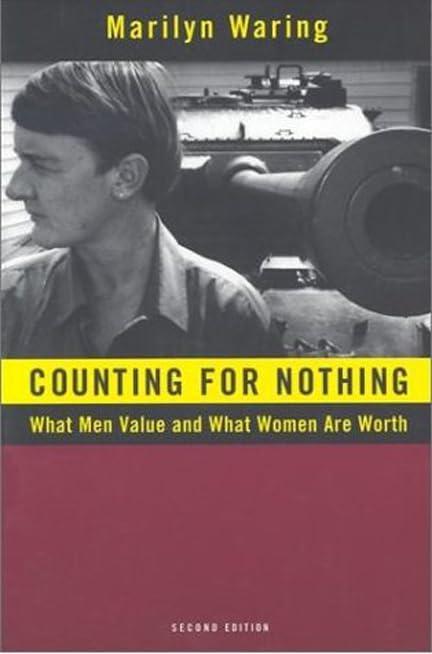
Counting for Nothing: What Men Value and What Women are Worth (Heritage),New
Sold by Ergodebooks, an authorized reseller.
Returns accepted within 30 days | support@ergodebooks.com
Shipping Information
- Free Standard Shipping — United States only
- Processing Time: 3–5 business days
- Estimated Delivery: 6–10 business days after dispatch
- Double-boxed, fully insured & discreetly packaged
- Tracking number sent via email once dispatched
Returns & Refund
Returns accepted within 30 days of delivery.
Damaged or Defective Item
Free return shipping + replacement or full refund
Wrong Item Received
Free return shipping + replacement or full refund
Change of Mind
Return shipping at customer's expense · 25% restocking fee applies
Payment Option

Safe drinking water counts for nothing. A pollutionfree environment counts for nothing. Even some people namely women count for nothing. This is the case, at least, according to the United Nations System of National Accounts. Author Marilyn Waring, former New Zealand M.P., now professor, development consultant, writer, and goat farmer, isolates the gender bias that exists in the current system of calculating national wealth.As Waring observes, in this accounting system women are considered 'nonproducers' and as such they cannot expect to gain from the distribution of benefits that flow from production. Issues like nuclear warfare, environmental conservation, and poverty are likewise excluded from the calculation of value in traditional economic theory. As a result, public policy, determined by these same accounting processes, inevitably overlooks the importance of the environment and half the world's population.Counting for Nothing, originally published in 1988, is a classic feminist analysis of women's place in the world economy brought up to date in this reprinted edition, including a sizeable new introduction by the author. In her new introduction, the author updates information and examples and revisits the original chapters with appropriate commentary. In an accessible and often humorous manner, Waring offers an explanation of the current economic systems of accounting and thoroughly outlines ways to ensure that the significance of the environment and the labour contributions of women receive the recognition they deserve.
⚠️ WARNING (California Proposition 65):
This product may contain chemicals known to the State of California to cause cancer, birth defects, or other reproductive harm.
For more information, please visit www.P65Warnings.ca.gov.
- Q: What is the main theme of 'Counting for Nothing'? A: The main theme of 'Counting for Nothing' is the critique of traditional economic systems that undervalue women's contributions and environmental factors, as illustrated by author Marilyn Waring.
- Q: Who is the author of 'Counting for Nothing'? A: The author of 'Counting for Nothing' is Marilyn Waring, a former New Zealand Member of Parliament and a noted feminist economist.
- Q: What edition of 'Counting for Nothing' is currently available? A: The currently available edition of 'Counting for Nothing' is the 2nd edition, published on December 15, 1999.
- Q: How many pages does 'Counting for Nothing' have? A: The book 'Counting for Nothing' contains a total of 362 pages.
- Q: What type of binding does 'Counting for Nothing' have? A: The binding of 'Counting for Nothing' is paperback.
- Q: Is 'Counting for Nothing' in good condition? A: Yes, the book is listed as a used book in good condition.
- Q: What key issues does 'Counting for Nothing' address? A: The book addresses key issues such as gender bias in economic accounting, the undervaluation of women's work, and the exclusion of environmental concerns from economic calculations.
- Q: Does 'Counting for Nothing' include new content? A: Yes, the 2nd edition includes a sizeable new introduction by the author, updating information and commentary on the original chapters.
- Q: What audience is 'Counting for Nothing' intended for? A: The book is intended for readers interested in feminist economics, social justice, and environmental issues.
- Q: Can 'Counting for Nothing' be used as a resource for academic studies? A: Yes, 'Counting for Nothing' can serve as a valuable resource for academic studies in economics, gender studies, and environmental policy.