
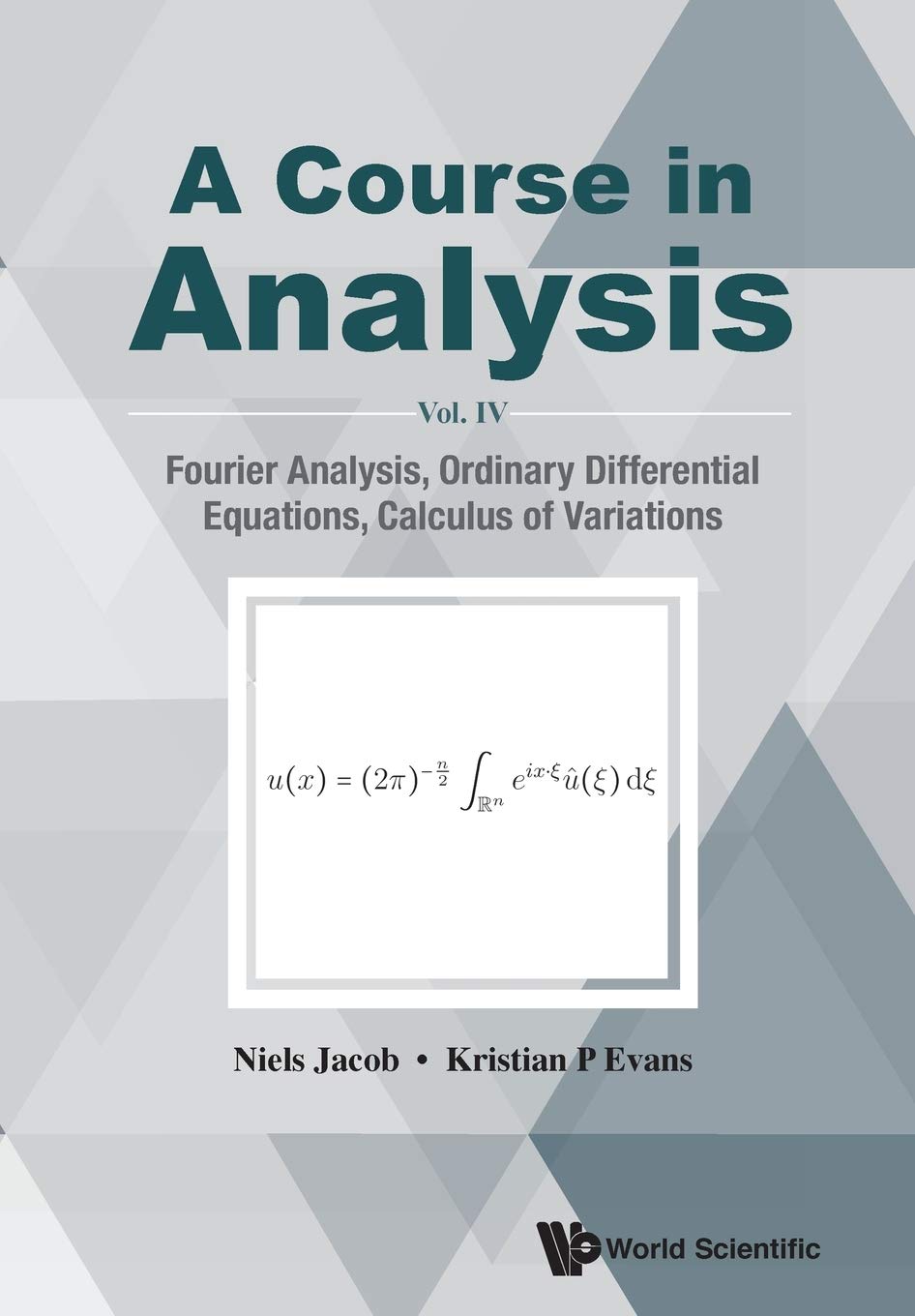
Title
Course In Analysis, A Vol. Iv: Fourier Analysis, Ordinary Differential Equations, Calculus Of Variations,Used
Sold by Ergodebooks, an authorized reseller.
Returns accepted within 30 days | support@ergodebooks.com
Shipping Information
- Free Standard Shipping — United States only
- Processing Time: 3–5 business days
- Estimated Delivery: 6–10 business days after dispatch
- Double-boxed, fully insured & discreetly packaged
- Tracking number sent via email once dispatched
Returns & Refund
Returns accepted within 30 days of delivery.
Damaged or Defective Item
Free return shipping + replacement or full refund
Wrong Item Received
Free return shipping + replacement or full refund
Change of Mind
Return shipping at customer's expense · 25% restocking fee applies
Payment Option

In the part on Fourier analysis, we discuss pointwise convergence results, summability methods and, of course, convergence in the quadratic mean of Fourier series. More advanced topics include a first discussion of Hardy spaces. We also spend some time handling general orthogonal series expansions, in particular, related to orthogonal polynomials. Then we switch to the Fourier integral, i.e. the Fourier transform in Schwartz space, as well as in some Lebesgue spaces or of measures. Our treatment of ordinary differential equations starts with a discussion of some classical methods to obtain explicit integrals, followed by the existence theorems of PicardLindelf and Peano which are proved by fixed point arguments. Linear systems are treated in great detail and we start a first discussion on boundary value problems. In particular, we look at SturmLiouville problems and orthogonal expansions. We also handle the hypergeometric differential equations (using complex methods) and their relations to special functions in mathematical physics. Some qualitative aspects are treated too, e.g. stability results (Ljapunov functions), phase diagrams, or flows. Our introduction to the calculus of variations includes a discussion of the EulerLagrange equations, the Legendre theory of necessary and sufficient conditions, and aspects of the HamiltonJacobi theory. Related first order partial differential equations are treated in more detail. The text serves as a companion to lecture courses, and it is also suitable for selfstudy. The text is complemented by ca. 260 problems with detailed solutions.
⚠️ WARNING (California Proposition 65):
This product may contain chemicals known to the State of California to cause cancer, birth defects, or other reproductive harm.
For more information, please visit www.P65Warnings.ca.gov.