
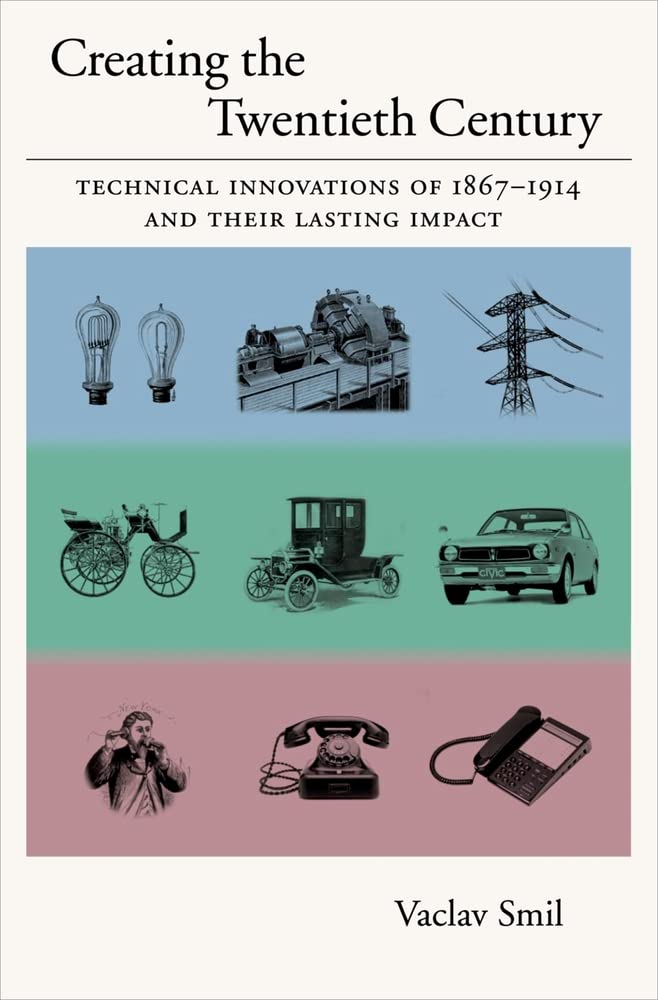
Title
Creating the Twentieth Century: Technical Innovations of 18671914 and Their Lasting Impact (Technical Revolutions and Their Las,Used
Sold by Ergodebooks, an authorized reseller.
Returns accepted within 30 days | support@ergodebooks.com
Shipping Information
- Free Standard Shipping — United States only
- Processing Time: 3–5 business days
- Estimated Delivery: 6–10 business days after dispatch
- Double-boxed, fully insured & discreetly packaged
- Tracking number sent via email once dispatched
Returns & Refund
Returns accepted within 30 days of delivery.
Damaged or Defective Item
Free return shipping + replacement or full refund
Wrong Item Received
Free return shipping + replacement or full refund
Change of Mind
Return shipping at customer's expense · 25% restocking fee applies
Payment Option

The period between 1867 and 1914 remains the greatest watershed in human history since the emergence of settled agricultural societies: the time when an expansive civilization based on synergy of fuels, science, and technical innovation was born. At its beginnings in the 1870s were dynamite, the telephone, photographic film, and the first light bulbs. Its peak decade the astonishing 1880s brought electricity generating plants, electric motors, steam turbines, the gramophone, cars, aluminum production, airfilled rubber tires, and prestressed concrete. And its post1900 period saw the first airplanes, tractors, radio signals and plastics, neon lights and assembly line production. This book is a systematic interdisciplinary account of the history of this outpouring of European and American intellect and of its truly epochal consequences. It takes a close look at four fundamental classes of these epochmaking innovations: formation, diffusion, and standardization of electric systems; invention and rapid adoption of internal combustion engines; the unprecedented pace of new chemical syntheses and material substitutions; and the birth of a new information age. These chapters are followed by an evaluation of the lasting impact these advances had on the 20th century, that is, the creation of highenergy societies engaged in mass production aimed at improving standards of living.
⚠️ WARNING (California Proposition 65):
This product may contain chemicals known to the State of California to cause cancer, birth defects, or other reproductive harm.
For more information, please visit www.P65Warnings.ca.gov.
- Q: What is the main focus of 'Creating the Twentieth Century'? A: The book focuses on the technical innovations between 1867 and 1914 and their lasting impact on society, highlighting key inventions and their contributions to modern civilization.
- Q: Who is the author of this book? A: The author of 'Creating the Twentieth Century' is Vaclav Smil, a prominent scholar known for his interdisciplinary approach to the history of technology and its societal implications.
- Q: How many pages does the book contain? A: The book contains a total of 368 pages, providing a comprehensive exploration of its subject matter.
- Q: What type of binding does the book have? A: This edition of the book is bound in hardcover, offering durability and a more prestigious presentation.
- Q: When was 'Creating the Twentieth Century' published? A: The book was published on August 25, 2005.
- Q: What are some key innovations discussed in the book? A: Key innovations discussed include dynamite, the telephone, electric motors, steam turbines, and the advent of plastics, among others.
- Q: Is this book suitable for academic purposes? A: Yes, the book is suitable for academic purposes as it provides a systematic interdisciplinary account, making it a valuable resource for students and scholars interested in technology and history.
- Q: What is the significance of the innovations covered in the book? A: The innovations are significant as they mark the transition to high-energy societies engaged in mass production, fundamentally changing living standards and societal structures.
- Q: Does the book address the impact of these innovations on the 20th century? A: Yes, the book evaluates the lasting impacts of these innovations on the 20th century, including developments in production, communication, and daily life.
- Q: Is the book suitable for general readers? A: Yes, while it has academic rigor, the book is also accessible to general readers interested in the history of technology and its effects on modern life.