
Title
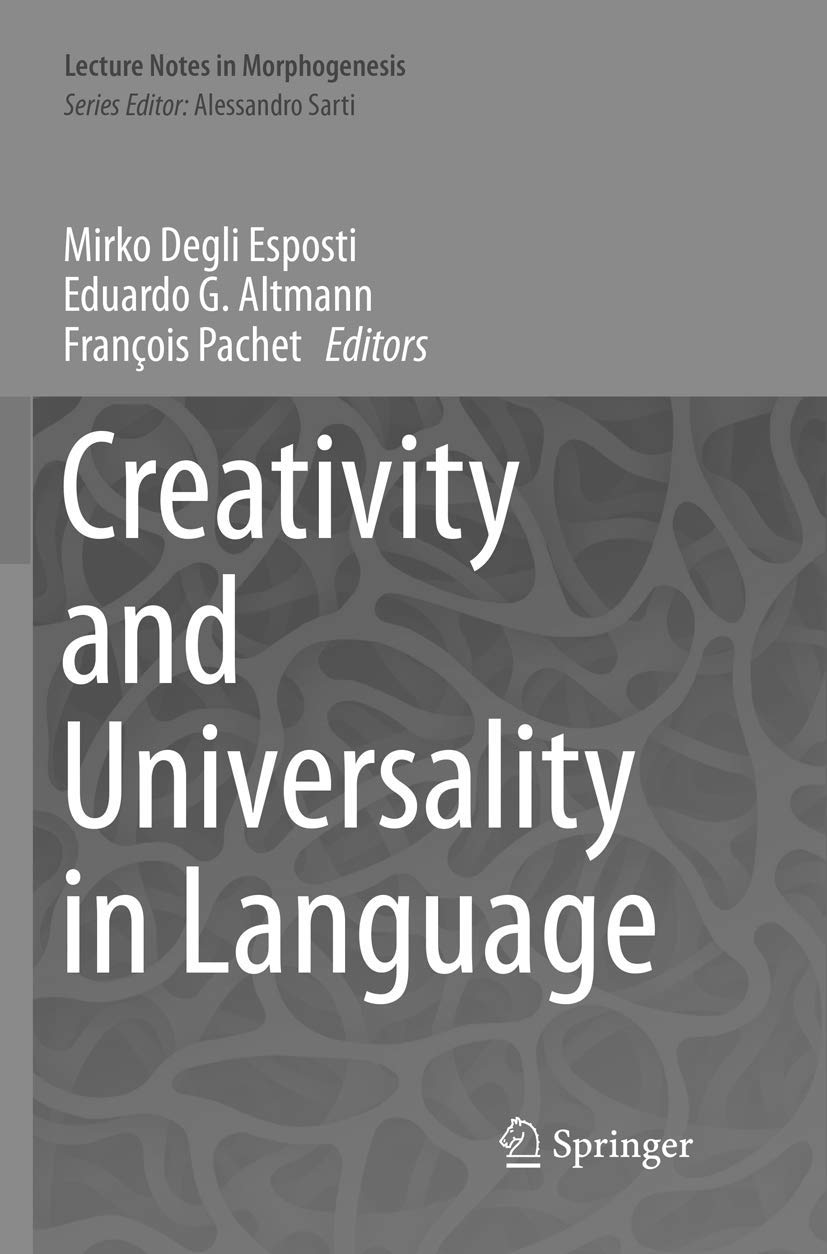
Creativity and Universality in Language (Lecture Notes in Morphogenesis),Used
Sold by Ergodebooks, an authorized reseller.
Returns accepted within 30 days | support@ergodebooks.com
Shipping Information
- Free Standard Shipping — United States only
- Processing Time: 3–5 business days
- Estimated Delivery: 6–10 business days after dispatch
- Double-boxed, fully insured & discreetly packaged
- Tracking number sent via email once dispatched
Returns & Refund
Returns accepted within 30 days of delivery.
Damaged or Defective Item
Free return shipping + replacement or full refund
Wrong Item Received
Free return shipping + replacement or full refund
Change of Mind
Return shipping at customer's expense · 25% restocking fee applies
Payment Option

This book collects research contributions concerning quantitative approaches to characterize originality and universality in language. The target audience comprises researchers and experts in the field but the book may also be beneficial for graduate students.Creativity might be considered as a morphogenetic process combining universal features with originality. While quantitative methods applied to text and music reveal universal features of language and music, originality is a highly appreciated feature of authors, composers, and performers. In this framework, the different methods of traditional problems of authorship attribution and document classification provide important insights on how to quantify the unique features of authors, composers, and styles. Such unique features contrast, and are restricted by, universal signatures, such as scaling laws in wordfrequency distribution, entropy measures, longrange correlations, among others. This interplay between innovation and universality is also an essential ingredient of methods for automatic text generation.Innovation in language becomes relevant when it is imitated and spread to other speakers and musicians. Modern digital databases provide new opportunities to characterize and model the creation and evolution of linguistic innovations on historical time scales, a particularly important example of the more general problem of spreading of innovations in complex social systems. This multidisciplinary book combines scientists from various different backgrounds interested in quantitative analysis of variations (synchronic and diachronic) in language and music. The aim is to obtain a deeper understanding of how originality emerges, can be quantified, and propagates.
⚠️ WARNING (California Proposition 65):
This product may contain chemicals known to the State of California to cause cancer, birth defects, or other reproductive harm.
For more information, please visit www.P65Warnings.ca.gov.