
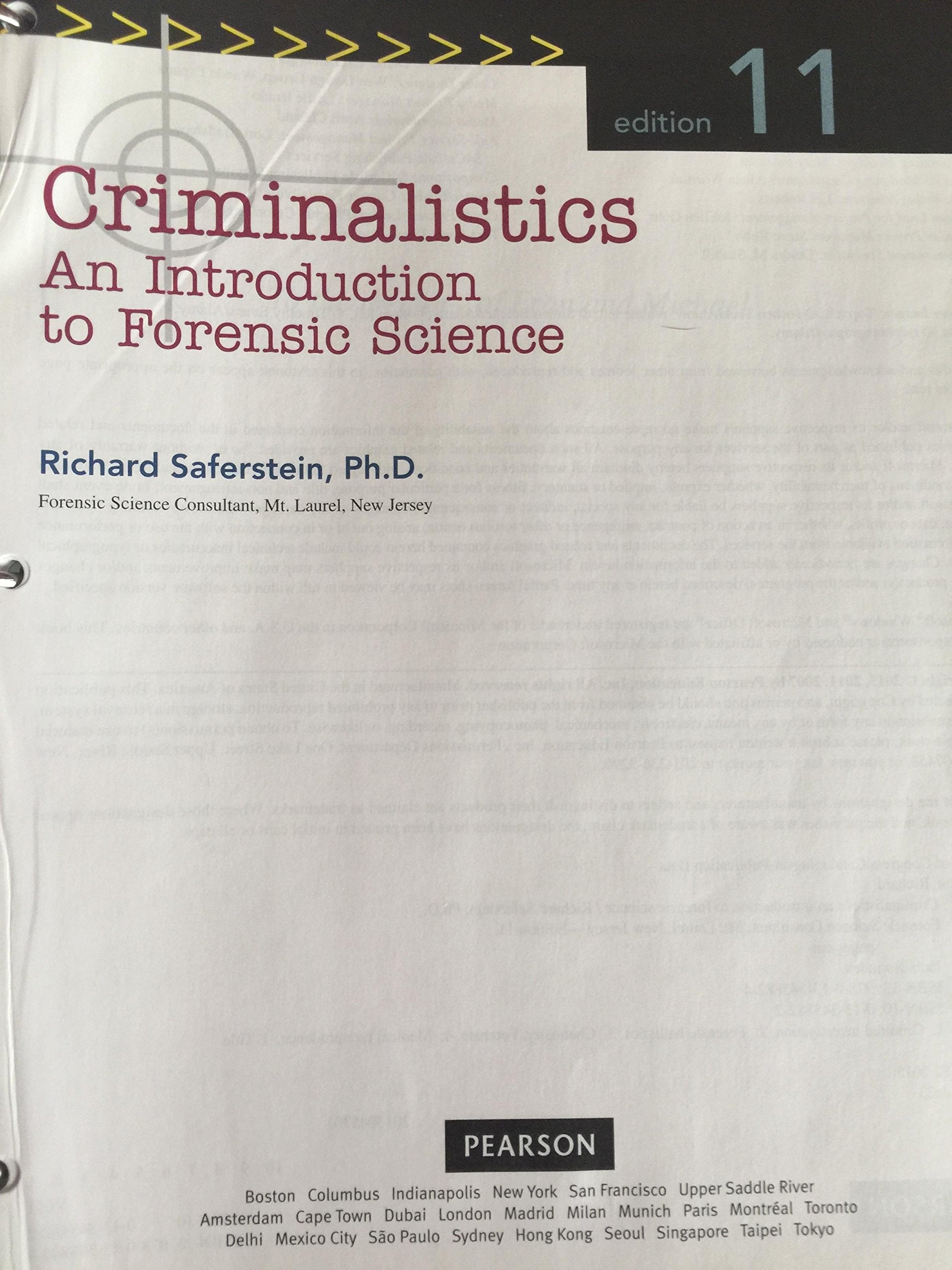
Title


Criminalistics: An Introduction To Forensic Science (11Th Edition)
Sold by Ergodebooks, an authorized reseller.
Returns accepted within 30 days | support@ergodebooks.com
Shipping Information
- Free Standard Shipping — United States only
- Processing Time: 3–5 business days
- Estimated Delivery: 6–10 business days after dispatch
- Double-boxed, fully insured & discreetly packaged
- Tracking number sent via email once dispatched
Returns & Refund
Returns accepted within 30 days of delivery.
Damaged or Defective Item
Free return shipping + replacement or full refund
Wrong Item Received
Free return shipping + replacement or full refund
Change of Mind
Return shipping at customer's expense · 25% restocking fee applies
Payment Option

This Bestselling Text, Written For The Nonscientist, Is Appropriate For A Wide Variety Of Students, Including Criminal Justice, Law Enforcement, Law, And More!Criminalistics: An Introduction To Forensic Science, 11E, Strives To Make The Technology Of The Modern Crime Laboratory Clear And Comprehensible To The Nonscientist. The Nature Of Physical Evidence Is Defined, And The Limitations That Technology And Current Knowledge Impose On Its Individualization And Characterization Are Examined. By Combining Case Stories With Applicable Technology, Criminalistics Endeavors To Capture The Pulse And Fervor Of Forensic Science Investigations. A Major Portion Of The Text Centers On Discussions Of The Common Items Of Physical Evidence Encountered At Crime Scenes. These Chapters Include Descriptions Of Forensic Analysis, As Well As Updated Techniques For The Proper Collection And Preservation Of Evidence At Crime Scenes. Particular Attention Is Paid To The Meaning And Role Of Probability In Interpreting The Evidential Significance Of Scientifically Evaluated Evidence.Teaching And Learningwritten By A Wellknown Authority In Forensic Science, This Text Introduces The Nonscientific Student To The Field Of Forensic Science. It Provides: Clear And Comprehensible Writing For The Nonscientific Student: Makes Text Appropriate For A Wide Variety Of Students, Including Criminal Justice, Law Enforcement, And More Comprehensive, Uptodate Coverage Of Forensics And Its Role In Criminal Investigation: Captures The Pulse And Intensity Of Forensic Science Investigations And The Attention Of The Busiest Student Outstanding Pedagogical Features: Supports Both Teaching And Learning
⚠️ WARNING (California Proposition 65):
This product may contain chemicals known to the State of California to cause cancer, birth defects, or other reproductive harm.
For more information, please visit www.P65Warnings.ca.gov.
- Q: How many pages are in this book? A: This book contains five hundred fifty-two pages. It provides comprehensive coverage of forensic science, making it suitable for students.
- Q: What are the dimensions of this book? A: The dimensions of this book are eight point four inches in length, zero point ninety-one inches in width, and ten point eight inches in height.
- Q: What type of binding does this book have? A: This book is available in paperback binding. This makes it lightweight and easy to carry for on-the-go students.
- Q: Who is the author of this book? A: The author of this book is Richard Saferstein. He is a well-known authority in forensic science.
- Q: What subjects does this book cover? A: This book covers topics like criminal justice, law enforcement, and forensic science. It's appropriate for a wide range of students.
- Q: Is this book suitable for beginners in forensic science? A: Yes, this book is suitable for beginners. It is written for non-scientist students, making complex topics easy to understand.
- Q: Can this book be used in law enforcement training? A: Yes, this book can be used in law enforcement training programs. It covers relevant forensic science topics that are important for law enforcement professionals.
- Q: Does the book include real-life case studies? A: Yes, the book includes case stories that illustrate forensic science applications. These stories help to engage students with practical examples.
- Q: What kind of topics are discussed in the forensic analysis chapters? A: The forensic analysis chapters discuss common physical evidence encountered at crime scenes. They also cover updated techniques for evidence collection and preservation.
- Q: Is this book updated with the latest forensic technology? A: Yes, this book is updated with the latest forensic technology. It provides comprehensive coverage of advancements in the field of forensic science.
- Q: How is the content structured for learning? A: The content is structured with outstanding pedagogical features. This supports both teaching and learning for students in forensic science.
- Q: Are there any prerequisites for reading this book? A: No, there are no prerequisites for reading this book. It is designed for non-scientific students and does not require prior knowledge.
- Q: What is the primary audience for this book? A: The primary audience includes students in criminal justice, law enforcement, and legal studies. It is suitable for anyone interested in forensic science.
- Q: Does this book address the limitations of forensic technology? A: Yes, the book examines the limitations of technology in forensic science. It discusses how these limitations affect the individualization of physical evidence.
- Q: How does this book address the role of probability in forensic science? A: The book pays particular attention to the role of probability in interpreting evidential significance. This is crucial for understanding forensic evaluations.
- Q: What makes this book a best-seller? A: This book is a best-seller due to its clear writing, comprehensive coverage, and engaging case studies. It appeals to a wide range of students.