
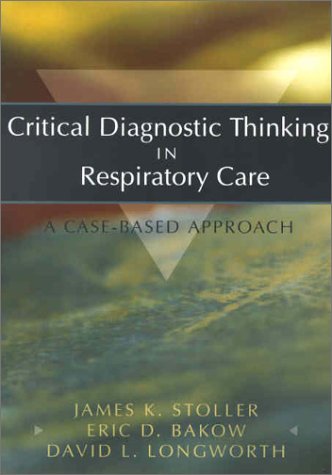
Title
Critical Diagnostic Thinking in Respiratory Care: A CaseBased Approach,Used
Sold by Ergodebooks, an authorized reseller.
Returns accepted within 30 days | support@ergodebooks.com
Shipping Information
- Free Standard Shipping — United States only
- Processing Time: 3–5 business days
- Estimated Delivery: 6–10 business days after dispatch
- Double-boxed, fully insured & discreetly packaged
- Tracking number sent via email once dispatched
Returns & Refund
Returns accepted within 30 days of delivery.
Damaged or Defective Item
Free return shipping + replacement or full refund
Wrong Item Received
Free return shipping + replacement or full refund
Change of Mind
Return shipping at customer's expense · 25% restocking fee applies
Payment Option

This book is organized into four logical sections. Section 1 is a thorough introduction to the processes involved in developing critical diagnostic thinking. It demonstrates how to use information from the patient's history and physical examination to develop the differential diagnosis: an ordered list of likeliest causes. The other sections of the book present cases typical of three broad clinical settings: outpatient, inpatient nonICU, and ICU. Each of the chapters in these sections begins with a clinical vignette posing an important respiratory problem with an accompanying description of the history and physical examination. This is followed by a review of the common and uncommon causes of the patient's symptom(s). The likelihood of a specific cause of the symptom is then analyzed using the specific features of the patient's history and physical examination. Finally, each chapter closes with a section on some of the more common pitfalls in diagnosing the patient. Organisation by symptons easier to is a unique feature which greatly helps the clinician to carry out a physical examination Casebased approach allows learning through reallife cases to evoke a broad differential diagnosis Background chapter to teach the techniques of gathering and analysing data from the patient history and physical examination in order to form a diagnosis Differential Diagnosis Boxes a unique feature for easy reference Interpreting Signs & Symptoms Tables a table that breaks down the symptom into possible causes, mechanisms by which the symptom occurs and suggestive clinical features All Chapters follow the same organisational format for ease of use Key words are shortlisted at the start of each chapter, which helps to guide the reader to get the most out of the Chapter The text is written at a level that is easy to understand for all health care students.
⚠️ WARNING (California Proposition 65):
This product may contain chemicals known to the State of California to cause cancer, birth defects, or other reproductive harm.
For more information, please visit www.P65Warnings.ca.gov.