
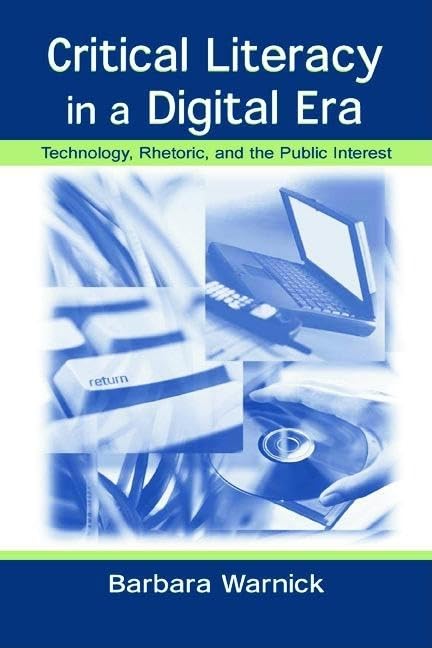
Title
Critical Literacy In A Digital Era,Used
Sold by Ergodebooks, an authorized reseller.
Returns accepted within 30 days | support@ergodebooks.com
Shipping Information
- Free Standard Shipping — United States only
- Processing Time: 3–5 business days
- Estimated Delivery: 6–10 business days after dispatch
- Double-boxed, fully insured & discreetly packaged
- Tracking number sent via email once dispatched
Returns & Refund
Returns accepted within 30 days of delivery.
Damaged or Defective Item
Free return shipping + replacement or full refund
Wrong Item Received
Free return shipping + replacement or full refund
Change of Mind
Return shipping at customer's expense · 25% restocking fee applies
Payment Option

Critical Literacy in a Digital Era offers an examination of the persuasive approaches used in discussions on and about the Internet. Its aim is to increase awareness of what is assumed, unquestioned, and naturalized in our media experience. Using a critical literacy framework for her analysis, author Barbara Warnick argues that new media technologies become accepted not only through their use, but also through the rhetorical use of discourse on and about them. She analyzes texts that discuss new media and technology, including articles from a major technologyoriented periodical; women's magazines and Web sites; and Internetbased political parody in the 2000 presidential campaign. These case studies bring to light the persuasive strategies used by writers to influence public discourse about technology.The book includes analyses of narrative structures, speech genres, intertextuality, argument forms, writing formulae, and patterns of emphasis and neglect used in traditional and new media outlets. As a result, this distinctive work identifies the features of online speech that bring people and ideas together and enable communities to form in new media environments.As a unique study of the ways in which ideology is embedded in rhetorical texts, this volume will play a significant role in the development of critical literacy about writing and speech concerning new communication technology. It will be of interest to readers concerned about how our talk about communication affects how we think about it, in particular those interested in communication and social change, public persuasion, and rhetorical criticism of new media content.
⚠️ WARNING (California Proposition 65):
This product may contain chemicals known to the State of California to cause cancer, birth defects, or other reproductive harm.
For more information, please visit www.P65Warnings.ca.gov.