
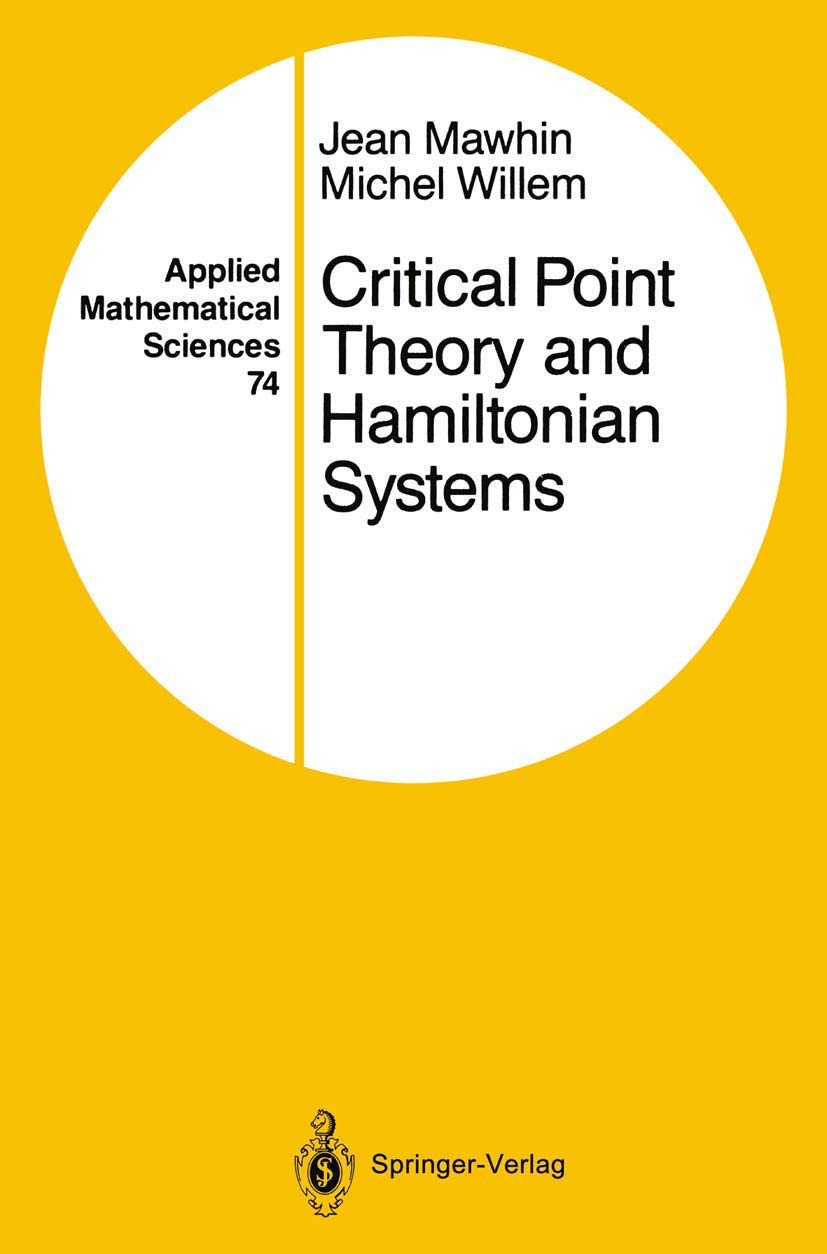
Title
Critical Point Theory And Hamiltonian Systems (Applied Mathematical Sciences, 74)
Sold by Ergodebooks, an authorized reseller.
Returns accepted within 30 days | support@ergodebooks.com
Shipping Information
- Free Standard Shipping — United States only
- Processing Time: 3–5 business days
- Estimated Delivery: 6–10 business days after dispatch
- Double-boxed, fully insured & discreetly packaged
- Tracking number sent via email once dispatched
Returns & Refund
Returns accepted within 30 days of delivery.
Damaged or Defective Item
Free return shipping + replacement or full refund
Wrong Item Received
Free return shipping + replacement or full refund
Change of Mind
Return shipping at customer's expense · 25% restocking fee applies
Payment Option

FACHGEB The last decade has seen a tremendous development in critical point theory in infinite dimensional spaces and its application to nonlinear boundary value problems. In particular, striking results were obtained in the classical problem of periodic solutions of Hamiltonian systems. This book provides a systematic presentation of the most basic tools of critical point theory: minimization, convex functions and Fenchel transform, dual least action principle, Ekeland variational principle, minimax methods, Lusternik Schirelmann theory for Z2 and S1 symmetries, Morse theory for possibly degenerate critical points and nondegenerate critical manifolds. Each technique is illustrated by applications to the discussion of the existence, multiplicity, and bifurcation of the periodic solutions of Hamiltonian systems. Among the treated questions are the periodic solutions with fixed period or fixed energy of autonomous systems, the existence of subharmonics in the nonautonomous case, the asymptotically linear Hamiltonian systems, free and forced superlinear problems. Application of those results to the equations of mechanical pendulum, to Josephson systems of solid state physics and to questions from celestial mechanics are given. The aim of the book is to introduce a reader familiar to more classical techniques of ordinary differential equations to the powerful approach of modern critical point theory. The style of the exposition has been adapted to this goal. The new topological tools are introduced in a progressive but detailed way and immediately applied to differential equation problems. The abstract tools can also be applied to partial differential equations and the reader will also find the basic references in this direction in the bibliography of more than 500 items which concludes the book. ERSCHEIN
⚠️ WARNING (California Proposition 65):
This product may contain chemicals known to the State of California to cause cancer, birth defects, or other reproductive harm.
For more information, please visit www.P65Warnings.ca.gov.