If you have any questions, you are always welcome to contact us. We'll get back to you as soon as possible, withing 24 hours on weekdays.
Customer service
All questions about your order, return and delivery must be sent to our customer service team by e-mail at yourstore@yourdomain.com
Sale & Press
If you are interested in selling our products, need more information about our brand or wish to make a collaboration, please contact us at press@yourdomain.com
Help
If you have any questions, you are always welcome to contact us. We'll get back to you as soon as possible, withing 24 hours on weekdays.
Customer service
All questions about your order, return and delivery must be sent to our customer service team by e-mail at yourstore@yourdomain.com
Sale & Press
If you are interested in selling our products, need more information about our brand or wish to make a collaboration, please contact us at press@yourdomain.com
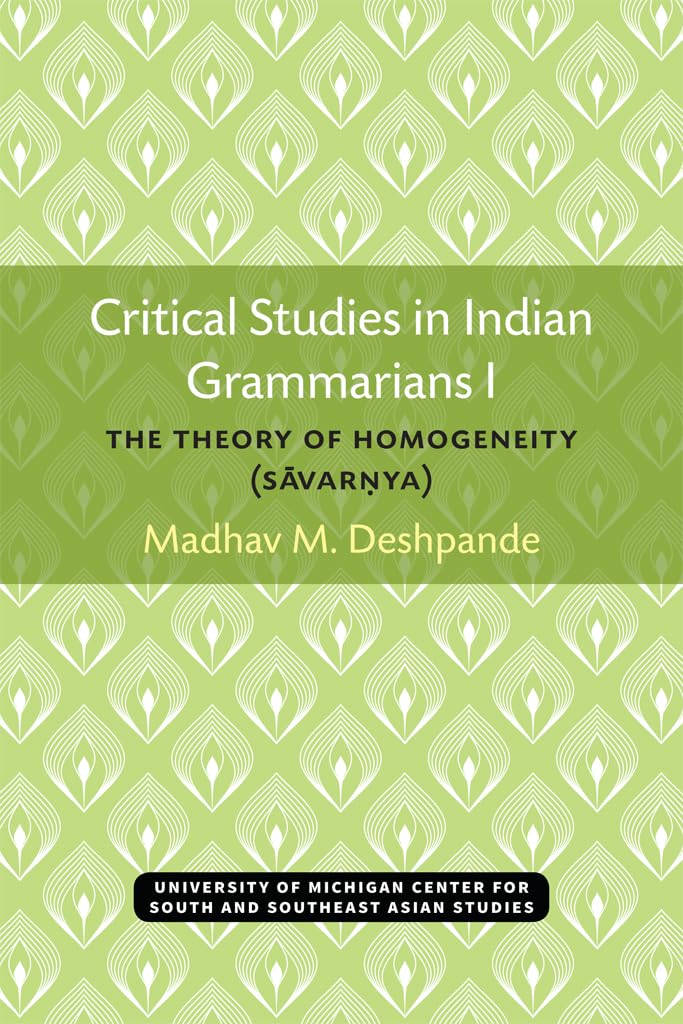
In the historical study of the Indian grammarian tradition, a line of demarcation can often be drawn between the conformity of a system with the wellknown grammar of Pa?ini and the explanatory effectiveness of that system. One element of Pa?inis grammar that scholars have sometimes struggled to bring across this line of demarcation is the theory of homogeneity, or savar?ya, which concerns the final consonants in Pa?inis reference catalog, as well as phonetic similarities between sounds. While modern Sanskrit scholars understand how to interpret and apply Pa?inis homogeneity, they still find it necessary to unravel the history of varying interpretations of the theory in subsequent grammars.Madhav Deshpandes The Theory of Homogeneity provides a thorough account of the historical development of the theory. Proceeding first to study this conception in the Pa?inian tradition, Deshpande then passes on to other grammatical systems. Deshpande gives attention not only to the definitions of homogeneity in these systems but also the implementation of the theory in those respective systems. Even where definitions are identical, the concept may be applied quite differently, in which cases Deshpande examines by considering the historical relationships among the various systems.
⚠️ WARNING (California Proposition 65):
This product may contain chemicals known to the State of California to cause cancer,
birth defects, or other reproductive harm.
For MAP (Minimum Advertised Price) violations and Intellectual Property (IP) or Trademark concerns, please contact:
support@ergodebooks.com
⚠️ California Proposition 65 Warning: Some products sold on this website may expose you to chemicals known to the State of California to cause cancer, birth defects, or other reproductive harm. For more information, visit www.P65Warnings.ca.gov.