If you have any questions, you are always welcome to contact us. We'll get back to you as soon as possible, withing 24 hours on weekdays.
Customer service
All questions about your order, return and delivery must be sent to our customer service team by e-mail at yourstore@yourdomain.com
Sale & Press
If you are interested in selling our products, need more information about our brand or wish to make a collaboration, please contact us at press@yourdomain.com
Help
If you have any questions, you are always welcome to contact us. We'll get back to you as soon as possible, withing 24 hours on weekdays.
Customer service
All questions about your order, return and delivery must be sent to our customer service team by e-mail at yourstore@yourdomain.com
Sale & Press
If you are interested in selling our products, need more information about our brand or wish to make a collaboration, please contact us at press@yourdomain.com
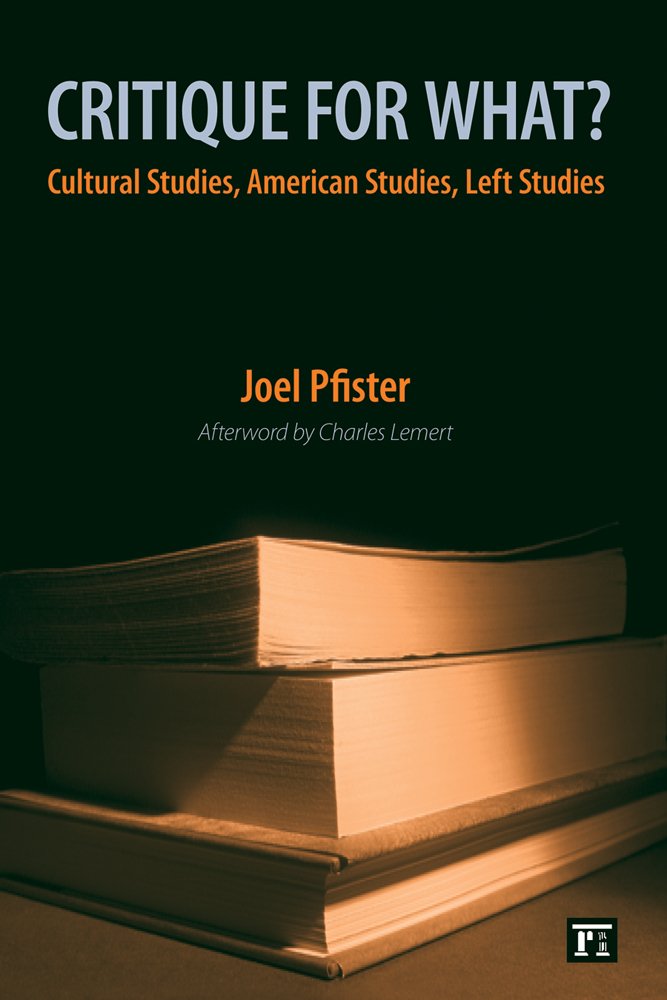
Students want to know: What does one do with critique? Fortunately, some of the most provocative selfcritical intellectuals, from the postwar period to the postmodern present, have wrestled with this. Joel Pfister, in Critique for What?, crisscrosses the Atlantic to take stock of exciting British and US cultural studies, American studies, and Left studies that challenge the academic critiqueforcritique'ssake and career'ssake business and ask: Critique for what and for whom? Historicizing for what and for whom? Politicizing for what and for whom? America for what and for whom? Here New Left revisionary socialists, members of the 'unpartied Left,' cultural studies theorists, American studies scholars, radical historians, progressive literary critics, and early proponents of transnational analysis interact in what amounts to a lively booklength strategy seminar. British political intellectuals, including Raymond Williams, E. P. Thompson, Stuart Hall, and Raphael Samuel, and Americans, including F. O. Matthiessen, Robert Lynd, C. Wright Mills, and Richard Ohmann, reconsider the critical project as social transformation studies, activism studies, organizing studies. Eager to prevent cultural studies from becoming cynicism studies, Critique for What? thinks creatively about the possibilities of using as well as developing critique in our new millennium.
⚠️ WARNING (California Proposition 65):
This product may contain chemicals known to the State of California to cause cancer,
birth defects, or other reproductive harm.
For MAP (Minimum Advertised Price) violations and Intellectual Property (IP) or Trademark concerns, please contact:
support@ergodebooks.com
⚠️ California Proposition 65 Warning: Some products sold on this website may expose you to chemicals known to the State of California to cause cancer, birth defects, or other reproductive harm. For more information, visit www.P65Warnings.ca.gov.