If you have any questions, you are always welcome to contact us. We'll get back to you as soon as possible, withing 24 hours on weekdays.
Customer service
All questions about your order, return and delivery must be sent to our customer service team by e-mail at yourstore@yourdomain.com
Sale & Press
If you are interested in selling our products, need more information about our brand or wish to make a collaboration, please contact us at press@yourdomain.com
Help
If you have any questions, you are always welcome to contact us. We'll get back to you as soon as possible, withing 24 hours on weekdays.
Customer service
All questions about your order, return and delivery must be sent to our customer service team by e-mail at yourstore@yourdomain.com
Sale & Press
If you are interested in selling our products, need more information about our brand or wish to make a collaboration, please contact us at press@yourdomain.com
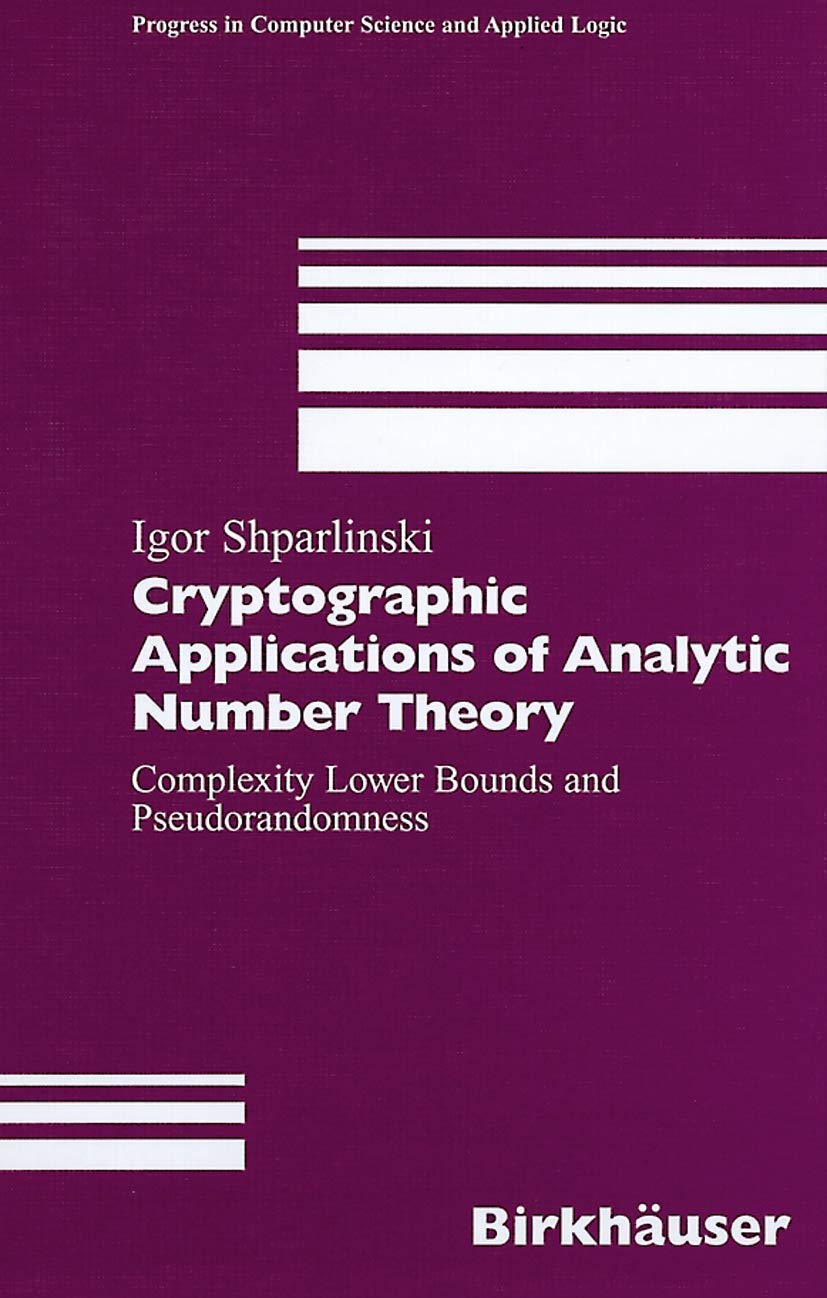
The book introduces new techniques that imply rigorous lower bounds on the com plexity of some numbertheoretic and cryptographic problems. It also establishes certain attractive pseudorandom properties of various cryptographic primitives. These methods and techniques are based on bounds of character sums and num bers of solutions of some polynomial equations over finite fields and residue rings. Other number theoretic techniques such as sieve methods and lattice reduction algorithms are used as well. The book also contains a number of open problems and proposals for further research. The emphasis is on obtaining unconditional rigorously proved statements. The bright side of this approach is that the results do not depend on any assumptions or conjectures. On the downside, the results are much weaker than those which are widely believed to be true. We obtain several lower bounds, exponential in terms of logp, on the degrees and orders of o polynomials; o algebraic functions; o Boolean functions; o linear recurrence sequences; coinciding with values of the discrete logarithm modulo a prime p at sufficiently many points (the number of points can be as small as pI/2+O:). These functions are considered over the residue ring modulo p and over the residue ring modulo an arbitrary divisor d of p 1. The case of d = 2 is of special interest since it corresponds to the representation of the rightmost bit of the discrete logarithm and defines whether the argument is a quadratic residue.
⚠️ WARNING (California Proposition 65):
This product may contain chemicals known to the State of California to cause cancer,
birth defects, or other reproductive harm.
For MAP (Minimum Advertised Price) violations and Intellectual Property (IP) or Trademark concerns, please contact:
support@ergodebooks.com
⚠️ California Proposition 65 Warning: Some products sold on this website may expose you to chemicals known to the State of California to cause cancer, birth defects, or other reproductive harm. For more information, visit www.P65Warnings.ca.gov.