
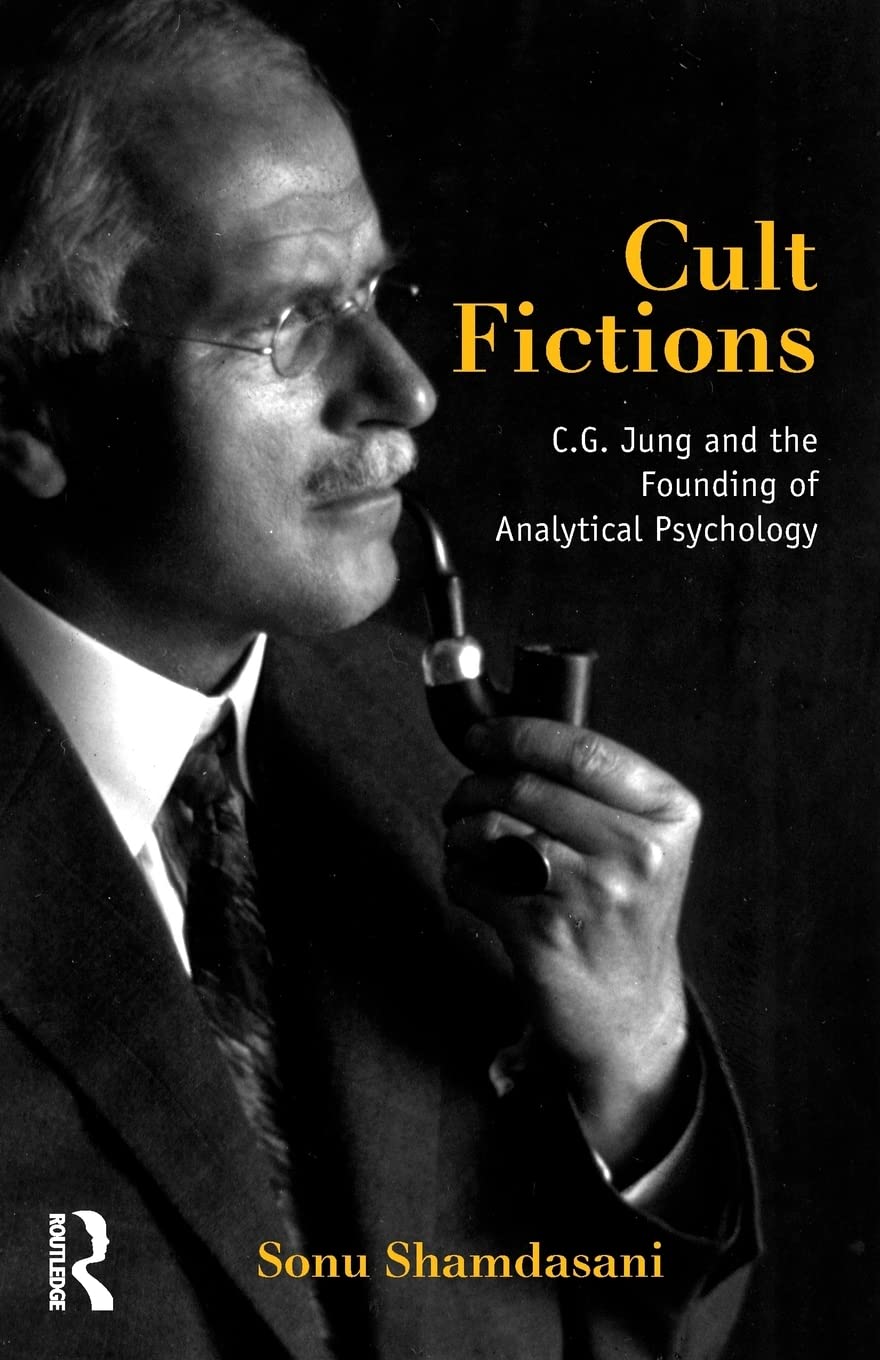
Title
Cult Fictions,Used
Sold by Ergodebooks, an authorized reseller.
Returns accepted within 30 days | support@ergodebooks.com
Shipping Information
- Free Standard Shipping — United States only
- Processing Time: 3–5 business days
- Estimated Delivery: 6–10 business days after dispatch
- Double-boxed, fully insured & discreetly packaged
- Tracking number sent via email once dispatched
Returns & Refund
Returns accepted within 30 days of delivery.
Damaged or Defective Item
Free return shipping + replacement or full refund
Wrong Item Received
Free return shipping + replacement or full refund
Change of Mind
Return shipping at customer's expense · 25% restocking fee applies
Payment Option

Controversial claims that C.G. Jung, founder of analytical psychology, was a charlatan and a selfappointed demigod have recently brought his legacy under renewed scrutiny. The basis of the attack on Jung is a previously unknown text, said to be Jung's inaugural address at the founding of his 'cult', otherwise known as the Psychological Club, in Zurich in 1916. It is claimed that this cult is alive and well in Jungian psychology as it is practised today, in a movement which continues to masquerade as a genuine professional discipline, whilst selling false dreams of spiritual redemption.In Cult Fictions, leading Jung scholar Sonu Shamdasani looks into the evidence for such claims and draws on previously unpublished documents to show that they are fallacious. This accurate and revealing account of the history of the Jungian movement, from the founding of the Psychological Club to the reformulation of Jung's approach by his followers, establishes a fresh agenda for the historical evaluation of analytical psychology today.
⚠️ WARNING (California Proposition 65):
This product may contain chemicals known to the State of California to cause cancer, birth defects, or other reproductive harm.
For more information, please visit www.P65Warnings.ca.gov.
- Q: What is the main topic of 'Cult Fictions'? A: 'Cult Fictions' explores controversial claims regarding C.G. Jung, examining his legacy and the founding of the Psychological Club in Zurich, while addressing accusations of charlatanism.
- Q: Who is the author of 'Cult Fictions'? A: The author of 'Cult Fictions' is Sonu Shamdasani, a leading scholar on Jung and analytical psychology.
- Q: What is the publication date of 'Cult Fictions'? A: 'Cult Fictions' was published on March 5, 1998.
- Q: What is the format of 'Cult Fictions'? A: 'Cult Fictions' is available in paperback format.
- Q: How many pages does 'Cult Fictions' have? A: 'Cult Fictions' has a total of 136 pages.
- Q: What category does 'Cult Fictions' fall under? A: 'Cult Fictions' is categorized under Mental Health.
- Q: Is 'Cult Fictions' a new book? A: Yes, 'Cult Fictions' is listed as a new item.
- Q: What subjects does 'Cult Fictions' cover? A: 'Cult Fictions' covers subjects related to analytical psychology, the history of Jungian thought, and the critique of Jung's legacy.
- Q: Are there any previously unpublished documents in 'Cult Fictions'? A: Yes, 'Cult Fictions' draws on previously unpublished documents to support its arguments.
- Q: What is the significance of the Psychological Club mentioned in 'Cult Fictions'? A: The Psychological Club, founded by Jung in 1916, is significant as it represents the beginnings of Jungian psychology and the controversies surrounding it.