
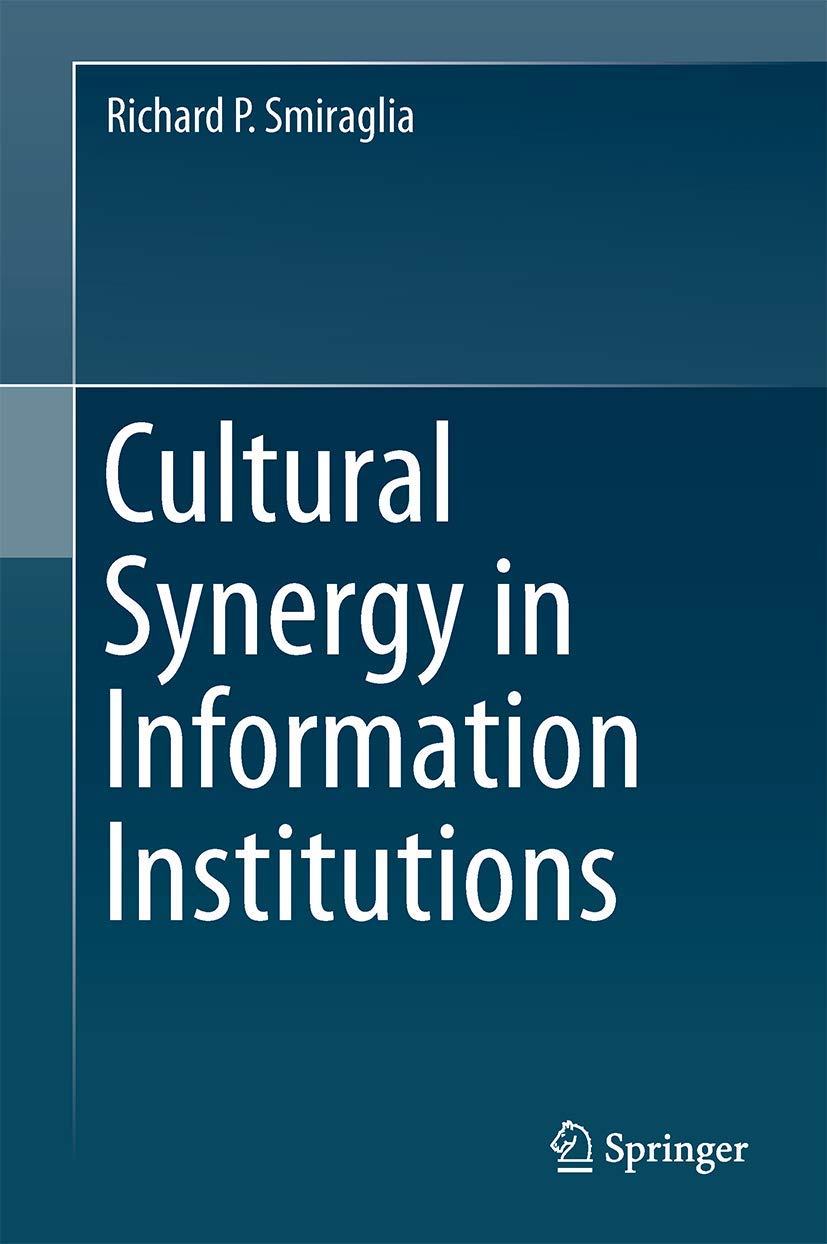
Title
Cultural Synergy in Information Institutions,Used
Sold by Ergodebooks, an authorized reseller.
Returns accepted within 30 days | support@ergodebooks.com
Shipping Information
- Free Standard Shipping — United States only
- Processing Time: 3–5 business days
- Estimated Delivery: 6–10 business days after dispatch
- Double-boxed, fully insured & discreetly packaged
- Tracking number sent via email once dispatched
Returns & Refund
Returns accepted within 30 days of delivery.
Damaged or Defective Item
Free return shipping + replacement or full refund
Wrong Item Received
Free return shipping + replacement or full refund
Change of Mind
Return shipping at customer's expense · 25% restocking fee applies
Payment Option

Cultural forces govern a synergistic relationship among information institutions that shapes their roles collectively and individually. Cultural synergy is the combination of perception and behaviorshaping knowledge within, between, and among groups. Our hyperlinked era makes informationsharing among institutions critically important for scholarship as well as for the advancement of humankind. Information institutions are those that have, or share in, the mission to preserve, conserve, and disseminate information objects and their informative content. A central idea is the notion of social epistemology that information institutions arise culturally from social forces of the cultures they inhabit, and that their purpose is to disseminate that culture. All information institutions are alike in critical ways. Intersecting lines of cultural mission are trajectories for synergy for allowing us to perceive the universe of information institutions as interconnected and evolving and moving forward in distinct ways for the improvement of the condition of humankind through the building up of its knowledge base and of its informationsharing processes. This book is an exploration of the cultural synergy that can be realized by seeing commonalities among information institutions (sometimes also called cultural heritage institutions): museums, libraries, and archives. The hyperlinked era of the Semantic Web makes information sharing among institutions critically important for scholarship as well as the advancement of mankind. The book addresses the origins of cultural information institutions, the history of the professions that run them, and the social imperative of information organization as a catalyst for semantic synergy.
⚠️ WARNING (California Proposition 65):
This product may contain chemicals known to the State of California to cause cancer, birth defects, or other reproductive harm.
For more information, please visit www.P65Warnings.ca.gov.