
Title
Culture Acquisition
Sold by Ergodebooks, an authorized reseller.
Returns accepted within 30 days | support@ergodebooks.com
Shipping Information
- Free Standard Shipping — United States only
- Processing Time: 3–5 business days
- Estimated Delivery: 6–10 business days after dispatch
- Double-boxed, fully insured & discreetly packaged
- Tracking number sent via email once dispatched
Returns & Refund
Returns accepted within 30 days of delivery.
Damaged or Defective Item
Free return shipping + replacement or full refund
Wrong Item Received
Free return shipping + replacement or full refund
Change of Mind
Return shipping at customer's expense · 25% restocking fee applies
Payment Option

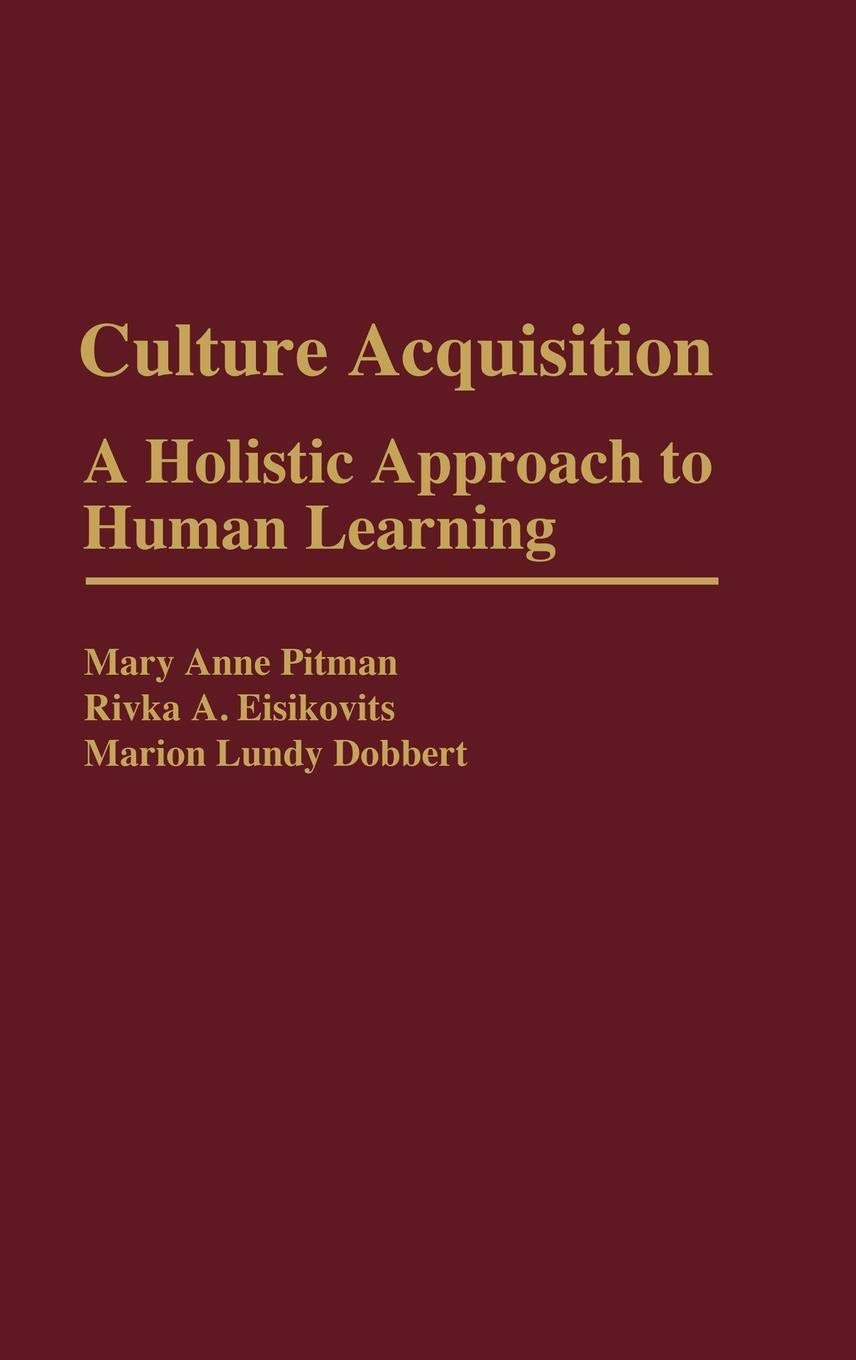
Challenging traditional orientations to the study of education and culture acquisition, the authors of this controversial work present a holistic, processoriented method for examining culture transmission. A biologically based materialistic theory, cultural transmission is defined as a process in which individuals come to store pattern information in their brains . . . and hence come to act in socially complementary ways, thereby contributing to a culture's evolving adaptive pattern mappings. Their work defines the biological parameters of culture learning, reviews previous research on cultural transmission, conceptualizes, operationalizes, and tests a holistic, contextspecific approach to learning culture and then illustrates its use. Dividing their work into two parts the authors first review the literature which is essential to the definition of a solidly grounded holism and to the development of an integrated theory. They then devote the second part of their work to the proposal of their systems based theory which describes the method by which 'active' learners come to see the whole of their culture. Their model is then operationalized by laying out a field research method and testing that method in a pilot study of three societies. Advanced students and scholars of anthropology as well as qualitative educational researchers will find Culture Acquisition invaluable reading.Reflecting the truly collaborative nature of the authors' work, this book has an overall additive structure. Chapters one through four review primate learning, examine neurological data and information processing in humans, review developmental theory and research on aging, and identify critical junctures in the study of cultural transmission. Chapters five through eight pose the theoretical model, present a field guide based on a broadly holistic approach, describe a test of the method, report on three analytic experiments exploring the potential of the model, and devise a coding system for comparative culture acquisition research. In their final chapters the authors illustrate the extent to which their theory can be applied by individual anthropologists to their own areas of research.
⚠️ WARNING (California Proposition 65):
This product may contain chemicals known to the State of California to cause cancer, birth defects, or other reproductive harm.
For more information, please visit www.P65Warnings.ca.gov.