
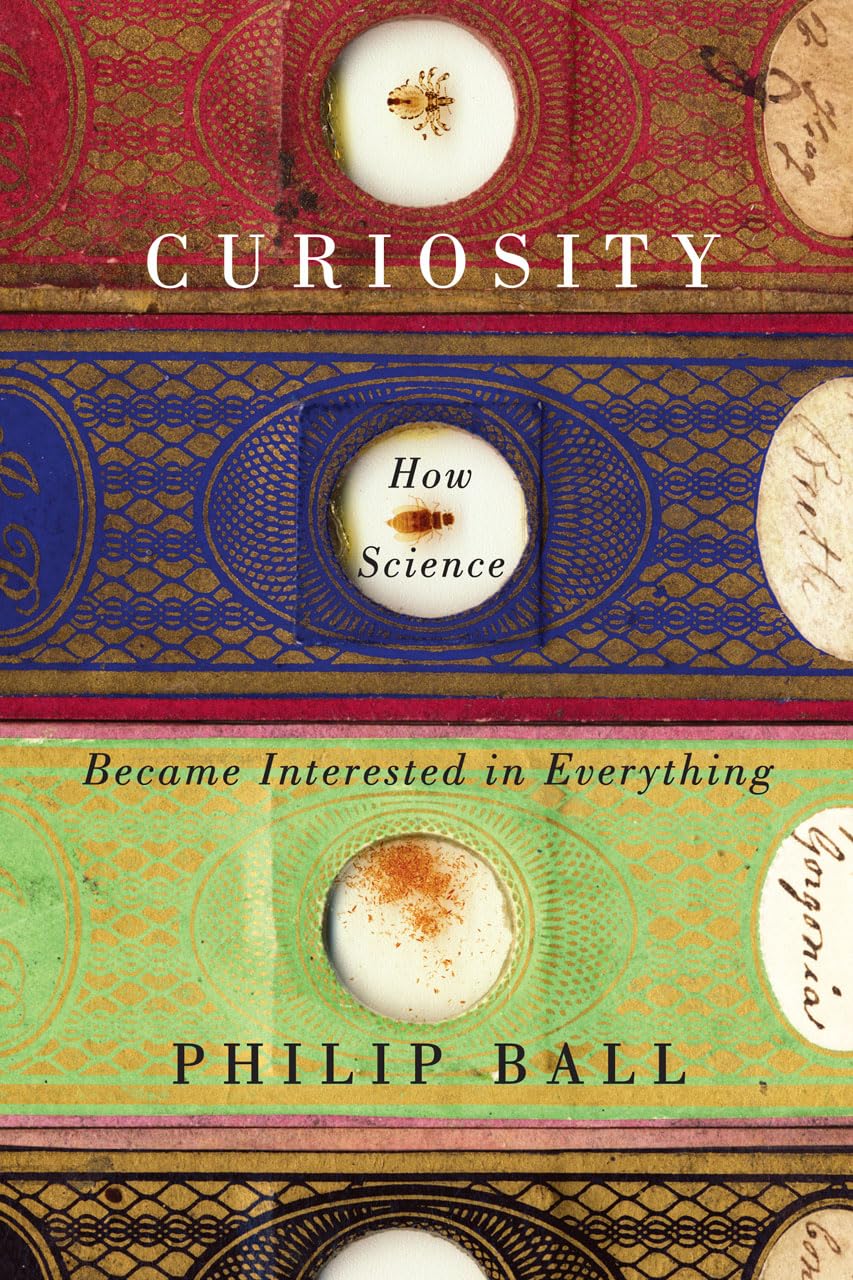
Title
Curiosity: How Science Became Interested in Everything,Used
Sold by Ergodebooks, an authorized reseller.
Returns accepted within 30 days | support@ergodebooks.com
Shipping Information
- Free Standard Shipping — United States only
- Processing Time: 3–5 business days
- Estimated Delivery: 6–10 business days after dispatch
- Double-boxed, fully insured & discreetly packaged
- Tracking number sent via email once dispatched
Returns & Refund
Returns accepted within 30 days of delivery.
Damaged or Defective Item
Free return shipping + replacement or full refund
Wrong Item Received
Free return shipping + replacement or full refund
Change of Mind
Return shipping at customer's expense · 25% restocking fee applies
Payment Option

With the recent landing of the Mars rover Curiosity, it seems safe to assume that the idea of being curious is alive and well in modern sciencethat its not merely encouraged but is seen as an essential component of the scientific mission. Yet there was a time when curiosity was condemned. Neither Pandora nor Eve could resist the dangerous allure of unanswered questions, and all knowledge wasnt equalfor millennia it was believed that there were some things we should not try to know. In the late sixteenth century this attitude began to change dramatically, and in Curiosity: How Science Became Interested in Everything, Philip Ball investigates how curiosity first became sanctionedwhen it changed from a vice to a virtue and how it became permissible to ask any and every question about the world.Looking closely at the sixteenth through eighteenth centuries, Ball vividly brings to life the age when modern science began, a time that spans the lives of Galileo and Isaac Newton. In this entertaining and illuminating account of the rise of science as we know it, Ball tells of scientists both legendary and lesser known, from Copernicus and Kepler to Robert Boyle, as well as the inventions and technologies that were inspired by curiosity itself, such as the telescope and the microscope. The socalled Scientific Revolution is often told as a story of great geniuses illuminating the world with flashes of inspiration. But Curiosity reveals a more complex story, in which the liberationand subsequent tamingof curiosity was linked to magic, religion, literature, travel, trade, and empire. Ball also asks what has become of curiosity today: how it functions in science, how it is spun and packaged for consumption, how well it is being sustained, and how the changing shape of science influences the kinds of questions it may continue to ask.Though proverbial wisdom tell us that it was through curiosity that our innocence was lost, that has not deterred us. Instead, it has been completely the contrary: today we spend vast sums trying to reconstruct the first instants of creation in particle accelerators, out of a pure desire to know. Ball refuses to let us take this desire for granted, and this book is a perfect homage to such an inquisitive attitude.
⚠️ WARNING (California Proposition 65):
This product may contain chemicals known to the State of California to cause cancer, birth defects, or other reproductive harm.
For more information, please visit www.P65Warnings.ca.gov.
- Q: How many pages does this book have? A: This book has four hundred eighty pages. It provides an in-depth exploration of the evolution of curiosity in science.
- Q: What is the binding type of this book? A: The binding type of this book is hardcover. This ensures durability and longevity for readers.
- Q: What are the dimensions of this book? A: The dimensions of this book are one point three inches in thickness, six point two inches in width, and nine point one inches in height.
- Q: Who is the author of this book? A: The author of this book is Philip Ball. He examines the historical significance of curiosity in the development of science.
- Q: What genre does this book belong to? A: This book belongs to the History genre. It discusses the relationship between curiosity and scientific discovery.
- Q: How should I read this book? A: You can read this book at your own pace. It's suitable for anyone interested in the history of science and curiosity.
- Q: Is this book suitable for young readers? A: This book is generally aimed at adults and older teens. It covers complex themes regarding the evolution of scientific thought.
- Q: Can I read this book in one sitting? A: Reading this book in one sitting may be challenging due to its length and depth. It is best enjoyed over multiple sessions.
- Q: How should I care for this hardcover book? A: To care for this hardcover book, keep it in a dry place and avoid exposure to direct sunlight. This will help maintain its condition.
- Q: Are there any special storage instructions for this book? A: No special storage instructions are needed for this book. Just store it upright on a shelf to prevent bending.
- Q: What if the book arrives damaged? A: If the book arrives damaged, you should contact the retailer for a return or exchange. Most retailers have policies for such issues.
- Q: Is there a warranty for this book? A: Books typically do not come with a warranty. However, check the retailer's return policy for any guarantees.
- Q: Can I return this book if I don't like it? A: Yes, you can return this book if it falls within the retailer's return policy period. Always check the specific terms.
- Q: Is this book a good choice for someone new to science history? A: Yes, this book is a great choice for beginners. It presents complex ideas in an accessible manner.
- Q: How does this book compare to other science history books? A: This book uniquely focuses on the concept of curiosity, making it distinct from many other science history titles.
- Q: What themes are explored in this book? A: This book explores themes of curiosity, the evolution of scientific inquiry, and the interplay of magic, religion, and empire.