
Title
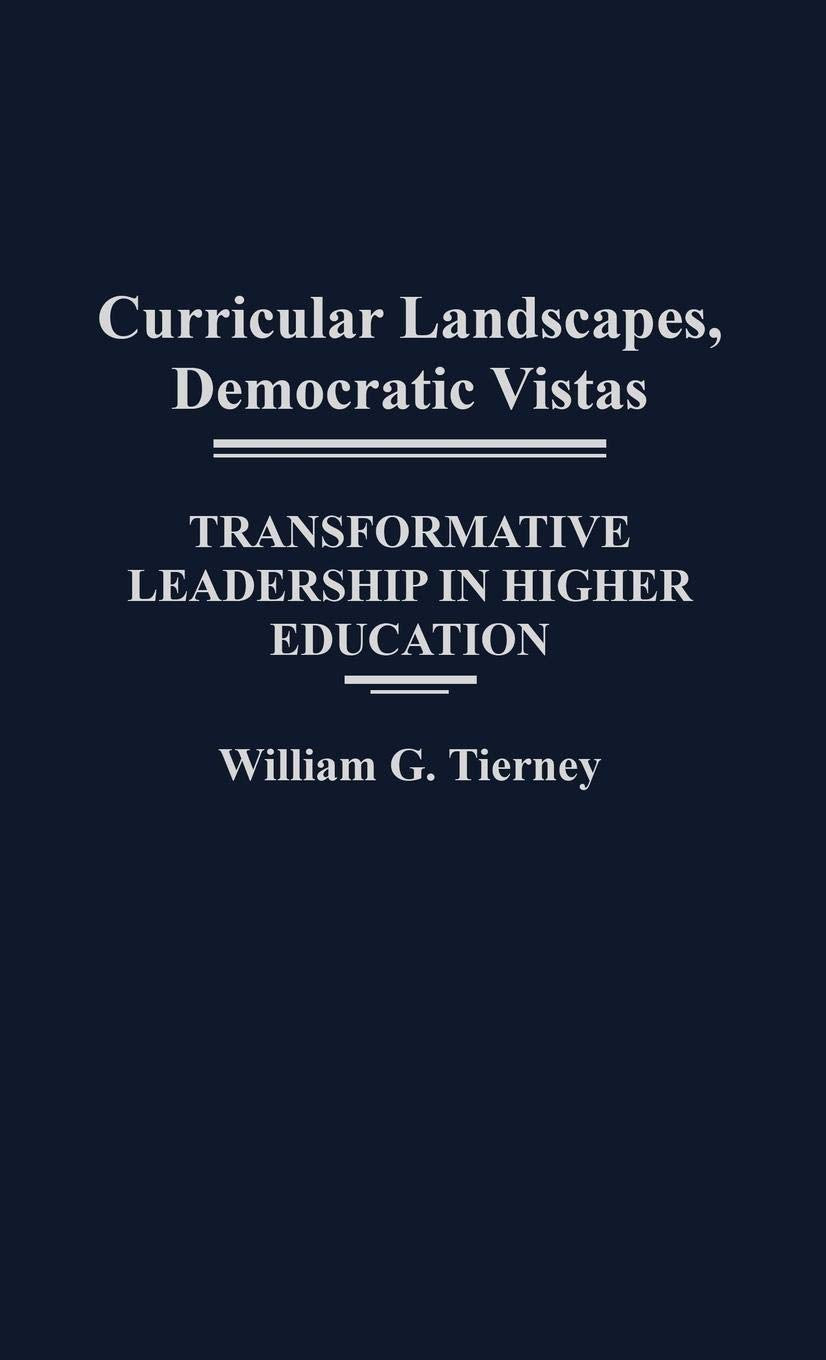
Curricular Landscapes, Democratic Vistas: Transformative Leadership In Higher Education
Sold by Ergodebooks, an authorized reseller.
Returns accepted within 30 days | support@ergodebooks.com
Shipping Information
- Free Standard Shipping — United States only
- Processing Time: 3–5 business days
- Estimated Delivery: 6–10 business days after dispatch
- Double-boxed, fully insured & discreetly packaged
- Tracking number sent via email once dispatched
Returns & Refund
Returns accepted within 30 days of delivery.
Damaged or Defective Item
Free return shipping + replacement or full refund
Wrong Item Received
Free return shipping + replacement or full refund
Change of Mind
Return shipping at customer's expense · 25% restocking fee applies
Payment Option

William G. Tierney offers a different way of thinking about the curriculum in postsecondary curriculum than is customary. Through an indepth analysis of seven ethnographic case studies, the author demonstrates how the curriculum itself is a cultural product which institutions of higher education construct socially. The manner in which the individual institution defines its curriculum, Tierney argues, commits it to certain philosophical and ideological choices, whether these are overtly recognized or not. It is the result of a year's research that included over 250 interviews at seven colleges in universities throughout the U.S. The volume concludes with recommendations administrators and faculty may employ in the effort to advance democracy in their colleges and universities.Organized around the theme of institutional curricula acting as a critical agent for preparing students to participate in the democratic sphere, the book begins by providing a conceptual map for the chapters which follow. Both curricular and cultural theories are reviewed and discussed. The next two sections explore the archaeology of the curriculum at the seven institutions under study. After examining the ways in which participants at the seven colleges and universities view different curricular concepts, the author illustrates how the individuals view one another's actions about the curriculum. As he demonstrates, the curriculum often becomes contested terrain because of the cultural constructions different groups develop about one another and toward the curriculum. Finally, the author offers an interpretation and analysis of the different curricula of the seven institutions, concluding with a discussion of how organizational participants might assume the roles of transformative leaders who create new curricular paths and directions for their organizations.
⚠️ WARNING (California Proposition 65):
This product may contain chemicals known to the State of California to cause cancer, birth defects, or other reproductive harm.
For more information, please visit www.P65Warnings.ca.gov.