
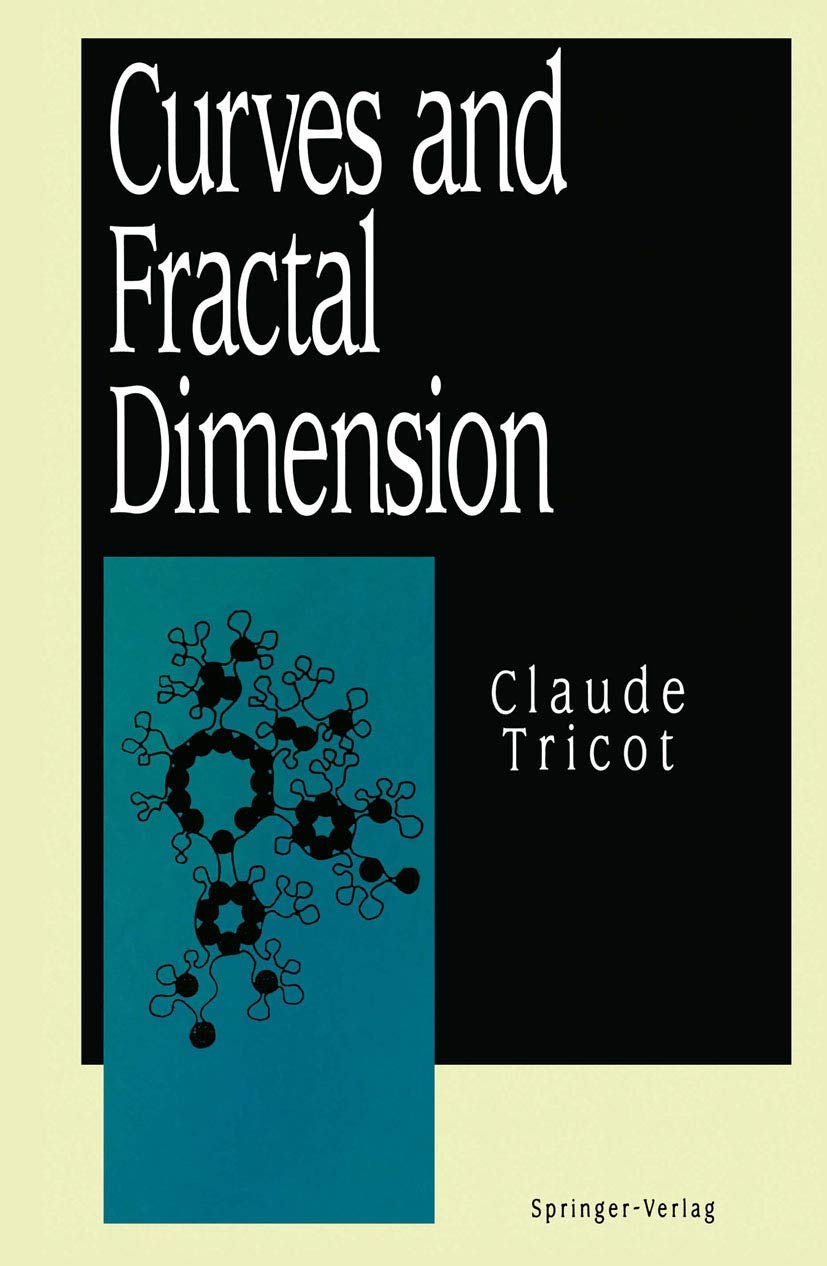
Title
Curves And Fractal Dimension (Inquiries In Social Construction (Hardcover))
Sold by Ergodebooks, an authorized reseller.
Returns accepted within 30 days | support@ergodebooks.com
Shipping Information
- Free Standard Shipping — United States only
- Processing Time: 3–5 business days
- Estimated Delivery: 6–10 business days after dispatch
- Double-boxed, fully insured & discreetly packaged
- Tracking number sent via email once dispatched
Returns & Refund
Returns accepted within 30 days of delivery.
Damaged or Defective Item
Free return shipping + replacement or full refund
Wrong Item Received
Free return shipping + replacement or full refund
Change of Mind
Return shipping at customer's expense · 25% restocking fee applies
Payment Option

A mathematician, a real one, one for whom mathematical objects are abstract and exist only in his mind or in some remote Platonic universe, never 'sees' a curve. A curve is infinitely narrow and invisible. Yet, we all have 'seen' straight lines, circles, parabolas, etc. when many years ago (for some of us) we were taught elementary geometry at school. E. Mach wanted to suppress from physics everything that could not be perceived: physics and metaphysics must not exist together. Many a scientist was deeply influenced by his philosophy. In his book Claude Tricot tells us that a curve has a nonvanishing width. Its width is that of the pencil or of the pen on the paper, or of the chalk on the blackboard. The abstract curve which cannot be seen and which does not really concern us here is the intersection of all those thick curves that contain it. For Claude Tricot it is only the thick curves that are pertinent. He describes in detail the way bumps, peaks, and irregularities appear on the curve as its width decreases. This is not a new point of view. Indeed Hausdorff and Bouligand initiated the idea at the beginning of this century. However, Claude Tricot manages to refine the theory extensively and interestingly. His approach is both realistic and mathematically rigorous. Mathematicians who only feed on abstractions as well as engineers who tackle tangible problems will enjoy reading this book.
⚠️ WARNING (California Proposition 65):
This product may contain chemicals known to the State of California to cause cancer, birth defects, or other reproductive harm.
For more information, please visit www.P65Warnings.ca.gov.