
Title
Cyclic Polymers
Sold by Ergodebooks, an authorized reseller.
Returns accepted within 30 days | support@ergodebooks.com
Shipping Information
- Free Standard Shipping — United States only
- Processing Time: 3–5 business days
- Estimated Delivery: 6–10 business days after dispatch
- Double-boxed, fully insured & discreetly packaged
- Tracking number sent via email once dispatched
Returns & Refund
Returns accepted within 30 days of delivery.
Damaged or Defective Item
Free return shipping + replacement or full refund
Wrong Item Received
Free return shipping + replacement or full refund
Change of Mind
Return shipping at customer's expense · 25% restocking fee applies
Payment Option

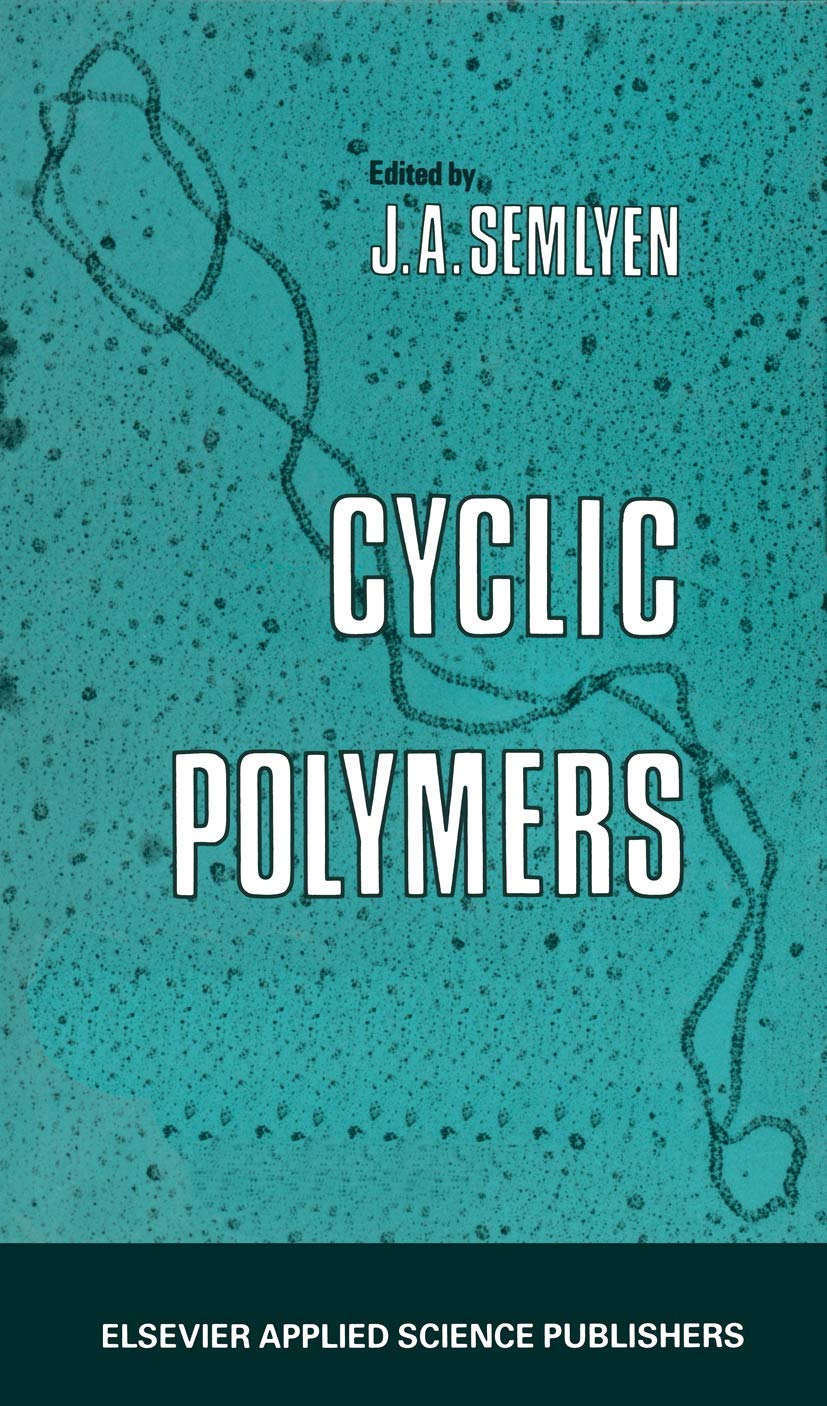
Synthetic Polymers Based On Long Chain Molecules Have Been Investigated Intensively For Over 50 Years. They Have Found Important Applications As Plastics, Fibres, Rubbers And Other Materials. The Chain Molecules May Be Simple Linear Structures Or They May Be Branched Or Crosslinked. During The Past Decade, Sharp Fractions Of The First Synthetic Cyclic Polymer Have Been Prepared. These Fractions Of Cyclic Poly(Dimethyl Siloxane) Consist Of Ring Molecules Containing Hundreds Of Skeletal Bonds. Some Of Their Properties Have Been Found To Be Quite Different From Those Of The Corresponding Linear Polymers. Synthetic Cyclic Polymers, Including Cyclic Polystyrene, Have Joined The Naturally Occurring Circular Dnas As Examples Of Substantially Large Ring Molecules. This Book Aims To Review Current Knowledge Of Cyclic Polymers And Biological Ring Macromolecules. In Addition, It Discusses Theories Of Cyclic Macromolecules And Describes Cyclization Processes Involving Long Chain Molecules. Since 1865, When Kekule Proposed A Simple Ring Structure For Benzene, Larger And Larger Ring Molecules Have Been Synthesized In The Laboratory And Discovered In Nature. Many More Examples Are To Be Expected In The Future. In Time, Large Ring Molecules Should Take Their Proper Place Alongside Long Chain Molecules As One Of The Two Possible Constituent Structural Units Of Polymers.
⚠️ WARNING (California Proposition 65):
This product may contain chemicals known to the State of California to cause cancer, birth defects, or other reproductive harm.
For more information, please visit www.P65Warnings.ca.gov.
- Q: How many pages does the book 'Cyclic Polymers' have? A: This book has three hundred ninety pages. It provides a comprehensive overview of synthetic cyclic polymers and their properties.
- Q: What is the binding type of 'Cyclic Polymers'? A: The book is available in hardcover binding. This ensures durability and a professional appearance for readers and libraries.
- Q: Who is the author of 'Cyclic Polymers'? A: The author of this book is E.R. Semlyen. He is known for his extensive research in the field of synthetic polymers.
- Q: What topics are covered in 'Cyclic Polymers'? A: The book covers topics such as theories of cyclic macromolecules and cyclization processes. It also reviews current knowledge in the field.
- Q: Is 'Cyclic Polymers' suitable for beginners in the field? A: Yes, beginners can benefit from this book. It provides foundational knowledge as well as advanced theories in cyclic polymers.
- Q: What makes cyclic polymers different from linear polymers? A: Cyclic polymers have unique properties due to their ring structure. These characteristics differ significantly from those of linear polymers.
- Q: How can I best utilize the information in 'Cyclic Polymers'? A: Readers can use this book as a reference for research and study in polymer science. It is helpful for both academic and practical applications.
- Q: Is 'Cyclic Polymers' appropriate for academic study? A: Yes, this book is suitable for academic study. It serves as a valuable resource for students and professionals in chemistry and materials science.
- Q: What should I do to care for my hardcover copy of 'Cyclic Polymers'? A: To care for your hardcover book, store it upright in a cool, dry place. Avoid exposure to direct sunlight to prevent fading.
- Q: Can I find information on synthetic cyclic polymers in this book? A: Yes, the book includes detailed information on synthetic cyclic polymers. It discusses their applications and properties extensively.
- Q: What is the primary focus of 'Cyclic Polymers'? A: The primary focus is on synthetic cyclic polymers and their relationship to biological ring macromolecules. It explores various scientific theories and discoveries.
- Q: Does 'Cyclic Polymers' cover historical developments in polymer science? A: Yes, it discusses historical developments, including the synthesis of larger ring molecules since the concept was introduced by Kekule in eighteen sixty-five.
- Q: Is 'Cyclic Polymers' useful for professionals in material science? A: Yes, professionals in material science will find this book useful. It provides insights into advancements and applications of cyclic polymers.
- Q: How does 'Cyclic Polymers' contribute to the understanding of polymer structures? A: The book contributes by detailing both cyclic and linear polymer structures. It highlights the significance of ring molecules in polymer science.
- Q: Are there any practical applications discussed in 'Cyclic Polymers'? A: Yes, the book discusses practical applications of cyclic polymers in plastics, fibers, and rubbers. These applications are pivotal in various industries.