
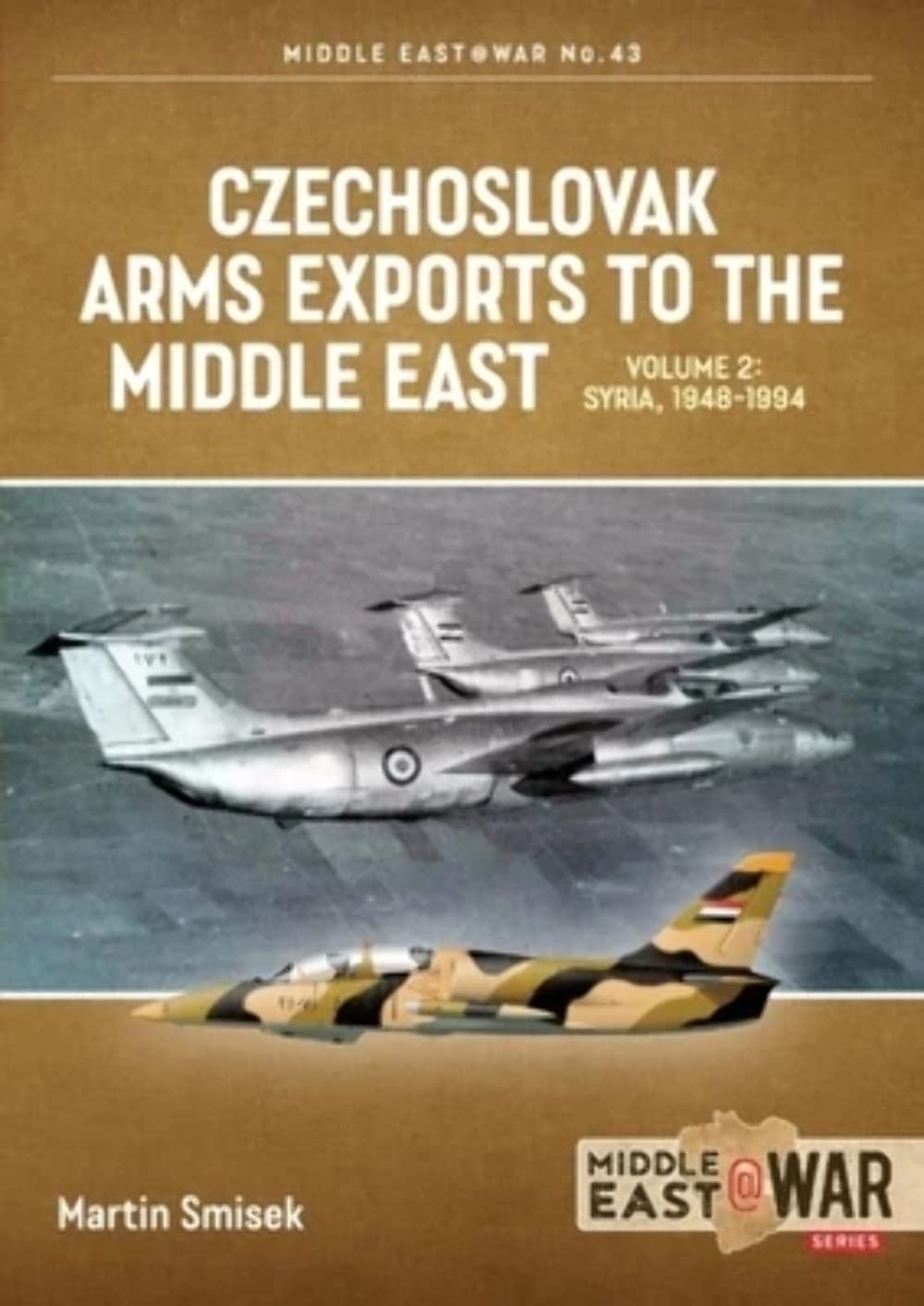
Title
Czechoslovak Arms Exports to the Middle East: Volume 2 Egypt, 19481990 (Middle East@War),Used
Sold by Ergodebooks, an authorized reseller.
Returns accepted within 30 days | support@ergodebooks.com
Shipping Information
- Free Standard Shipping — United States only
- Processing Time: 3–5 business days
- Estimated Delivery: 6–10 business days after dispatch
- Double-boxed, fully insured & discreetly packaged
- Tracking number sent via email once dispatched
Returns & Refund
Returns accepted within 30 days of delivery.
Damaged or Defective Item
Free return shipping + replacement or full refund
Wrong Item Received
Free return shipping + replacement or full refund
Change of Mind
Return shipping at customer's expense · 25% restocking fee applies
Payment Option

During the Cold War, communist Czechoslovakia was one of the largest arms exporters to the Middle East among the Soviet Bloc countries. The second volume of this miniseries describes the history of arms exports from Czechoslovakia to Egypt including related military assistance.Although Egypt had expressed interest in buying Czechoslovak arms just before the 1948 ArabIsraeli War, no deliveries were eventually made. The reason was the preferences of Prague, which fully supported Israel. The situation began to change from July 1950 when Czechoslovakia banned exports of its weapons to the Jewish country. These developments culminated in September 1955, when the first huge CzechoslovakEgyptian arms deal was concluded. As a proxy of Moscow, Prague delivered impressive quantities of armament and ammunition together with spare parts, logistics, and support equipment.At the same time, Czechoslovak military instructors and advisors were sent to Egypt. A crucial role was played by a group of Czechoslovak Air Force personnel, whose task was to provide the tactical and combat training for two Egyptian fighter squadrons equipped with MiG15bis jets prior to the Suez Crisis in 1956. At the same time, Egyptian military specialists were trained in the facilities of the Czechoslovak Peoples Army. However, from the end of the 1950s, there was a significant reduction in the supply of military hardware from Czechoslovakia because Prague was unwilling or unable to supply the stateoftheart weapons required by the Egyptians.Therefore, the focus of CzechoslovakEgyptian military cooperation in the following years was limited to the establishment of the Military Technical College in Cairo and different military repair facilities around Egypt. The situation in the supply of Czechoslovak armament to Egypt began to change gradually in the mid1960s as the Czechoslovak arms industry commenced the production of a new generation of weapons developed by domestic industry or provided under Soviet license. A huge boom in arms deals occurred after the Egyptian defeat in the 1967 ArabIsraeli War. During the following years, Czechoslovakia supplied Egypt with OT62 armored personnel carriers, T55 tanks, MiG21F13 fighters and L29 Delfin jet trainers, which subsequently took part in the fighting of the 1973 ArabIsraeli War. Another major turning point came in the mid1970s with the deterioration of SovietEgyptian relations. Following instructions from Moscow, Prague was forced to abruptly stop supplying arms to Egypt in 1976.Using the declassified original documentation, this is the most comprehensive account of the Czechoslovak military involvement in the Middle East during the Cold War which was ever published.
⚠️ WARNING (California Proposition 65):
This product may contain chemicals known to the State of California to cause cancer, birth defects, or other reproductive harm.
For more information, please visit www.P65Warnings.ca.gov.
- Q: How many pages does the book have? A: The book has seventy-two pages. It provides a comprehensive overview of Czechoslovak arms exports to Egypt during the Cold War.
- Q: What are the dimensions of the book? A: The book measures eight point two seven inches in length, zero point two five inches in width, and eleven point seven five inches in height. These dimensions make it a manageable size for reading.
- Q: What type of binding does the book have? A: The book is paperback bound. This type of binding is lightweight and portable, making it convenient for readers.
- Q: Who is the author of the book? A: The author of the book is Martin Smisek. He provides detailed insights into the historical context of arms exports.
- Q: What is the main subject of the book? A: The book focuses on Czechoslovak arms exports to Egypt from nineteen forty-eight to nineteen ninety. It details military assistance and historical developments.
- Q: How is this book relevant to military history? A: This book offers a detailed account of Czechoslovak military involvement in Egypt during the Cold War. It highlights significant arms deals and their impact on military cooperation.
- Q: Is this book suitable for general readers? A: Yes, the book is suitable for general readers with an interest in military history. It is well-researched and accessible.
- Q: Can this book be used for academic purposes? A: Yes, this book can be used for academic research on Cold War military history. It includes original documentation and comprehensive analysis.
- Q: How do I care for this book? A: To care for the book, keep it in a dry place away from direct sunlight. Avoid bending or folding the pages to maintain its condition.
- Q: Is the book safe for young readers? A: Yes, the book is safe for young readers interested in history. However, parental guidance is recommended due to complex themes.
- Q: What if the book arrives damaged? A: If the book arrives damaged, you should contact the seller for a replacement or refund. Most sellers have return policies for such issues.
- Q: Can I gift this book to someone interested in military history? A: Yes, this book makes an excellent gift for anyone interested in military history or the Cold War. It's informative and engaging.
- Q: What historical events does the book cover? A: The book covers significant events from nineteen forty-eight to nineteen ninety, including arms deals and military cooperation between Czechoslovakia and Egypt.
- Q: Does the book include illustrations or maps? A: No, the book does not include illustrations or maps. It focuses on textual content and analysis of historical events.
- Q: Is there a bibliography or references in the book? A: Yes, the book includes a bibliography and references, providing sources for further research on the topic.
- Q: What makes this book unique? A: This book is unique because it provides a comprehensive account based on declassified documentation regarding Czechoslovak military involvement in the Middle East.