If you have any questions, you are always welcome to contact us. We'll get back to you as soon as possible, withing 24 hours on weekdays.
Customer service
All questions about your order, return and delivery must be sent to our customer service team by e-mail at yourstore@yourdomain.com
Sale & Press
If you are interested in selling our products, need more information about our brand or wish to make a collaboration, please contact us at press@yourdomain.com
Help
If you have any questions, you are always welcome to contact us. We'll get back to you as soon as possible, withing 24 hours on weekdays.
Customer service
All questions about your order, return and delivery must be sent to our customer service team by e-mail at yourstore@yourdomain.com
Sale & Press
If you are interested in selling our products, need more information about our brand or wish to make a collaboration, please contact us at press@yourdomain.com
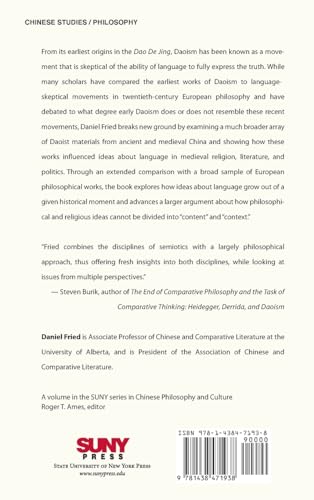
From its earliest origins in the Dao De Jing, Daoism has been known as a movement that is skeptical of the ability of language to fully express the truth. While many scholars have compared the earliest works of Daoism to languageskeptical movements in twentiethcentury European philosophy and have debated to what degree early Daoism does or does not resemble these recent movements, Daniel Fried breaks new ground by examining a much broader array of Daoist materials from ancient and medieval China and showing how these works influenced ideas about language in medieval religion, literature, and politics. Through an extended comparison with a broad sample of European philosophical works, the book explores how ideas about language grow out of a given historical moment and advances a larger argument about how philosophical and religious ideas cannot be divided into "content" and "context."
⚠️ WARNING (California Proposition 65):
This product may contain chemicals known to the State of California to cause cancer,
birth defects, or other reproductive harm.
For MAP (Minimum Advertised Price) violations and Intellectual Property (IP) or Trademark concerns, please contact:
support@ergodebooks.com
⚠️ California Proposition 65 Warning: Some products sold on this website may expose you to chemicals known to the State of California to cause cancer, birth defects, or other reproductive harm. For more information, visit www.P65Warnings.ca.gov.