
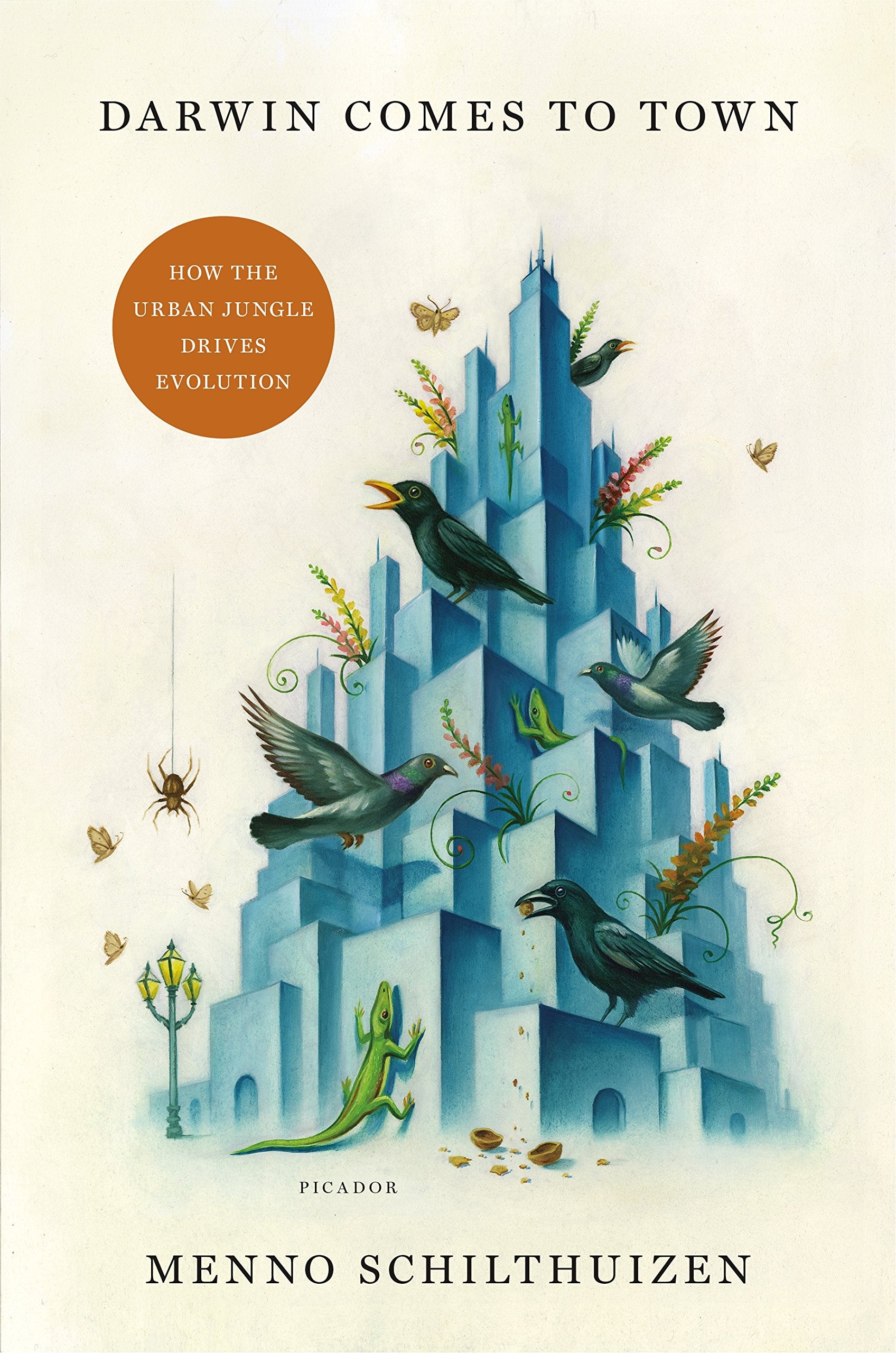
Title
Darwin Comes To Town: How The Urban Jungle Drives Evolution
Sold by Ergodebooks, an authorized reseller.
Returns accepted within 30 days | support@ergodebooks.com
Shipping Information
- Free Standard Shipping — United States only
- Processing Time: 3–5 business days
- Estimated Delivery: 6–10 business days after dispatch
- Double-boxed, fully insured & discreetly packaged
- Tracking number sent via email once dispatched
Returns & Refund
Returns accepted within 30 days of delivery.
Damaged or Defective Item
Free return shipping + replacement or full refund
Wrong Item Received
Free return shipping + replacement or full refund
Change of Mind
Return shipping at customer's expense · 25% restocking fee applies
Payment Option

*Carrion Crows In The Japanese City Of Sendai Have Learned To Use Passing Traffic To Crack Nuts.*Lizards In Puerto Rico Are Evolving Feet That Better Grip Surfaces Like Concrete.*Europes Urban Blackbirds Sing At A Higher Pitch Than Their Rural Cousins, To Be Heardover The Din Of Traffic.How Is This Happening?Menno Schilthuizen Is One Of A Growing Number Of Urban Ecologists Studying How Our Manmade Environments Are Accelerating And Changing The Evolution Of The Animals And Plants Around Us. In Darwin Comes To Town, He Takes Us Around The World For An Upclose Look At Just How Stunningly Flexible And Swiftmoving Natural Selection Can Be.With Human Populations Growing, Were Having An Increasing Impact On Global Ecosystems, And Nowhere Do These Impacts Overlap As Much As They Do In Cities. The Urban Environment Is About As Extreme As It Gets, And The Wild Animals And Plants That Live Sidebyside With Us Need To Adapt To A Whole Suite Of Challenging Conditions: They Must Manage In The Citys Hotter Climate (The Urban Heat Island); They Need To Be Able To Live Either In The Semidesert Of The Tall, Rocky, And Cavernous Structures We Call Buildings Or In The Pocketlike Oases Of City Parks (Which Pose Their Own Dangers, Including Smog And Freerangingdogs And Cats); Traffic Causes Continuous Noise, A Mist Of Fine Dust Particles, And Barriers To Movement For Any Animal That Cannot Fly Or Burrow; Food Sources Are Mainly Humanderived. And Yet, As Schilthuizen Shows, The Wildlife Sharing These Spaces With Us Is Not Just Surviving, But Evolving Ways Of Thriving.Darwin Comes Totown Draws On Eyepopping Examples Of Adaptation To Share A Stunning Vision Of Urban Evolution In Which Humans And Wildlife Coexist In A Unique Harmony. It Reveals That Evolution Can Happen Far More Rapidly Than Darwin Dreamed, While Providing A Glimmer Of Hope That Our Race Toward Over Population Might Not Take The Rest Of Nature Down With Us.
⚠️ WARNING (California Proposition 65):
This product may contain chemicals known to the State of California to cause cancer, birth defects, or other reproductive harm.
For more information, please visit www.P65Warnings.ca.gov.
- Q: What is the page count of 'Darwin Comes to Town'? A: The book has three hundred four pages. It provides an in-depth look at urban evolution through various examples.
- Q: What are the dimensions of this book? A: The book measures six point four six inches in length, one point one five inches in width, and nine point six six inches in height.
- Q: What type of binding does 'Darwin Comes to Town' have? A: This book is bound in hardcover. It offers durability and a premium feel for readers.
- Q: Who is the author of 'Darwin Comes to Town'? A: The author is Menno Schilthuizen. He is known for his work in urban ecology and evolution.
- Q: What genre does 'Darwin Comes to Town' fall under? A: The book falls under the Ecology genre. It explores the intersection of urban life and evolutionary biology.
- Q: How should I read 'Darwin Comes to Town'? A: You can read this book at your own pace. It's suitable for anyone interested in ecology and evolution.
- Q: Is 'Darwin Comes to Town' suitable for children? A: Yes, the book is appropriate for older children and adults. It discusses complex themes but is accessible to younger readers.
- Q: Can I use this book for educational purposes? A: Yes, it can be used as a resource in educational settings. It provides valuable insights into urban ecology.
- Q: What themes are explored in 'Darwin Comes to Town'? A: The book explores adaptation, evolution, and the impact of urban environments on wildlife. It highlights unique examples from around the world.
- Q: How should I store 'Darwin Comes to Town'? A: Store the book upright on a shelf to avoid bending the cover. Keep it in a dry, cool place to preserve its condition.
- Q: Is there a warranty for 'Darwin Comes to Town'? A: Typically, books do not come with a warranty. However, check with the retailer for their return policy.
- Q: What if 'Darwin Comes to Town' arrives damaged? A: If the book arrives damaged, contact the retailer for a return or exchange. Most sellers have customer service for such issues.
- Q: What if I have questions about 'Darwin Comes to Town'? A: You can contact the retailer or publisher for questions. They often provide additional resources or support.
- Q: Is this book well-reviewed? A: Yes, 'Darwin Comes to Town' has received positive reviews for its engaging writing and fascinating insights into urban evolution.
- Q: What makes 'Darwin Comes to Town' unique? A: The book offers a fresh perspective on evolution, focusing on how urban environments shape wildlife. It presents compelling case studies.
- Q: Where can I purchase 'Darwin Comes to Town'? A: You can purchase the book from major retailers, online bookstores, or directly from the publisher. Check availability in your region.