
Title
Data Analytics Applications in Education,Used
Sold by Ergodebooks, an authorized reseller.
Returns accepted within 30 days | support@ergodebooks.com
Shipping Information
- Free Standard Shipping — United States only
- Processing Time: 3–5 business days
- Estimated Delivery: 6–10 business days after dispatch
- Double-boxed, fully insured & discreetly packaged
- Tracking number sent via email once dispatched
Returns & Refund
Returns accepted within 30 days of delivery.
Damaged or Defective Item
Free return shipping + replacement or full refund
Wrong Item Received
Free return shipping + replacement or full refund
Change of Mind
Return shipping at customer's expense · 25% restocking fee applies
Payment Option

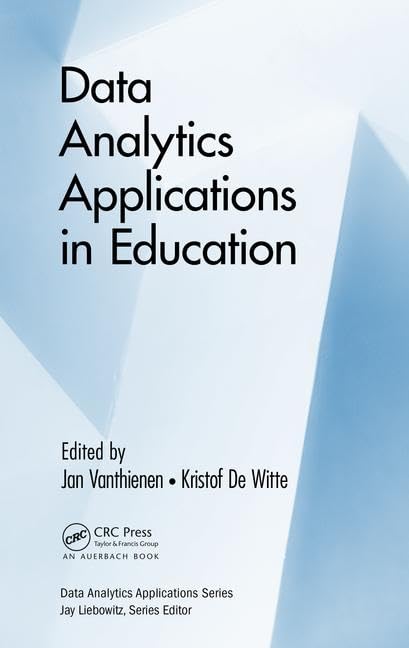
The abundance of data and the rise of new quantitative and statistical techniques have created a promising area: data analytics. This combination of a culture of datadriven decision making and techniques to include domain knowledge allows organizations to exploit big data analytics in their evaluation and decision processes. Also, in education and learning, big data analytics is being used to enhance the learning process, to evaluate efficiency, to improve feedback, and to enrich the learning experience.As every step a student takes in the online world can be traced, analyzed, and used, there are plenty of opportunities to improve the learning process of students. First, data analytics techniques can be used to enhance the student s learning process by providing realtime feedback, or by enriching the learning experience. Second, data analytics can be used to support the instructor or teacher. Using data analytics, the instructor can better trace, and take targeted actions to improve, the learning process of the student. Third, there are possibilities in using data analytics to measure the performance of instructors. Finally, for policy makers, it is often unclear how schools use their available resources to "produce" outcomes. By combining structured and unstructured data from various sources, data analytics might provide a solution for governments that aim to monitor the performance of schools more closely.Data analytics in education should not be the domain of a single discipline. Economists should discuss the possibilities, issues, and normative questions with a multidisciplinary team of pedagogists, philosophers, computer scientists, and sociologists. By bringing together various disciplines, a more comprehensive answer can be formulated to the challenges ahead. This book starts this discussion by highlighting some economic perspectives on the use of data analytics in education. The book begins a rich, multidisciplinary discussion that may make data analytics in education seem as natural as a teacher in front of a classroom.
⚠️ WARNING (California Proposition 65):
This product may contain chemicals known to the State of California to cause cancer, birth defects, or other reproductive harm.
For more information, please visit www.P65Warnings.ca.gov.