
Title
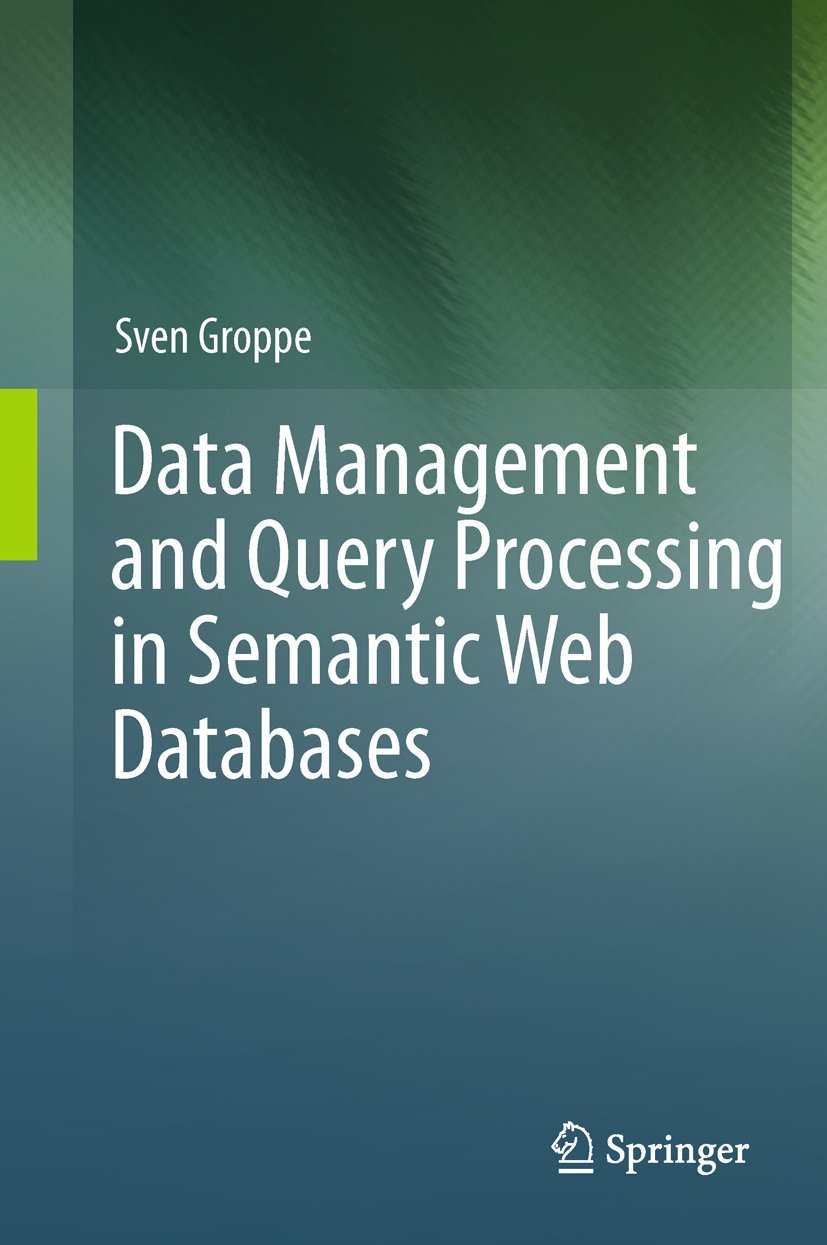
Data Management and Query Processing in Semantic Web Databases,Used
Sold by Ergodebooks, an authorized reseller.
Returns accepted within 30 days | support@ergodebooks.com
Shipping Information
- Free Standard Shipping — United States only
- Processing Time: 3–5 business days
- Estimated Delivery: 6–10 business days after dispatch
- Double-boxed, fully insured & discreetly packaged
- Tracking number sent via email once dispatched
Returns & Refund
Returns accepted within 30 days of delivery.
Damaged or Defective Item
Free return shipping + replacement or full refund
Wrong Item Received
Free return shipping + replacement or full refund
Change of Mind
Return shipping at customer's expense · 25% restocking fee applies
Payment Option

Product Description The Semantic Web, which is intended to establish a machineunderstandable Web, is currently changing from being an emerging trend to a technology used in complex realworld applications. A number of standards and techniques have been developed by the World Wide Web Consortium (W3C), e.g., the Resource Description Framework (RDF), which provides a general method for conceptual descriptions for Web resources, and SPARQL, an RDF querying language. Recent examples of large RDF data with billions of facts include the UniProt comprehensive catalog of protein sequence, function and annotation data, the RDF data extracted from Wikipedia, and Princeton Universitys WordNet. Clearly, querying performance has become a key issue for Semantic Web applications.In his book, Groppe details various aspects of highperformance Semantic Web data management and query processing. His presentation fills the gap between Semantic Web and database books, which either fail to take into account the performance issues of largescale data management or fail to exploit the special properties of Semantic Web data models and queries. After a general introduction to the relevant Semantic Web standards, he presents specialized indexing and sorting algorithms, adapted approaches for logical and physical query optimization, optimization possibilities when using the parallel database technologies of todays multicore processors, and visual and embedded query languages.Groppe primarily targets researchers, students, and developers of largescale Semantic Web applications. On the complementary book webpage readers will find additional material, such as an online demonstration of a query engine, and exercises, and their solutions, that challenge their comprehension of the topics presented. From the Back Cover The Semantic Web, which is intended to establish a machineunderstandable Web, is currently changing from being an emerging trend to a technology used in complex realworld applications. A number of standards and techniques have been developed by the World Wide Web Consortium (W3C), e.g., the Resource Description Framework (RDF), which provides a general method for conceptual descriptions for Web resources, and SPARQL, an RDF querying language. Recent examples of large RDF data with billions of facts include the UniProt comprehensive catalog of protein sequence, function and annotation data, the RDF data extracted from Wikipedia, and Princeton Universitys WordNet. Clearly, querying performance has become a key issue for Semantic Web applications.In his book, Groppe details various aspects of highperformance Semantic Web data management and query processing. His presentation fills the gap between Semantic Web and database books, which either fail to take into account the performance issues of largescale data management or fail to exploit the special properties of Semantic Web data models and queries. After a general introduction to the relevant Semantic Web standards, he presents specialized indexing and sorting algorithms, adapted approaches for logical and physical query optimization, optimization possibilities when using the parallel database technologies of todays multicore processors, and visual and embedded query languages.Groppe primarily targets researchers, students, and developers of largescale Semantic Web applications. On the complementary book webpage readers will find additional material, such as an online demonstration of a query engine, and exercises, and their solutions, that challenge their comprehension of the topics presented. About the Author Sven Groppe is a research assistant in the Institute of Information Systems at the University of Lbeck, Germany. He holds a Ph.D. from the University of Paderborn on query reformulation for the XML standards XPath, XSLT and XQuery. He was a member of the DAWG W3C Working Group that developed the W3C standard query language SPARQL. His research focus is
⚠️ WARNING (California Proposition 65):
This product may contain chemicals known to the State of California to cause cancer, birth defects, or other reproductive harm.
For more information, please visit www.P65Warnings.ca.gov.