If you have any questions, you are always welcome to contact us. We'll get back to you as soon as possible, withing 24 hours on weekdays.
Customer service
All questions about your order, return and delivery must be sent to our customer service team by e-mail at yourstore@yourdomain.com
Sale & Press
If you are interested in selling our products, need more information about our brand or wish to make a collaboration, please contact us at press@yourdomain.com
Help
If you have any questions, you are always welcome to contact us. We'll get back to you as soon as possible, withing 24 hours on weekdays.
Customer service
All questions about your order, return and delivery must be sent to our customer service team by e-mail at yourstore@yourdomain.com
Sale & Press
If you are interested in selling our products, need more information about our brand or wish to make a collaboration, please contact us at press@yourdomain.com
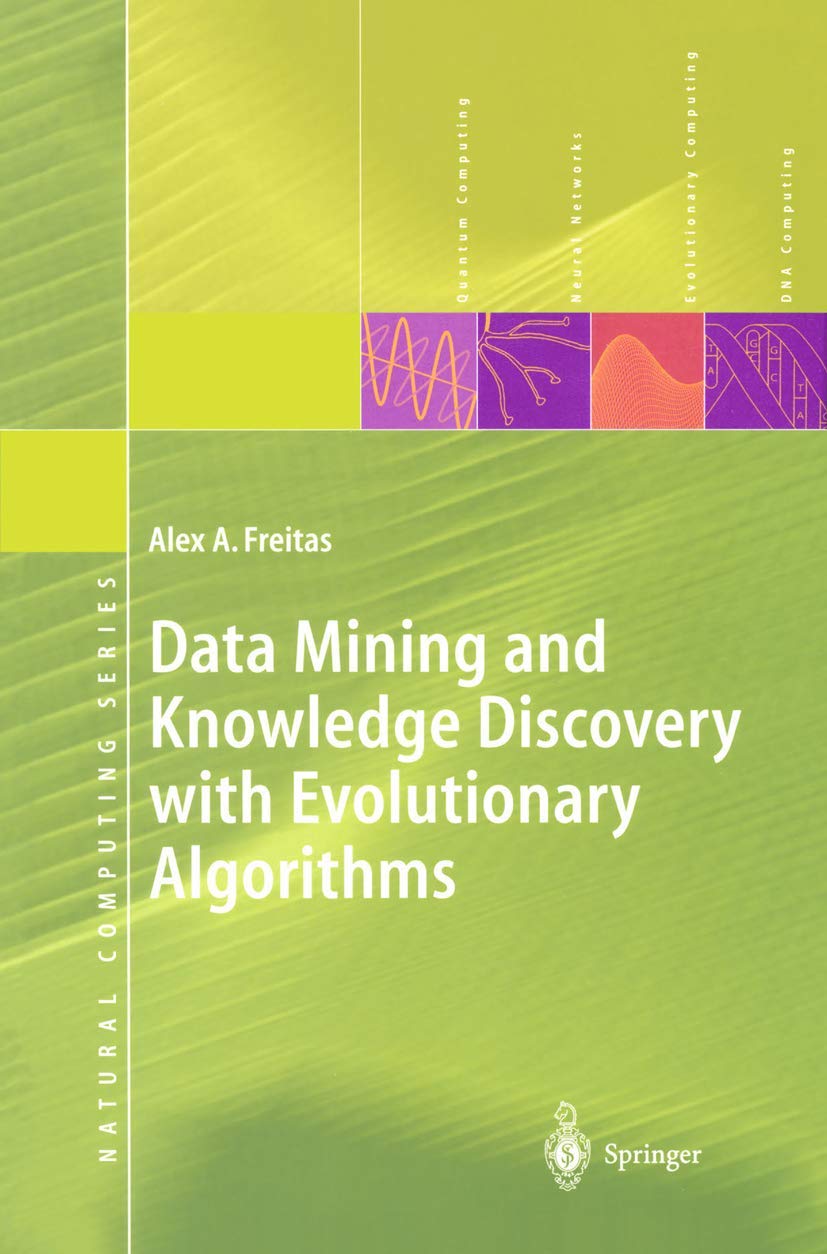
This book addresses the integration of two areas of computer science, namely data mining and evolutionary algorithms. Both these areas have become increas ingly popular in the last few years, and their integration is currently an area of active research. In essence, data mining consists of extracting valid, comprehensible, and in teresting knowledge from data. Data mining is actually an interdisciplinary field, since there are many kinds of methods that can be used to extract knowledge from data. Arguably, data mining mainly uses methods from machine learning (a branch of artificial intelligence) and statistics (including statistical pattern recog nition). Our discussion of data mining and evolutionary algorithms is primarily based on machine learning concepts and principles. In particular, in this book we emphasize the importance of discovering comprehensible, interesting knowledge, which the user can potentially use to make intelligent decisions. In a nutshell, the motivation for applying evolutionary algorithms to data mining is that evolutionary algorithms are robust search methods which perform a global search in the space of candidate solutions (rules or another form of knowl edge representation). In contrast, most rule induction methods perform a local, greedy search in the space of candidate rules. Intuitively, the global search of evolutionary algorithms can discover interesting rules and patterns that would be missed by the greedy search.
⚠️ WARNING (California Proposition 65):
This product may contain chemicals known to the State of California to cause cancer,
birth defects, or other reproductive harm.
For MAP (Minimum Advertised Price) violations and Intellectual Property (IP) or Trademark concerns, please contact:
support@ergodebooks.com
⚠️ California Proposition 65 Warning: Some products sold on this website may expose you to chemicals known to the State of California to cause cancer, birth defects, or other reproductive harm. For more information, visit www.P65Warnings.ca.gov.