
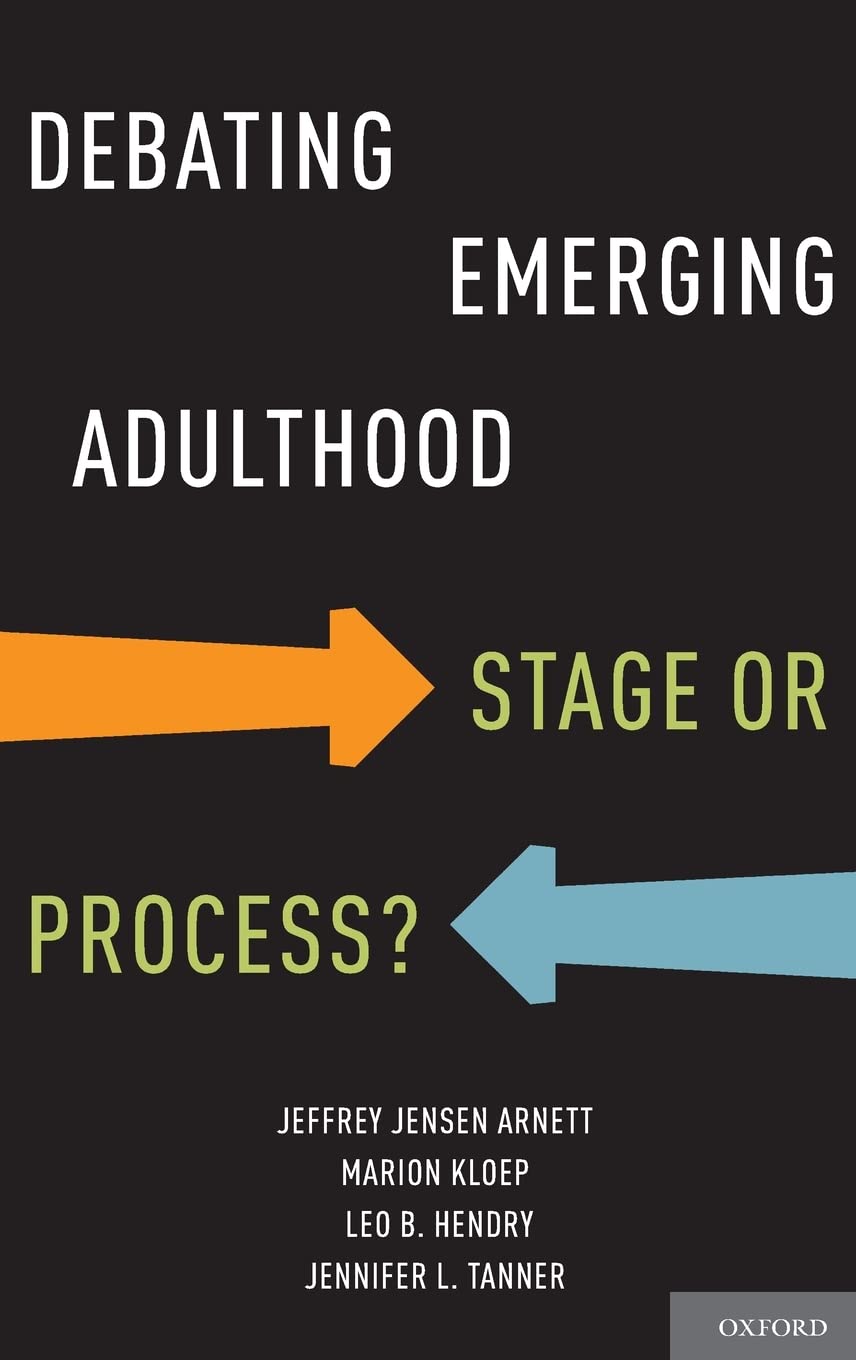
Title
Debating Emerging Adulthood: Stage or Process?,New
Sold by Ergodebooks, an authorized reseller.
Returns accepted within 30 days | support@ergodebooks.com
Shipping Information
- Free Standard Shipping — United States only
- Processing Time: 3–5 business days
- Estimated Delivery: 6–10 business days after dispatch
- Double-boxed, fully insured & discreetly packaged
- Tracking number sent via email once dispatched
Returns & Refund
Returns accepted within 30 days of delivery.
Damaged or Defective Item
Free return shipping + replacement or full refund
Wrong Item Received
Free return shipping + replacement or full refund
Change of Mind
Return shipping at customer's expense · 25% restocking fee applies
Payment Option

The transition from adolescence to adulthood has undergone significant changes in recent decades. Unlike a half century ago, when young people in industrialized countries moved from adolescence into young adulthood in relatively short order at around age 20, now the decade from the late teens to the late twenties is seen as an extended time of selffocused exploration and education in pursuit of optimally fulfilling relationships and careers. Recognition of this new period is stronger than ever, but an important question remains: should emerging adulthood be considered a developmental stage, or a process?In Debating Emerging Adulthood: Stage or Process? two pairs of developmental psychologists take sides in a debate that is central to the very concept of emerging adulthood. Arnett and Tanner argue that as young people around the world share demographic similarities, such as longer education and later marriage, the years between the ages 18 and 25 are best understood as entailing a new life stage. However, because the experiences of emerging adults worldwide vary according to cultural context, educational attainment, and social class, these two scholars suggest that there may not be one but many different emerging adulthoods. An important issue for this burgeoning area of inquiry is to explore and describe this variation. In contrast, Hendry and Kloep assert that stage theories have never been able to explain individual transitions across the life course; in their view, stage theoriesincluding the theory of emerging adulthoodought to be abolished altogether, and explanations found for the processes and mechanisms that govern human change at any age. This engaging book maps out the argument of 'stage or process' in detail, with vigorous disagreements, conflicting alternatives, and some leavening humor, ultimately even finding some common ground. Debating Emerging Adulthood is an absolute mustread for developmental psychologists as well as anyone interested in this indisputably important time of life.
⚠️ WARNING (California Proposition 65):
This product may contain chemicals known to the State of California to cause cancer, birth defects, or other reproductive harm.
For more information, please visit www.P65Warnings.ca.gov.