
Title
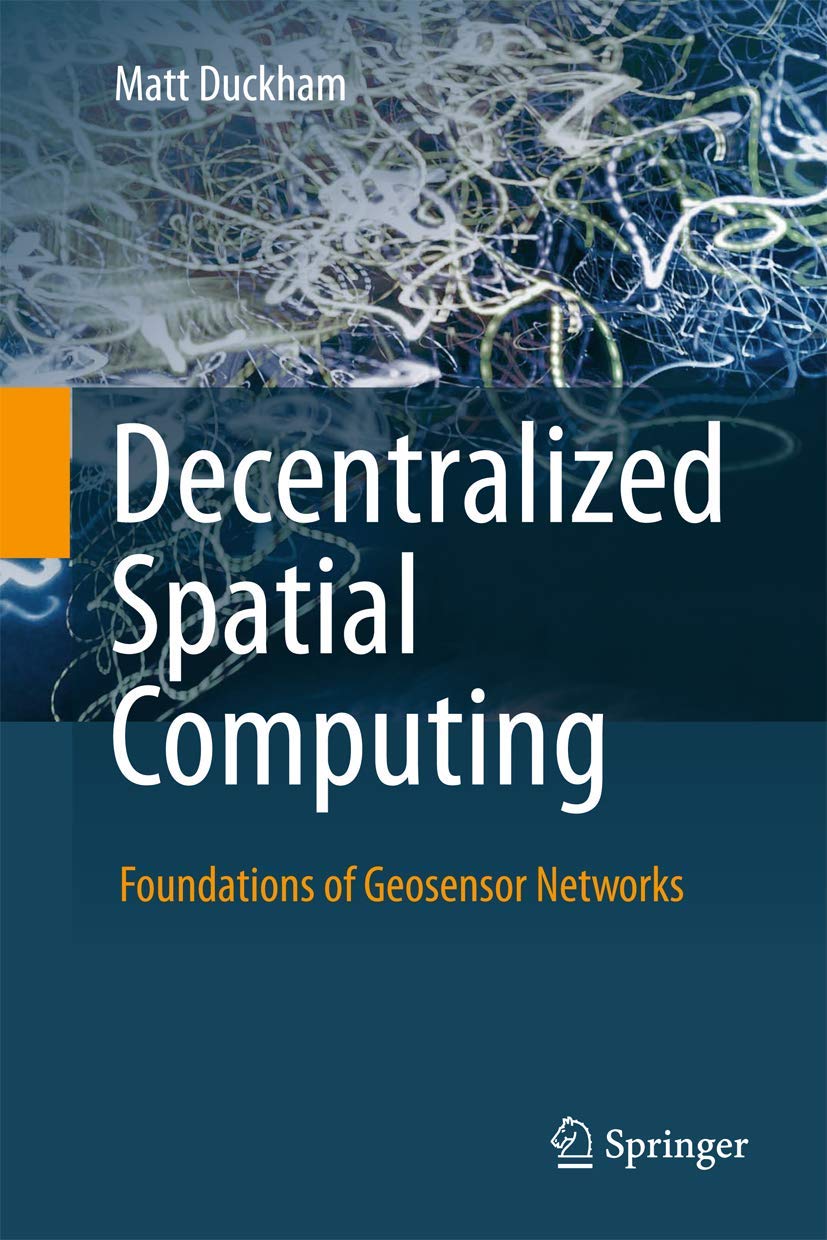
Decentralized Spatial Computing: Foundations of Geosensor Networks,Used
Sold by Ergodebooks, an authorized reseller.
Returns accepted within 30 days | support@ergodebooks.com
Shipping Information
- Free Standard Shipping — United States only
- Processing Time: 3–5 business days
- Estimated Delivery: 6–10 business days after dispatch
- Double-boxed, fully insured & discreetly packaged
- Tracking number sent via email once dispatched
Returns & Refund
Returns accepted within 30 days of delivery.
Damaged or Defective Item
Free return shipping + replacement or full refund
Wrong Item Received
Free return shipping + replacement or full refund
Change of Mind
Return shipping at customer's expense · 25% restocking fee applies
Payment Option

Computing increasingly happens somewhere, with that geographic location important to the computational process itself. Many new and evolving spatial technologies, such as geosensor networks and smartphones, embody this trend. Conventional approaches to spatial computing are centralized, and do not account for the inherently decentralized nature of "computing somewhere": the limited, local knowledge of individual system components, and the interaction between those components at different locations. On the other hand, despite being an established topic in distributed systems, decentralized computing is not concerned with geographical constraints to the generation and movement of information. In this context, of (centralized) spatial computing and decentralized (nonspatial) computing, the key question becomes: "What makes decentralized spatial computing special?"In Part I of the book the author covers the foundational concepts, structures, and design techniques for decentralized computing with spatial and spatiotemporal information. In Part II he applies those concepts and techniques to the development of algorithms for decentralized spatial computing, stepping through a suite of increasingly sophisticated algorithms: from algorithms with minimal spatial information about their neighborhoods; to algorithms with access to more detailed spatial information, such as direction, distance, or coordinate location; to truly spatiotemporal algorithms that monitor environments that are dynamic, even using networks that are mobile or volatile. Finally, in Part III the author shows how decentralized spatial and spatiotemporal algorithms designed using the techniques explored in Part II can be simulated and tested. In particular, he investigates empirically the important properties of a decentralized spatial algorithm: its computational efficiency and its robustness to unavoidable uncertainty. Part III concludes with a survey of the opportunities for connecting decentralized spatial computing to ongoing research and emerging hot topics in related fields, such as biologically inspired computing, geovisualization, and stream computing.The book is written for students and researchers of computer science and geographic information science. Throughout the book the author's style is characterized by a focus on the broader message, explaining the process of decentralized spatial algorithm design rather than the technical details. Each chapter ends with review questions designed to test the reader's understanding of the material and to point to further work or research. The book includes short appendices on discrete mathematics and SQL. Simulation models written in NetLogo and associated source code for all the algorithms presented in the book can be found on the author's accompanying website.
⚠️ WARNING (California Proposition 65):
This product may contain chemicals known to the State of California to cause cancer, birth defects, or other reproductive harm.
For more information, please visit www.P65Warnings.ca.gov.