If you have any questions, you are always welcome to contact us. We'll get back to you as soon as possible, withing 24 hours on weekdays.
Customer service
All questions about your order, return and delivery must be sent to our customer service team by e-mail at yourstore@yourdomain.com
Sale & Press
If you are interested in selling our products, need more information about our brand or wish to make a collaboration, please contact us at press@yourdomain.com
Help
If you have any questions, you are always welcome to contact us. We'll get back to you as soon as possible, withing 24 hours on weekdays.
Customer service
All questions about your order, return and delivery must be sent to our customer service team by e-mail at yourstore@yourdomain.com
Sale & Press
If you are interested in selling our products, need more information about our brand or wish to make a collaboration, please contact us at press@yourdomain.com
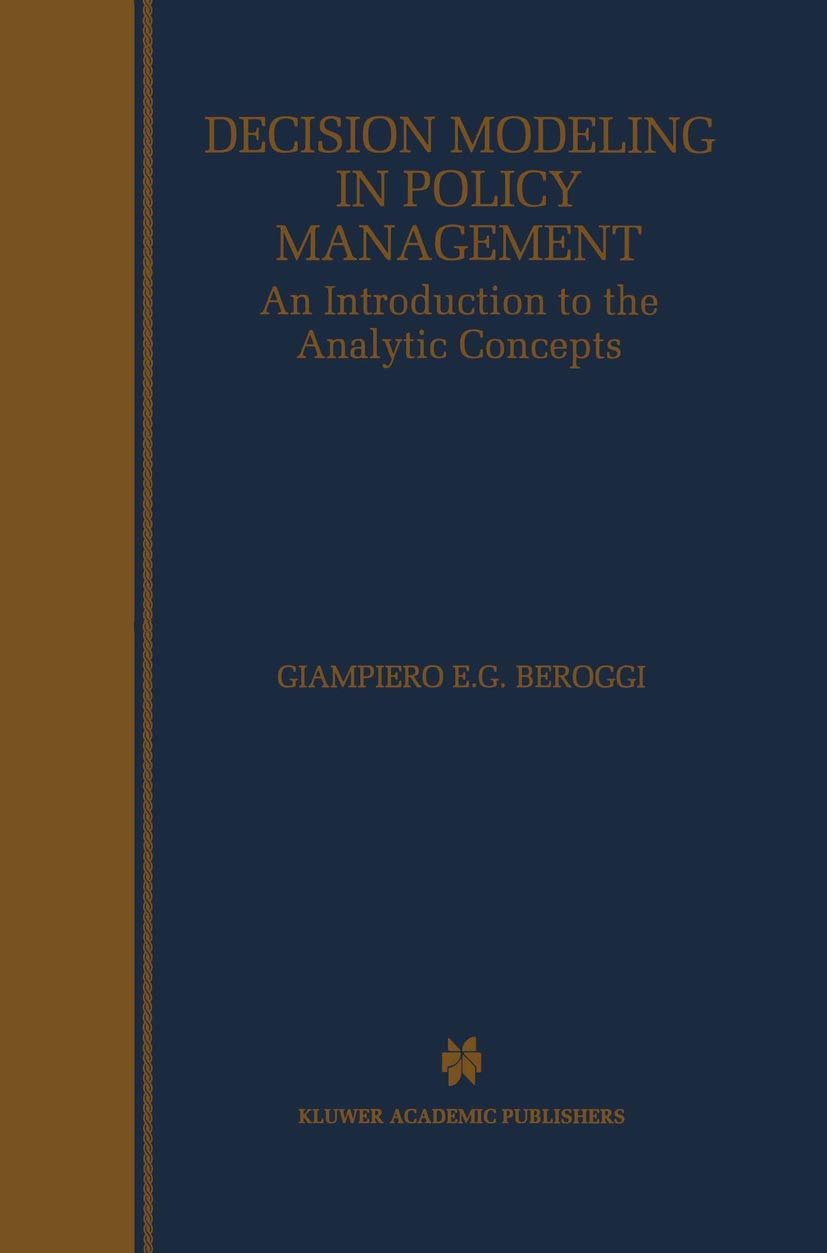
The last decade has experienced major societal challenges at the intersection of technological systems and policy making. Prevalent examples are the liberalization of energy and telecommunications markets, the public aversion towards nuclear power plants, the development of highspeed trains, the debates about global warming and sustainability, the development of intelligent vehicle systems, and the controversies concerning the location of waste depositories, airports, and energy systems. These challenges, coupled with the call from industry for a systemsengineering oriented approach to policy analysis, motivated Delft University of Technology to launch the first European School of Systems Engineering, Policy Analysis. and Management (SEPA). The purpose was to educate engineering oriented policy analysts in bridging the gap between engineering systems and policy decision making processes, both for the public and private sector. Up to now, more than 500 firstyear students and 30 Ph.D. students have enrolled in the program. In 1993, I set up a class called Quantitative Methods for Problem Solving which had to address the most relevant issues in decision making for policy management, such as linear and nonlinear optimization, multiattribute utility theory, multicriteria decision making, concepts from game theory, outranking relations, and probabilistic influence diagrams.
⚠️ WARNING (California Proposition 65):
This product may contain chemicals known to the State of California to cause cancer,
birth defects, or other reproductive harm.
For MAP (Minimum Advertised Price) violations and Intellectual Property (IP) or Trademark concerns, please contact:
support@ergodebooks.com
⚠️ California Proposition 65 Warning: Some products sold on this website may expose you to chemicals known to the State of California to cause cancer, birth defects, or other reproductive harm. For more information, visit www.P65Warnings.ca.gov.