
Title
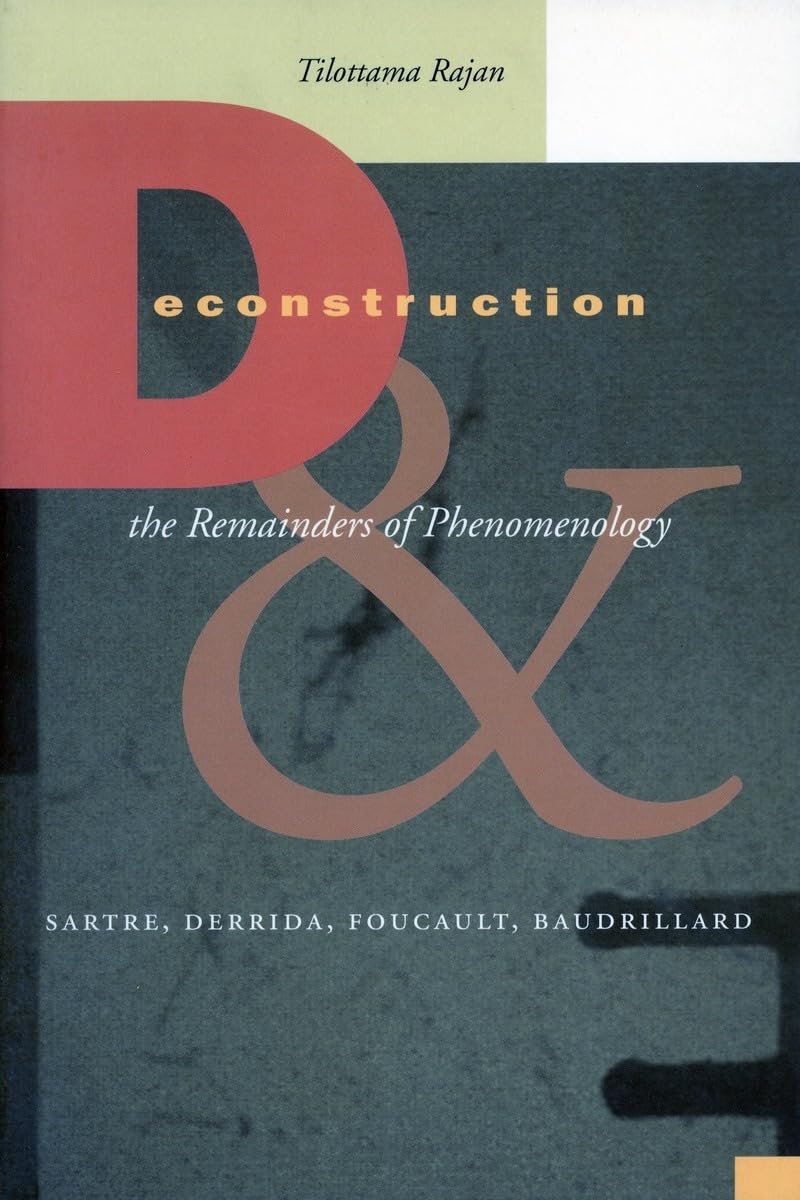
Deconstruction and the Remainders of Phenomenology: Sartre, Derrida, Foucault, Baudrillard,Used
Sold by Ergodebooks, an authorized reseller.
Returns accepted within 30 days | support@ergodebooks.com
Shipping Information
- Free Standard Shipping — United States only
- Processing Time: 3–5 business days
- Estimated Delivery: 6–10 business days after dispatch
- Double-boxed, fully insured & discreetly packaged
- Tracking number sent via email once dispatched
Returns & Refund
Returns accepted within 30 days of delivery.
Damaged or Defective Item
Free return shipping + replacement or full refund
Wrong Item Received
Free return shipping + replacement or full refund
Change of Mind
Return shipping at customer's expense · 25% restocking fee applies
Payment Option

This book disentangles two terms that were conflated in the initial AngloAmerican appropriation of French theory: deconstruction and poststructuralism. Focusing on Sartre, Derrida, Foucault, and Baudrillard (but also considering Levinas, Blanchot, de Man, and others), it traces the turn from a deconstruction inflected by phenomenology to a poststructuralism formed by the rejection of models based on consciousness in favor of ones based on language and structure. The book provides a wideranging and complex genealogy of French theory from the 1940s onward, placing particular emphasis on the largely neglected early work of the theorists involved and on deconstruction's continuing relevance.The author argues that deconstruction is a form of radical, antiscientific modernity: an interdisciplinary reconfiguration of philosophy as it confronted the positivism of the human sciences in the 1960s. By contrast, poststructuralism is a type of postmodern theory inflected by changes in technology and the mode of information. Inasmuch as poststructuralism is founded upon its 'constitutive loss' of phenomenology (in Judith Butler's phrase), the author is also concerned with the ways phenomenology (particularly Sartre's forgotten but seminal Being and Nothingness) is remembered, repeated in different ways, and never quite worked through in its theoretical successors. Thus the book also exemplifies a way of reading intellectual history that is not only concerned with the transmission of concepts, but also with the processes of transference, mourning, and disavowal that inform the relationships between bodies of thought.
⚠️ WARNING (California Proposition 65):
This product may contain chemicals known to the State of California to cause cancer, birth defects, or other reproductive harm.
For more information, please visit www.P65Warnings.ca.gov.