
Title
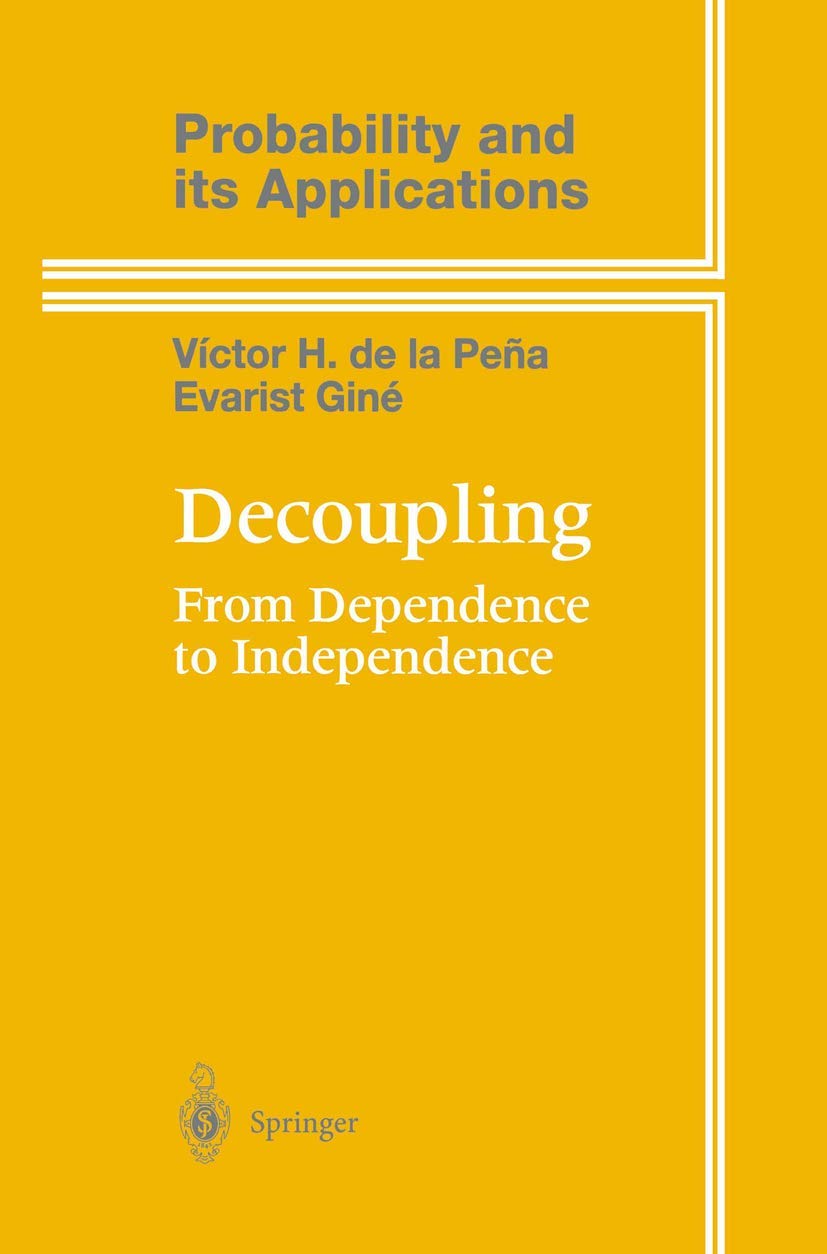
Decoupling: From Dependence to Independence (Probability and Its Applications),New
Sold by Ergodebooks, an authorized reseller.
Returns accepted within 30 days | support@ergodebooks.com
Shipping Information
- Free Standard Shipping — United States only
- Processing Time: 3–5 business days
- Estimated Delivery: 6–10 business days after dispatch
- Double-boxed, fully insured & discreetly packaged
- Tracking number sent via email once dispatched
Returns & Refund
Returns accepted within 30 days of delivery.
Damaged or Defective Item
Free return shipping + replacement or full refund
Wrong Item Received
Free return shipping + replacement or full refund
Change of Mind
Return shipping at customer's expense · 25% restocking fee applies
Payment Option

Decoupling theory provides a general framework for analyzing problems involving dependent random variables as if they were independent. It was born in the early eighties as a natural continuation of martingale theory and has acquired a life of its own due to vigorous development and wide applicability. The authors provide a friendly and systematic introduction to the theory and applications of decoupling. The book begins with a chapter on sums of independent random variables and vectors, with maximal inequalities and sharp estimates on moments which are later used to develop and interpret decoupling inequalities. Decoupling is first introduced as it applies in two specific areas, randomly stopped processes (boundary crossing problems) and unbiased estimation (U statistics and Uprocesses), where it has become a basic tool in obtaining several definitive results. In particular, decoupling is an essential component in the development of the asymptotic theory of U statistics and Uprocesses. The authors then proceed with the theory of decoupling in full generality. Special attention is given to comparison and interplay between martingale and decoupling theory, and to applications. Among other results, the applications include limit theorems, momemt and exponential inequalities for martingales and more general dependence structures, results with biostatistical implications, and moment convergence in Anscombe's theorem and Wald's equation for Ustatistics. This book is addressed to researchers in probability and statistics and to graduate students. The expositon is at the level of a second graduate probability course, with a good portion of the material fit for use in a first year course. Victor de la Pe$a is Associate Professor of Statistics at Columbia University and is one of the more active developers of decoupling
⚠️ WARNING (California Proposition 65):
This product may contain chemicals known to the State of California to cause cancer, birth defects, or other reproductive harm.
For more information, please visit www.P65Warnings.ca.gov.