
Title
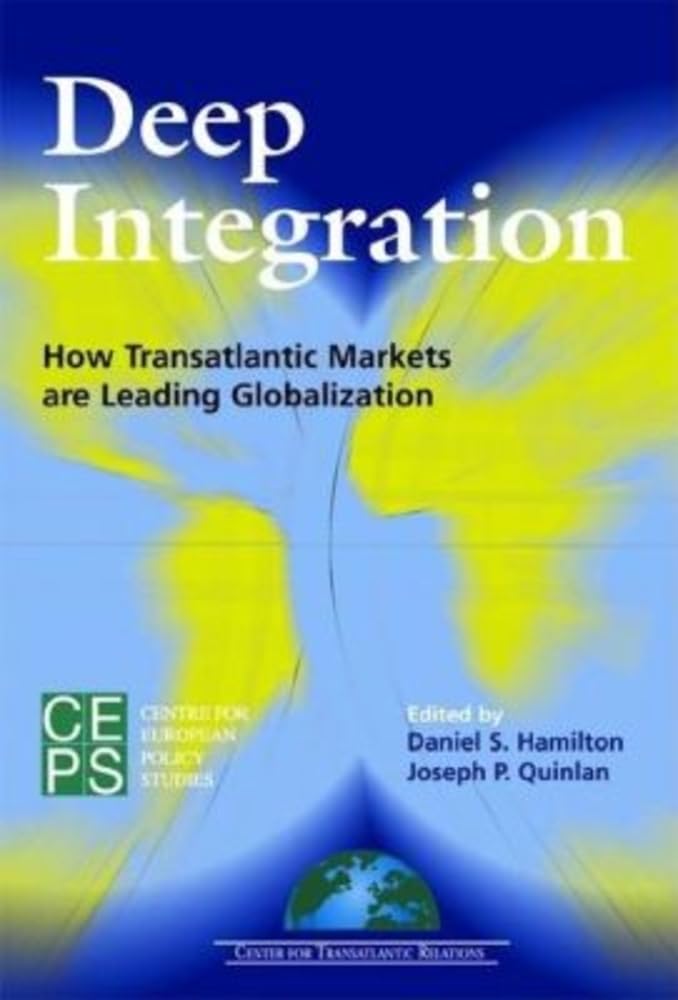
Deep Integration: How Transatlantic Markets are Leading Globalization (Centre for European Policy Studies),Used
Sold by Ergodebooks, an authorized reseller.
Returns accepted within 30 days | support@ergodebooks.com
Shipping Information
- Free Standard Shipping — United States only
- Processing Time: 3–5 business days
- Estimated Delivery: 6–10 business days after dispatch
- Double-boxed, fully insured & discreetly packaged
- Tracking number sent via email once dispatched
Returns & Refund
Returns accepted within 30 days of delivery.
Damaged or Defective Item
Free return shipping + replacement or full refund
Wrong Item Received
Free return shipping + replacement or full refund
Change of Mind
Return shipping at customer's expense · 25% restocking fee applies
Payment Option

One of the defining features of the global economic landscape over the past decade has been the increasing integration and cohesion of the transatlantic economy. Globalization is happening faster and reaching deeper between Europe and America than between any other two continents.Transatlantic markets are the cutting edge of globalization. Key sectors of the transatlantic economy are integrating as never before. Europeans and Americans have become so intertwined that they are literally in each other's business. These linkages underpin a $3 trillion economy that provides up to 14 million ""insourced jobs"" on both sides of the Atlantic. Deep integration, however, can also generate frictions when different systems rub up against each other. Neither the framework for our relationship nor the ways our governments are currently organized adequately capture these new realities.Case studies illustrate the phenomenon of deep transatlantic integration and its implications for a truly free Transatlantic Market in such sectors as aerospace and civil aviation, biopharmaceuticals, services, financial markets and telecommunications, and in such controversial policy areas as climate change and emissions trading, corporate governance and chemicals regulation.Contributors include: Richard Aboulafia (Teal Group), Matthew Dixon (Tyler and Company), Christian Egenhofer (Centre for European Policy Studies), Frederick Erixon (Timbro), Daniel Gros (SAIS Center for Transatlantic Relations, Johns Hopkins University), Arman Khachaturyan (Armenia Telephone Company and CEPS), Karel Lannoo (CEPS), Boaz Moselle (Brattle Group), Thomas Mayer (Deutsche Bank), Joseph A. McCahery (University of Amsterdam), Jacques Pelkmans (College of Europe, Bruges, and Scientific Council for Government Policy, The Hague), James Reitzes (Brattle Group), Andrea Rendo (CEPS), Garel Rhys (Centre for Automotive Industry Research), Dorothy Robyn (Brattle Group), Francoise Simon(Columbia University and SDC Consulting Group), and Michael Tyler (Tyler and Company).
⚠️ WARNING (California Proposition 65):
This product may contain chemicals known to the State of California to cause cancer, birth defects, or other reproductive harm.
For more information, please visit www.P65Warnings.ca.gov.