
Title
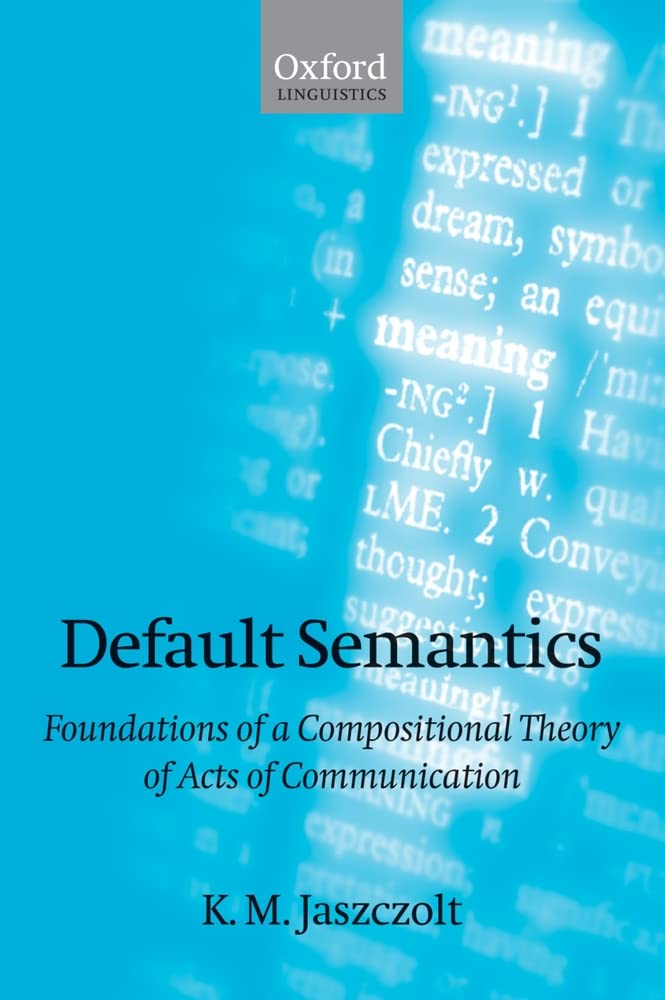
Default Semantics: Foundations of a Compositional Theory of Acts of Communication,Used
Sold by Ergodebooks, an authorized reseller.
Returns accepted within 30 days | support@ergodebooks.com
Shipping Information
- Free Standard Shipping — United States only
- Processing Time: 3–5 business days
- Estimated Delivery: 6–10 business days after dispatch
- Double-boxed, fully insured & discreetly packaged
- Tracking number sent via email once dispatched
Returns & Refund
Returns accepted within 30 days of delivery.
Damaged or Defective Item
Free return shipping + replacement or full refund
Wrong Item Received
Free return shipping + replacement or full refund
Change of Mind
Return shipping at customer's expense · 25% restocking fee applies
Payment Option

In this pioneering book Katarzyna Jaszczolt lays down the foundations of an original theory of meaning in discourse, reveals the cognitive foundations of discourse interpretation, and puts forward a new basis for the analysis of discourse processing. She provides a stepbystep introduction to the theory and its application, and explains new terms and formalisms as required. Dr. Jaszczolt unites the precision of truthconditional, dynamic approaches with insights from neoGricean pragmatics into the role of speaker's intentions in communication. She shows that the compositionality of meaning may be understood as merger representations combining information from various sources including word meaning and sentence structure, various kinds of default interpretations, and conscious pragmatic inference.Among the applications the author discusses are constructions that pose problems in semantic analysis such as referring expressions, propositional attitude constructions, presupposition, modality, numerals, and sentential connectives. She proposes solutions to cutting edge problems in the semantics/pragmatics interface for example, how many levels of meaning should be distinguished; the status of underspecification; how much contextual information should be placed in the representation of the speaker's meaning; whether there are default interpretations; the stage of utterance interpretation at which pragmatic inference begins; and whether compositionality is a necessary feature of the theory of meaning and if so how it is to be defined.The book is for students and researchers in semantics, pragmatics, computational linguistics, and philosophy of language at advanced undergraduate level and above.
⚠️ WARNING (California Proposition 65):
This product may contain chemicals known to the State of California to cause cancer, birth defects, or other reproductive harm.
For more information, please visit www.P65Warnings.ca.gov.