
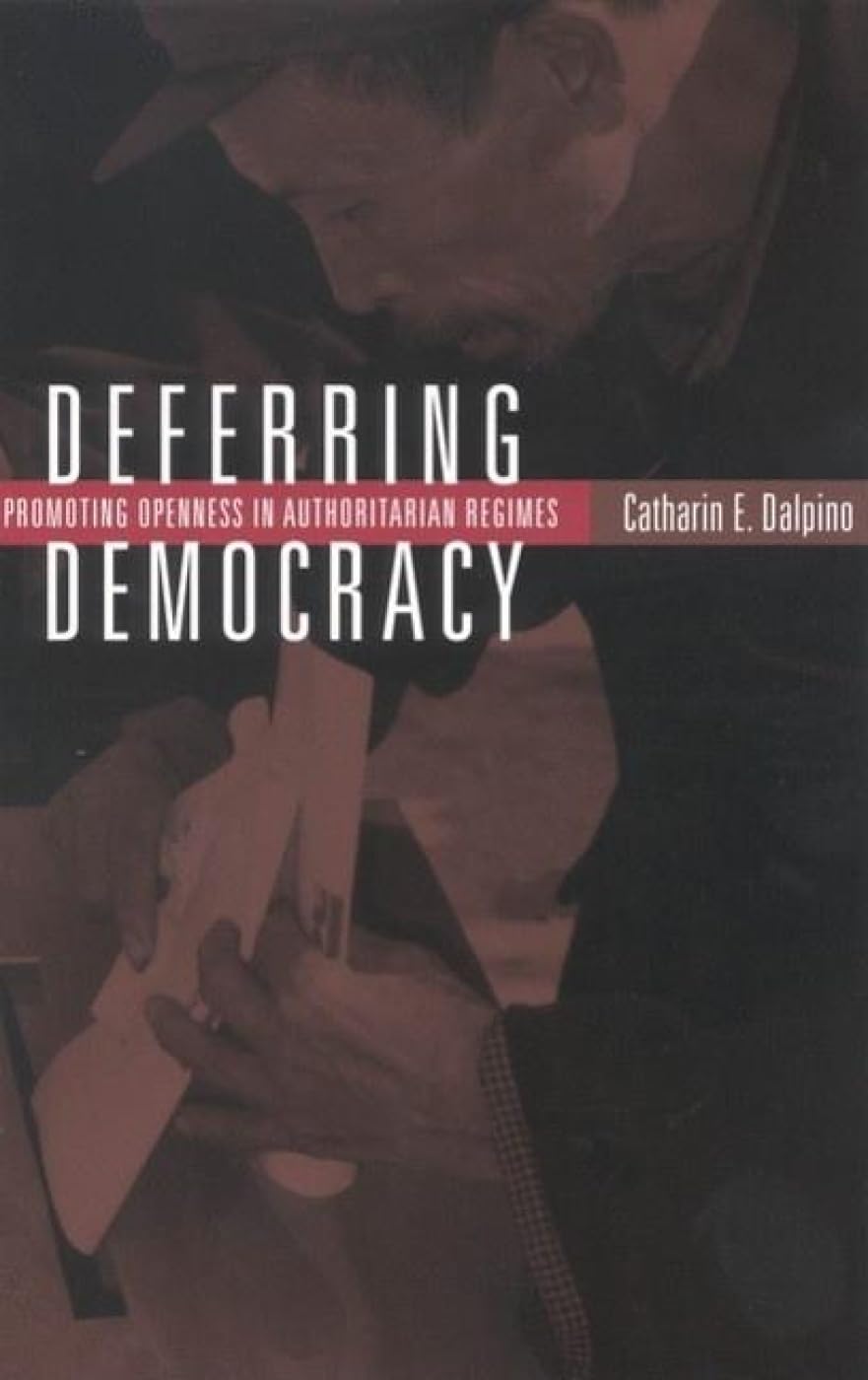
Title
Deferring Democracy: Promoting Openness In Authoritarian Regimes,New
Sold by Ergodebooks, an authorized reseller.
Returns accepted within 30 days | support@ergodebooks.com
Shipping Information
- Free Standard Shipping — United States only
- Processing Time: 3–5 business days
- Estimated Delivery: 6–10 business days after dispatch
- Double-boxed, fully insured & discreetly packaged
- Tracking number sent via email once dispatched
Returns & Refund
Returns accepted within 30 days of delivery.
Damaged or Defective Item
Free return shipping + replacement or full refund
Wrong Item Received
Free return shipping + replacement or full refund
Change of Mind
Return shipping at customer's expense · 25% restocking fee applies
Payment Option

The Democratic Surge In The Past Twenty Years Has Led Many Americans To Assume That All Societies Are, Or Should Be, Making Progress Toward Becoming Practicing Democracies. Many In The United States Approach Countries Such As China, Iran, And Vietnam With Impatience And Bewilderment. These Seemingly Intransigent Holdouts Are The Subject Of Intense Policy Debates, Not In The Least Because They Also Play Important Roles In U.S. Security And Economic Policy. This Book Takes A Fresh Look At The Prospects For Political Change In These Countries And Argues That Immediate Opportunities Exist To Advance Political Liberalization, With The Possibility That Democratization Will Follow In The Mid To Long Term. But To Encourage These Trends, The United States Must Deemphasize Shortterm Human Rights And Democracy Strategies To Focus On More Subtle Attitudinal And Institutional Changes In Both State And Society, And Develop New Policy Measures To Enlarge Political Space.'
⚠️ WARNING (California Proposition 65):
This product may contain chemicals known to the State of California to cause cancer, birth defects, or other reproductive harm.
For more information, please visit www.P65Warnings.ca.gov.
- Q: What is the page count of this book? A: The book contains one hundred four pages. This concise length makes it accessible for readers seeking a quick yet informative read.
- Q: What is the binding type of 'Deferring Democracy'? A: This book is published in paperback binding. Paperback is lightweight and convenient for both casual and academic readers.
- Q: What are the dimensions of this book? A: The book measures six inches in length, zero point thirty-nine inches in width, and nine point zero two inches in height. These dimensions make it easy to handle and store.
- Q: Who is the author of 'Deferring Democracy'? A: The author is Catharin E. Dalpino. She provides insightful analysis on political liberalization in authoritarian regimes.
- Q: What genre does this book belong to? A: This book falls under the Human Rights genre. It offers a critical examination of democracy in challenging political contexts.
- Q: What is the main focus of 'Deferring Democracy'? A: The book focuses on promoting openness in authoritarian regimes. It discusses strategies for political change in countries like China and Iran.
- Q: How can I apply the insights from this book? A: You can apply the insights by understanding how policy measures can enlarge political space in authoritarian contexts. It encourages a nuanced approach to U.S. foreign policy.
- Q: Is this book suitable for academic study? A: Yes, this book is suitable for academic study. Its analysis provides valuable perspectives for students and scholars of political science and international relations.
- Q: What audience is this book intended for? A: This book is intended for readers interested in human rights and democracy. It caters to both general readers and those with a professional interest in political science.
- Q: How should I store this book to keep it in good condition? A: Store the book in a cool, dry place away from direct sunlight. This will help preserve its quality and prevent fading or damage.
- Q: Can I share this book with others? A: Yes, you can share this book with others. It's a great resource for discussions on democracy and political change.
- Q: What should I do if the book arrives damaged? A: If the book arrives damaged, contact the seller for a return or exchange. Most sellers offer a policy for returns on damaged items.
- Q: What is the main thesis of 'Deferring Democracy'? A: The main thesis argues that immediate opportunities exist for advancing political liberalization in authoritarian regimes. It suggests that democratization may follow in the long term.
- Q: Is there a focus on specific countries in the book? A: Yes, the book focuses on countries like China, Iran, and Vietnam. It analyzes the unique challenges and opportunities each country presents for political change.
- Q: What type of discussions does this book encourage? A: The book encourages discussions on U.S. foreign policy and its approach to promoting democracy. It suggests a shift in strategy for better results.