
Title
Degrammaticalization,Used
Sold by Ergodebooks, an authorized reseller.
Returns accepted within 30 days | support@ergodebooks.com
Shipping Information
- Free Standard Shipping — United States only
- Processing Time: 3–5 business days
- Estimated Delivery: 6–10 business days after dispatch
- Double-boxed, fully insured & discreetly packaged
- Tracking number sent via email once dispatched
Returns & Refund
Returns accepted within 30 days of delivery.
Damaged or Defective Item
Free return shipping + replacement or full refund
Wrong Item Received
Free return shipping + replacement or full refund
Change of Mind
Return shipping at customer's expense · 25% restocking fee applies
Payment Option

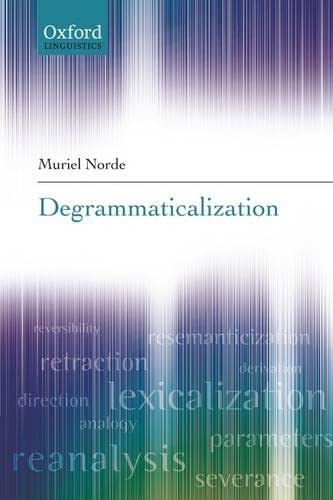
Grammaticalization is a wellattested process of linguistic change in which a lexical item becomes a function word, which may be further reduced to a clitic or affix. Proponents of the universality of grammaticalization have usually argued that it is unidirectional and have thus found it a useful tool in linguistic reconstruction. In this book Professor Norde shows that change is reversible on all levels: semantic, morphological, syntactic, and phonological. As a consequence, the alleged unidirectionality of grammaticalization is not a reliable reconstructional tool, even if degrammaticalization is a rare phenomenon.Degrammaticalization, she argues, is essentially different from grammaticalization: it usually comprises a single change, examples being shifts from affix to clitic, or from function word to lexical item. And where grammaticalization can be seen as a process, degrammaticalization is often the byproduct of other changes. Nevertheless, she shows that it can be described, like grammaticalization, in a principled way, in order to establish whether a change in a word has been from more to less grammatical or vice versa, and the stages by which it has become so. Using data from different languages she constructs a typology of degrammaticalization changes. She explains why degrammaticalization is so rare and why some linguists have such strongly negative feelings about the possibility of its existence. She adds to the understanding of grammaticalization and makes a significant contribution to methods of linguistic reconstruction and the study of language change. She writes clearly, aiming to be understood by advanced undergraduate students as well as appealing to scholars and graduate researchers in historical linguistics.
⚠️ WARNING (California Proposition 65):
This product may contain chemicals known to the State of California to cause cancer, birth defects, or other reproductive harm.
For more information, please visit www.P65Warnings.ca.gov.