
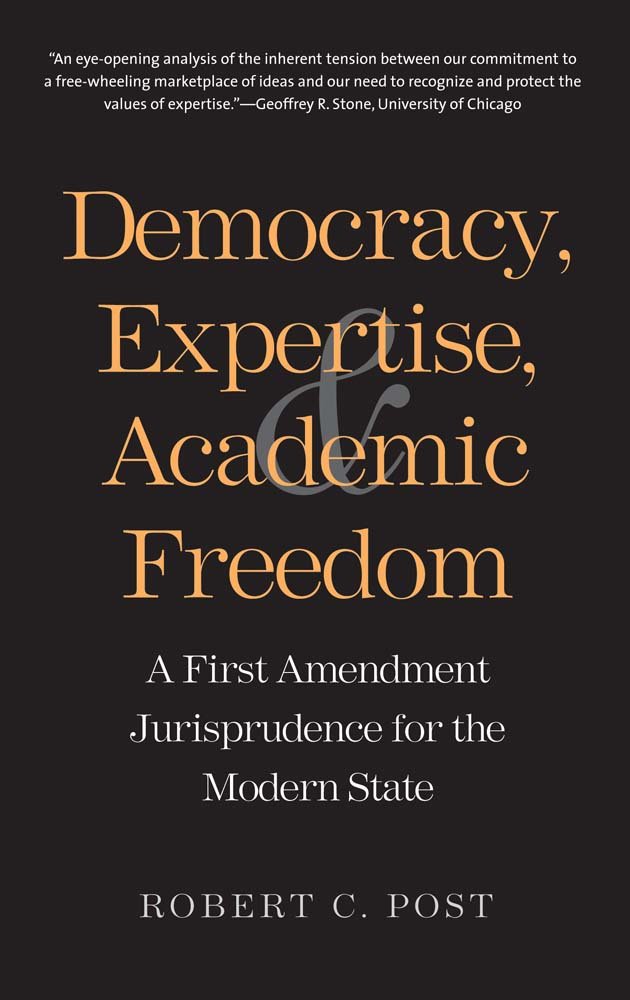
Title
Democracy, Expertise, And Academic Freedom: A First Amendment Jurisprudence For The Modern State,Used
Sold by Ergodebooks, an authorized reseller.
Returns accepted within 30 days | support@ergodebooks.com
Shipping Information
- Free Standard Shipping — United States only
- Processing Time: 1–3 business days
- Estimated Delivery: 3–5 business days after dispatch
- Double-boxed, fully insured & discreetly packaged
- Tracking number sent via email once dispatched
- Orders over $250 require signature upon delivery. Taxes calculated at checkout.
Returns & Refund
Returns accepted within 30 days of delivery.
Damaged or Defective Item
Free return shipping + replacement or full refund
Wrong Item Received
Free return shipping + replacement or full refund
Change of Mind
Return shipping at customer's expense · 25% restocking fee applies
Payment Option

A Leading American Legal Scholar Offers A Surprising Account Of The Incompleteness Of Prevailing Theories Of Freedom Of Speech. Robert C. Post Shows That The Familiar Understanding Of The First Amendment, Which Stresses The Marketplace Of Ideas And Which Holds That 'Everyone Is Entitled To An Opinion,' Is Inadequate To Create And Preserve The Expert Knowledge That Is Necessary For A Modern Democracy To Thrive. For A Modern Society Reliably To Answer Such Questions As Whether Nicotine Causes Cancer, The Free And Open Exchange Of Ideas Must Be Complemented By Standards Of Scientific Competence And Practice That Are Both Hierarchical And Judgmental.Post Develops A Theory Of First Amendment Rights That Seeks To Explain Both The Need For The Free Formation Of Public Opinion And The Need For The Distribution And Creation Of Expertise. Along The Way He Offers A New And Useful Account Of Constitutional Doctrines Of Academic Freedom. These Doctrines Depend Both Upon Free Expression And The Necessity Of The Kinds Of Professional Judgment That Universities Exercise When They Grant Or Deny Tenure, Or That Professional Journals Exercise When They Accept Or Reject Submissions.
⚠️ WARNING (California Proposition 65):
This product may contain chemicals known to the State of California to cause cancer, birth defects, or other reproductive harm.
For more information, please visit www.P65Warnings.ca.gov.
- Q: How many pages are in this book? A: This book contains one hundred seventy-seven pages. It offers a comprehensive exploration of freedom of speech and academic freedom.
- Q: What is the binding type of this book? A: This book is available in paperback binding. Paperback editions are typically flexible and lightweight, making them easy to handle.
- Q: Who is the author of this book? A: The author of this book is Robert C. Post. He is a leading American legal scholar known for his work on the First Amendment.
- Q: What is the main theme of this book? A: The main theme is the relationship between democracy, expertise, and academic freedom. It critiques existing theories of free speech.
- Q: What is the recommended reading level for this book? A: This book is suitable for adult readers, particularly those interested in law and political theory. It delves into complex legal concepts.
- Q: How does this book address academic freedom? A: This book offers a new account of constitutional doctrines of academic freedom. It explores the interplay between free expression and professional judgment.
- Q: How should I store this book? A: Store this book in a dry, cool place away from direct sunlight. This will help preserve its condition and readability over time.
- Q: Can I lend this book to others? A: Yes, you can lend this book to others. Just be sure to keep track of it to avoid losing it.
- Q: Is this book suitable for students? A: Yes, this book is suitable for students studying law, political science, or related fields. It provides valuable insights into First Amendment rights.
- Q: What should I do if the book arrives damaged? A: If the book arrives damaged, contact the seller immediately for a return or replacement. Most sellers have policies for such issues.
- Q: Does this book contain any illustrations? A: No, this book does not contain illustrations. It focuses on text-based analysis of legal theories.
- Q: What is the size of this book? A: The dimensions of this book are approximately seven point nine one inches by five inches by zero point five nine inches. It's a compact size for easy reading.
- Q: Are there any notable quotes in this book? A: Yes, the book contains several notable quotes that reflect its critical analysis of freedom of speech and expertise.
- Q: How often should I read this book? A: You can read this book as often as you like, especially if you're revisiting its themes and arguments for study or discussion.
- Q: What kind of reader would benefit from this book? A: Readers interested in legal theory, democracy, and academic freedom will benefit most from this book. It's particularly relevant for scholars and students.