
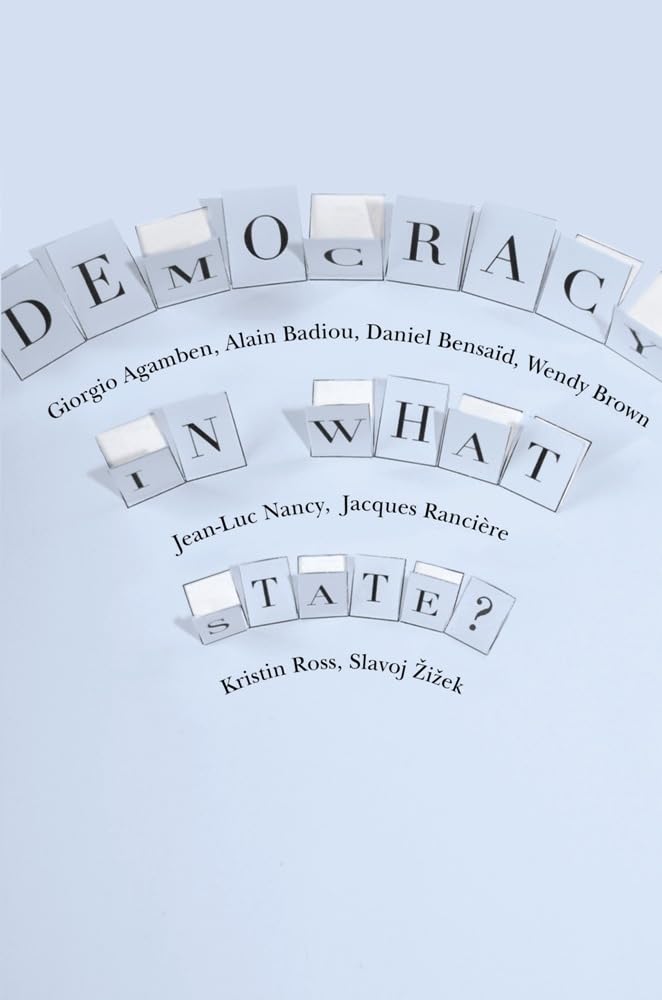
Title
Democracy In What State? (New Directions In Critical Theory, 11)
Sold by Ergodebooks, an authorized reseller.
Returns accepted within 30 days | support@ergodebooks.com
Shipping Information
- Free Standard Shipping — United States only
- Processing Time: 3–5 business days
- Estimated Delivery: 6–10 business days after dispatch
- Double-boxed, fully insured & discreetly packaged
- Tracking number sent via email once dispatched
Returns & Refund
Returns accepted within 30 days of delivery.
Damaged or Defective Item
Free return shipping + replacement or full refund
Wrong Item Received
Free return shipping + replacement or full refund
Change of Mind
Return shipping at customer's expense · 25% restocking fee applies
Payment Option

Is It Meaningful To Call Oneself A Democrat? And If So, How Do You Interpret The Word?In Responding To This Question, Eight Iconoclastic Thinkers Prove The Rich Potential Of Democracy, Along With Its Critical Weaknesses, And Reconceive The Practice To Accommodate New Political And Cultural Realities. Giorgio Agamben Traces The Tense History Of Constitutions And Their Coexistence With Various Governments. Alain Badiou Contrasts Current Democratic Practice With Democratic Communism. Daniel Bensaid Ponders The Institutionalization Of Democracy, While Wendy Brown Discusses The Democratization Of Society Under Neoliberalism. Jeanluc Nancy Measures The Difference Between Democracy As A Form Of Rule And As A Human End, And Jacques Rancire Highlights Its Egalitarian Nature. Kristin Ross Identifies Hierarchical Relationships Within Democratic Practice, And Slavoj Zizek Complicates The Distinction Between Those Who Desire To Own The State And Those Who Wish To Do Without It.Concentrating On The Classical Roots Of Democracy And Its Changing Meaning Over Time And Within Different Contexts, These Essays Uniquely Defend What Is Left Of The Leftwing Tradition After The Fall Of Soviet Communism. They Confront Disincentives To Active Democratic Participation That Have Caused Voter Turnout To Decline In Western Countries, And They Address Electoral Indifference By Invoking And Reviving The Tradition Of Citizen Involvement. Passionately Written And Theoretically Rich, This Collection Speaks To All Facets Of Modern Political And Democratic Debate.
⚠️ WARNING (California Proposition 65):
This product may contain chemicals known to the State of California to cause cancer, birth defects, or other reproductive harm.
For more information, please visit www.P65Warnings.ca.gov.
- Q: What are the dimensions of 'Democracy in What State?' A: The book measures eight point nineteen inches in length, five point fifty-one inches in width, and zero point fifty-one inches in height.
- Q: How many pages does this book have? A: The book contains one hundred forty-four pages, providing a concise yet thorough exploration of democratic theory.
- Q: What is the binding style of this book? A: This book is paperback bound, making it lightweight and easy to handle.
- Q: Who is the author of 'Democracy in What State?' A: The author is Giorgio Agamben, a prominent figure in contemporary philosophy and critical theory.
- Q: What themes are explored in this book? A: The book addresses themes such as democracy, political theory, and citizen involvement, focusing on its evolution and challenges.
- Q: Is this book suitable for beginners in political theory? A: Yes, it is suitable for beginners, as it presents complex ideas in an accessible manner, making it a good starting point.
- Q: How can I apply the concepts from this book in real life? A: You can apply its concepts by engaging in political discussions, participating in local governance, and advocating for democratic practices.
- Q: What age group is this book appropriate for? A: This book is appropriate for adults and college students interested in political theory and democracy.
- Q: How should I store this book to keep it in good condition? A: Store the book upright in a cool, dry place, away from direct sunlight to preserve its quality.
- Q: Can I clean the book's cover? A: Yes, you can gently wipe the cover with a damp cloth to remove dust, but avoid using harsh chemicals.
- Q: What if I receive a damaged copy of the book? A: If your copy arrives damaged, contact the seller for a return or exchange policy to resolve the issue.
- Q: Does this book come with a warranty? A: No, books typically do not come with warranties, but check the seller's return policy for any guarantees.
- Q: Is there a digital version of 'Democracy in What State?' A: Yes, a digital version may be available for e-readers, depending on the publisher's offerings.
- Q: How does this book compare to other works in political theory? A: This book uniquely combines classical democracy roots and contemporary challenges, differentiating it from other political theory texts.
- Q: Is there a specific audience this book targets? A: The book targets scholars, students, and anyone interested in critically examining the concept of democracy.
- Q: What if I have further questions about this book? A: You can reach out to the publisher or consult online resources for more information about the book.