
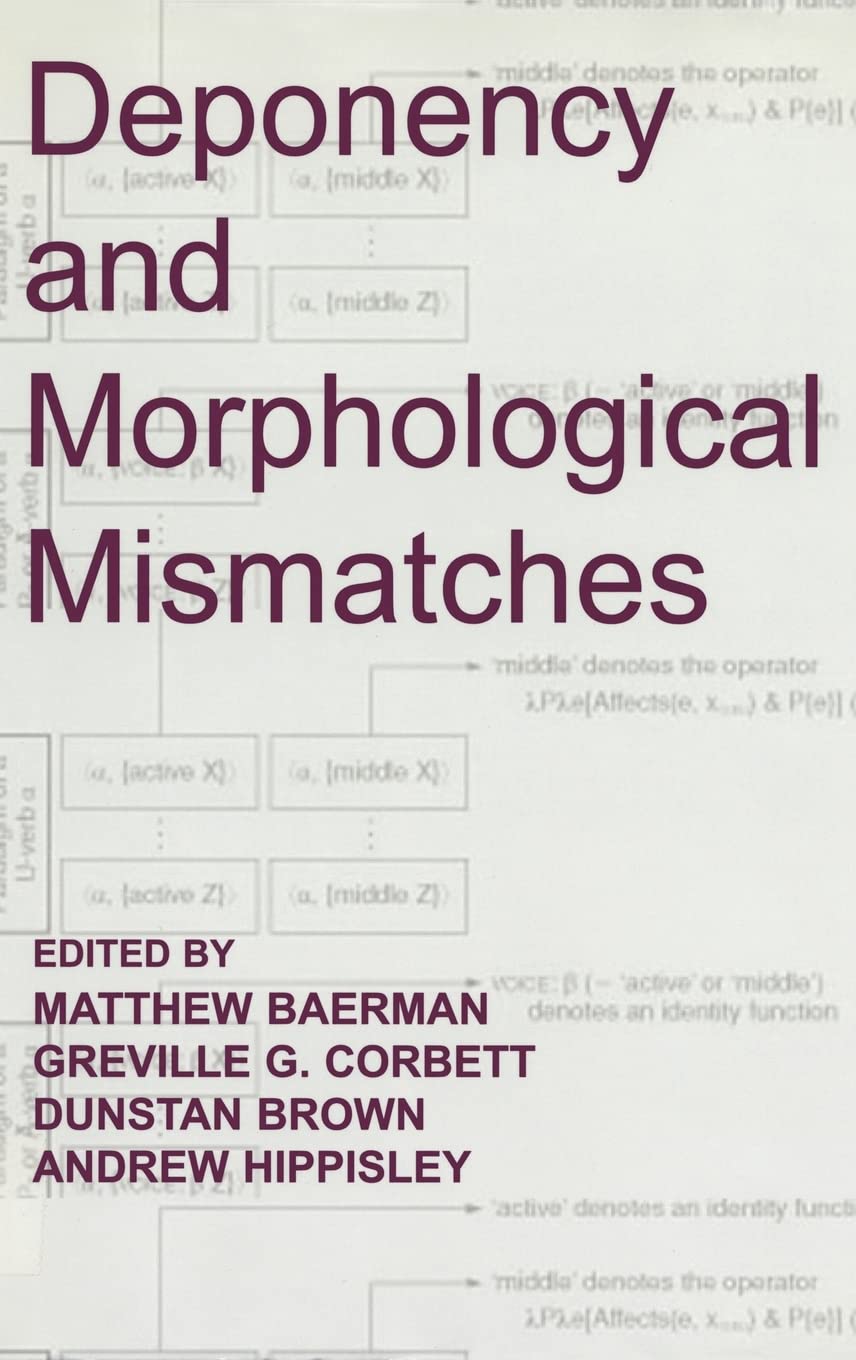
Title
Deponency and Morphological Mismatches (Proceedings of the British Academy),New
Sold by Ergodebooks, an authorized reseller.
Returns accepted within 30 days | support@ergodebooks.com
Shipping Information
- Free Standard Shipping — United States only
- Processing Time: 3–5 business days
- Estimated Delivery: 6–10 business days after dispatch
- Double-boxed, fully insured & discreetly packaged
- Tracking number sent via email once dispatched
Returns & Refund
Returns accepted within 30 days of delivery.
Damaged or Defective Item
Free return shipping + replacement or full refund
Wrong Item Received
Free return shipping + replacement or full refund
Change of Mind
Return shipping at customer's expense · 25% restocking fee applies
Payment Option

Deponency is a mismatch between form and function in language that was first described for Latin, where there is a group of verbs (the deponents) which are morphologically passive but syntactically active. This is evidence of a larger problem involving the interface between syntax and morphology: inflectional morphology is supposed to specify syntactic function, but sometimes it sends out the wrong signal. Although the problem is as old as the Western linguistic tradition, no generally accepted account of it has yet been given, and it is safe to say that all current theories of language have been constructed as if deponency did not exist.In recent years, however, linguists have begun to confront its theoretical implications, albeit largely in isolation from each other. There is as yet no definitive statement of the problem, nor any generally accepted definition of its nature and scope.This volume brings together the findings of leading scholars working in the area of morphological mismatches, and represents the first booklength typological and theoretical treatment of the topic. It will establish the important role that research on deponency has to play in contemporary linguistics, and set the standard for future work.
⚠️ WARNING (California Proposition 65):
This product may contain chemicals known to the State of California to cause cancer, birth defects, or other reproductive harm.
For more information, please visit www.P65Warnings.ca.gov.