
Title
Design And Control Of Distillation Systems For Separating Azeotropes
Sold by Ergodebooks, an authorized reseller.
Returns accepted within 30 days | support@ergodebooks.com
Shipping Information
- Free Standard Shipping — United States only
- Processing Time: 3–5 business days
- Estimated Delivery: 6–10 business days after dispatch
- Double-boxed, fully insured & discreetly packaged
- Tracking number sent via email once dispatched
Returns & Refund
Returns accepted within 30 days of delivery.
Damaged or Defective Item
Free return shipping + replacement or full refund
Wrong Item Received
Free return shipping + replacement or full refund
Change of Mind
Return shipping at customer's expense · 25% restocking fee applies
Payment Option

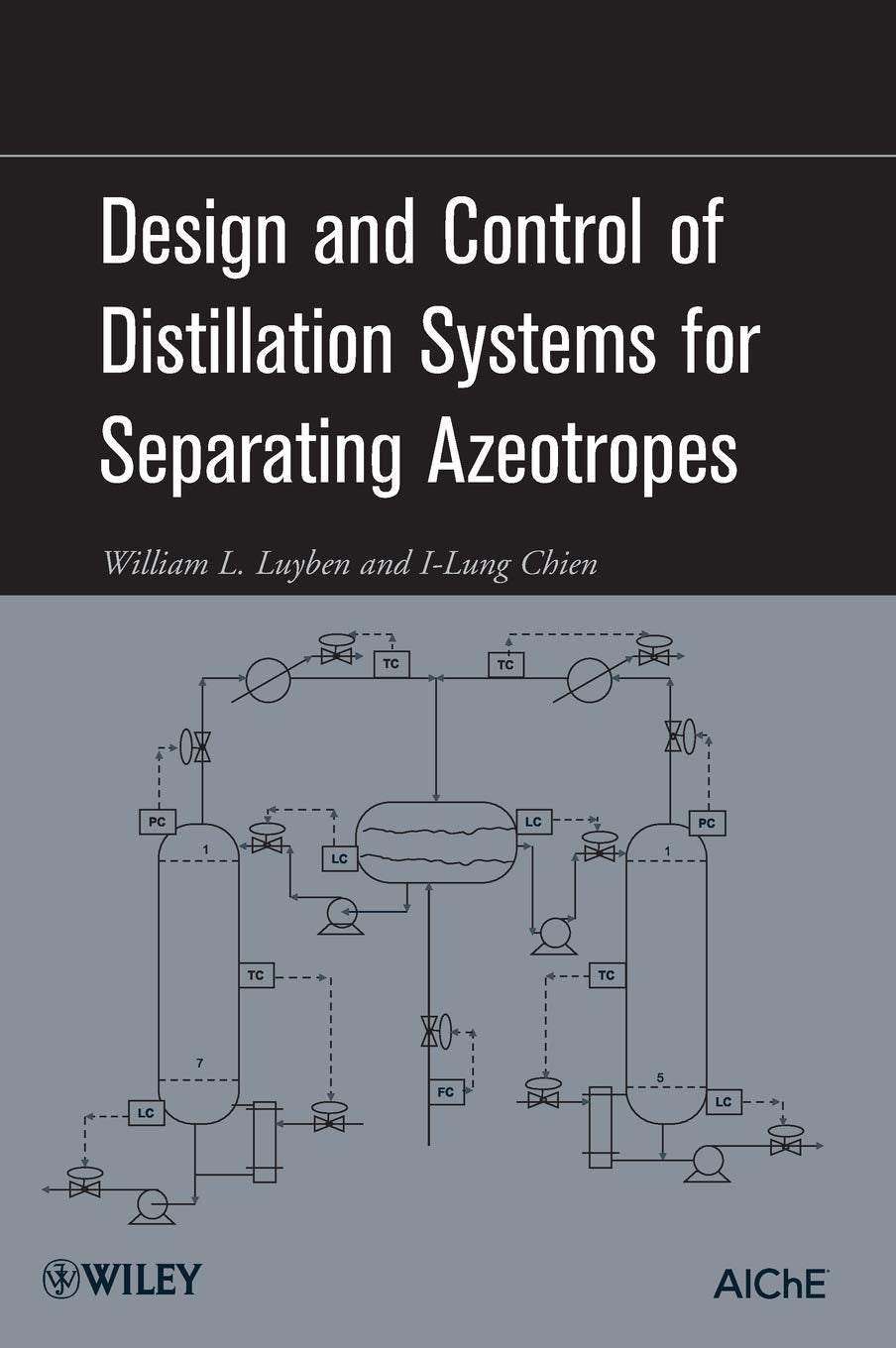
Handson guidance for the design, control, and operation of azeotropic distillation systemsFollowing this book's stepbystep guidance, readers learn to master tested and proven methods to overcome a major problem in chemical processing: the distillation and separation of azeotropes. Practical in focus, the book fully details the design, control, and operation of azeotropic distillation systems, using rigorous steadystate and dynamic simulation tools.Design and Control of Distillation Systems for Separating Azeotropes is divided into five parts:Fundamentals and toolsSeparations without adding other componentsSeparations using light entrainer (heterogeneous azeotropic distillation)Separations using heavy entrainer (extractive distillation)Other ways for separating azeotropesThe distillation methods presented cover a variety of important industrial chemical systems, including the processing of biofuels. For most of these chemical systems, the authors explain how to achieve economically optimum steadystate designs. Moreover, readers learn how to implement practical control structures that provide effective load rejection to manage disturbances in throughput and feed composition.Tradeoffs between steadystate energy savings and dynamic controllability are discussed, helping readers design and implement the distillation system that best meets their particular needs. In addition, economic and dynamic comparisons between alternative methods are presented, including an example of azeotropic distillation versus extractive distillation for the isopropanol/water system.With its focus on practical solutions, Design and Control of Distillation Systems for Separating Azeotropes is ideal for engineers facing a broad range of azeotropic separation problems. Moreover, this book is recommended as a supplemental text for undergraduate and graduate engineering courses in design, control, mass transfer, and bioprocessing.
⚠️ WARNING (California Proposition 65):
This product may contain chemicals known to the State of California to cause cancer, birth defects, or other reproductive harm.
For more information, please visit www.P65Warnings.ca.gov.