
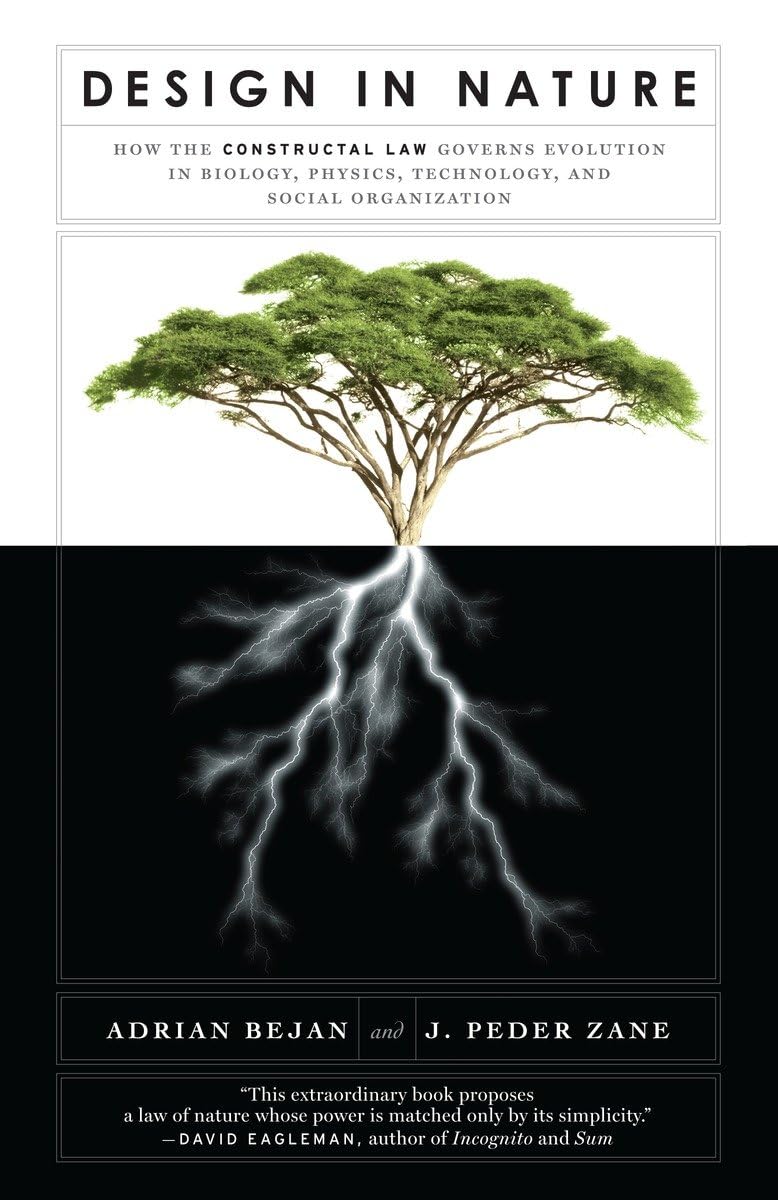
Title
Design In Nature: How The Constructal Law Governs Evolution In Biology, Physics, Technology, And Social Organizations
Sold by Ergodebooks, an authorized reseller.
Returns accepted within 30 days | support@ergodebooks.com
Shipping Information
- Free Standard Shipping — United States only
- Processing Time: 3–5 business days
- Estimated Delivery: 6–10 business days after dispatch
- Double-boxed, fully insured & discreetly packaged
- Tracking number sent via email once dispatched
Returns & Refund
Returns accepted within 30 days of delivery.
Damaged or Defective Item
Free return shipping + replacement or full refund
Wrong Item Received
Free return shipping + replacement or full refund
Change of Mind
Return shipping at customer's expense · 25% restocking fee applies
Payment Option

In This Groundbreaking Book, Adrian Bejan Takes The Recurring Patterns In Naturetrees, Tributaries, Air Passages, Neural Networks, And Lightning Boltsand Reveals How A Single Principle Of Physics, The Constructal Law, Accounts For The Evolution Of These And Many Other Designs In Our World.Everythingfrom Biological Life To Inanimate Systemsgenerates Shape And Structure And Evolves In A Sequence Of Everimproving Designs In Order To Facilitate Flow. River Basins, Cardiovascular Systems, And Bolts Of Lightning Are Very Efficient Flow Systems To Move A Currentof Water, Blood, Or Electricity. Likewise, The More Complex Architecture Of Animals Evolve To Cover Greater Distance Per Unit Of Useful Energy, Or Increase Their Flow Across The Land. Such Designs Also Appear In Human Organizations, Like The Hierarchical Flowcharts Or Reporting Structures In Corporations And Political Bodies. All Are Governed By The Same Principle, Known As The Constructal Law, And Configure And Reconfigure Themselves Over Time To Flow More Efficiently. Written In An Easy Style That Achieves Clarity Without Sacrificing Complexity, Design In Nature Is A Paradigmshifting Book That Will Fundamentally Transform Our Understanding Of The World Around Us.
⚠️ WARNING (California Proposition 65):
This product may contain chemicals known to the State of California to cause cancer, birth defects, or other reproductive harm.
For more information, please visit www.P65Warnings.ca.gov.
- Q: What is the page count of this book? A: This book has three hundred four pages. It provides an in-depth exploration of the constructal law and its applications.
- Q: What are the dimensions of the book? A: The dimensions of the book are five point fifteen inches in length, zero point sixty-three inches in width, and seven point ninety-eight inches in height.
- Q: What type of binding does this book have? A: This book is paperback bound. The binding makes it lightweight and easy to handle.
- Q: Who is the author of this book? A: The author of this book is Adrian Bejan. He is a prominent figure in the fields of biology and physics.
- Q: What genre does this book belong to? A: This book belongs to the Mechanical genre. It combines principles from biology, physics, and technology.
- Q: Is this book suitable for beginners? A: Yes, this book is suitable for beginners. It is written in an easy style that balances clarity and complexity.
- Q: What is the main theme of this book? A: The main theme of this book is the constructal law. It discusses how this principle governs designs in nature and human organizations.
- Q: Can this book be used as a textbook? A: Yes, this book can be used as a textbook. Its comprehensive approach makes it suitable for educational purposes.
- Q: Is this book appropriate for children? A: No, this book is not specifically targeted at children. It discusses complex concepts in biology and physics.
- Q: How should I store this book? A: Store this book in a cool, dry place. Keep it away from direct sunlight to prevent damage to the cover.
- Q: How do I clean this book? A: To clean this book, gently wipe the cover with a dry cloth. Avoid using water or cleaning solutions.
- Q: What if the book arrives damaged? A: If the book arrives damaged, you should contact customer service for a return or exchange. They typically have a straightforward process.
- Q: Does this book come with a warranty? A: No, this book does not come with a warranty. However, you can check the return policy for any issues.
- Q: What should I do if I have a question about the book? A: If you have a question about the book, contact the seller or publisher for assistance. They can provide specific information.
- Q: Is there a glossary or index in the book? A: Yes, the book includes an index. This helps readers locate specific topics related to the constructal law.