
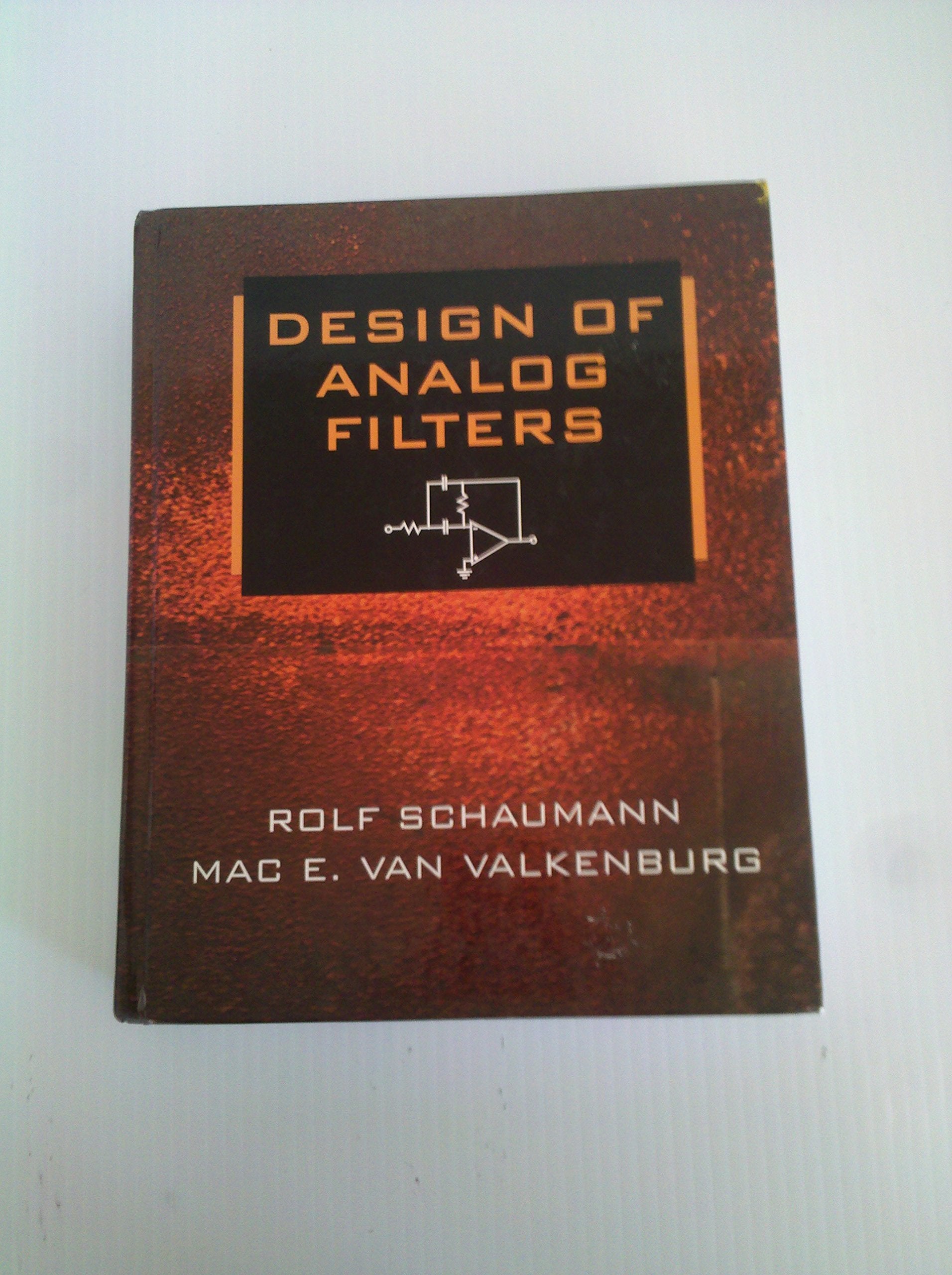
Title


Design Of Analog Filters
Sold by Ergodebooks, an authorized reseller.
Returns accepted within 30 days | support@ergodebooks.com
Shipping Information
- Free Standard Shipping — United States only
- Processing Time: 3–5 business days
- Estimated Delivery: 6–10 business days after dispatch
- Double-boxed, fully insured & discreetly packaged
- Tracking number sent via email once dispatched
Returns & Refund
Returns accepted within 30 days of delivery.
Damaged or Defective Item
Free return shipping + replacement or full refund
Wrong Item Received
Free return shipping + replacement or full refund
Change of Mind
Return shipping at customer's expense · 25% restocking fee applies
Payment Option

Written For Advanced Undergraduate And Firstyear Graduate Courses In Analog Filter Design And Signal Processing, Design Of Analog Filters Integrates Theory And Practice To Provide A Modern And Practical Howto Approach To Design. A Complete Revision Of Mac Van Valkenburg'S Classic Work, Analog Filter Design (1982), This Text Builds On The Presentation And Style Of Its Predecessor, Updating It To Meet The Needs Of Today'S Engineering Students. Reflecting Recent Developments In The Field And Emphasizing Intuitive Understanding, It Provides Readers With An Uptodate Introduction And Design Guidelines And Also Helps Them To Develop A Feel For Analog Circuit Behavior.Design Of Analog Filters Moves Beyond The Simple Treatment Of Active Filters Built With Opamps To Discuss The More Recent Design Of Filters Based On Transconductors. Topics Covered Include Fundamental Concepts; Opamps; First And Secondorder Filters; Secondorder Filters With Arbitrary Transmission Zeros; Filters With Maximally Flat Magnitude, With Equal Ripple (Chebyshev) Magnitude, And With Inverse Chebyshev And Cauer Response Functions; Frequency Transformation; Cascade Designs; Delay Filters And Delay Equalization; Sensitivity; Lc Ladder Filters; Ladder Simulations By Element Replacement And By Operational Simulation; Transconductancec Filters; And Switchedcapacitor Filters.Features* Includes A Wealth Of Examples, All Of Which Have Been Tested On Simulators Or In Actual Industrial Use* Employs Matlab To Minimize Algebraic And Other Computational Needs* Uses Electronics Workbench To Help Students Simulate Actual Experimental Behavior* Provides Sample Design Tables And Design And Performance Curves* Avoids Sophisticated Mathematics Wherever Possible In Favor Of Algebraic Or Intuitive Derivations
⚠️ WARNING (California Proposition 65):
This product may contain chemicals known to the State of California to cause cancer, birth defects, or other reproductive harm.
For more information, please visit www.P65Warnings.ca.gov.
- Q: How many pages does 'Design of Analog Filters' have? A: This book has seven hundred thirty-seven pages. It provides a comprehensive guide to analog filter design and signal processing.
- Q: What is the binding type of this book? A: The binding type is hardcover. This ensures durability and protection for the pages inside.
- Q: What are the dimensions of 'Design of Analog Filters'? A: The dimensions are nine point one inches in length, one point sixty-one inches in width, and seven point one inches in height. These measurements make it a standard-sized textbook.
- Q: Who is the author of 'Design of Analog Filters'? A: The author is Rolf Schaumann. He is a recognized expert in the field of analog filter design.
- Q: What is the primary focus of 'Design of Analog Filters'? A: The primary focus is on advanced undergraduate and first-year graduate courses in analog filter design. It integrates theory and practice effectively for students.
- Q: How does this book help with understanding analog circuit behavior? A: The book helps develop an intuitive understanding of analog circuit behavior through practical examples. It emphasizes design guidelines relevant to modern engineering.
- Q: Is 'Design of Analog Filters' suitable for beginners? A: No, this book is designed for advanced undergraduate and first-year graduate students. It assumes a foundational understanding of analog filter design.
- Q: Can I use MATLAB with this book? A: Yes, the book employs MATLAB to minimize algebraic and computational needs. This enhances the learning experience for students.
- Q: Are there practical examples in this book? A: Yes, there is a wealth of examples included. All have been tested on simulators or in actual industrial use.
- Q: Does this book avoid complex mathematics? A: Yes, it avoids sophisticated mathematics whenever possible. The focus is on algebraic or intuitive derivations.
- Q: How can I simulate experimental behavior while using this book? A: The book uses Electronics Workbench to help students simulate actual experimental behavior. This feature aids in practical understanding.
- Q: What topics are covered in 'Design of Analog Filters'? A: Topics include opamps, first and second-order filters, frequency transformation, and sensitivity among others. It covers both fundamental concepts and advanced designs.
- Q: Is this book a revision of an older work? A: Yes, it is a complete revision of Mac Van Valkenburg's classic work, Analog Filter Design from nineteen eighty-two. It updates the content for modern engineering students.
- Q: What kind of design examples does this book provide? A: The book provides sample design tables and performance curves. These examples are practical and relevant to current engineering practices.
- Q: Does this book include advanced filter topics? A: Yes, it discusses advanced topics like transconductors and switched-capacitor filters. This reflects recent developments in the field.