
Title
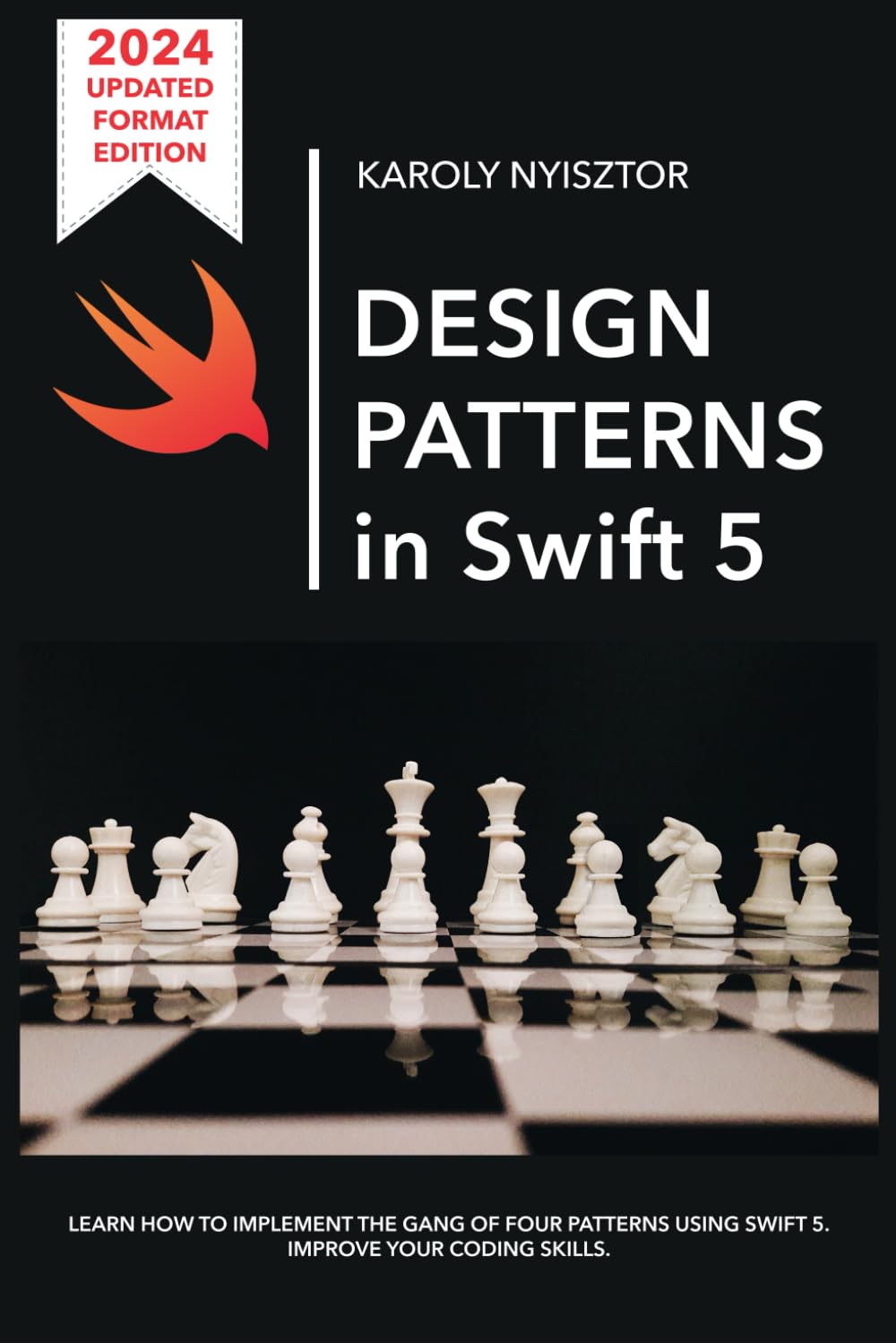
Design Patterns in Swift 5: Learn how to implement the Gang of Four Design Patterns using Swift 5. Improve your coding skills. (,Used
Sold by Ergodebooks, an authorized reseller.
Returns accepted within 30 days | support@ergodebooks.com
Shipping Information
- Free Standard Shipping — United States only
- Processing Time: 3–5 business days
- Estimated Delivery: 6–10 business days after dispatch
- Double-boxed, fully insured & discreetly packaged
- Tracking number sent via email once dispatched
Returns & Refund
Returns accepted within 30 days of delivery.
Damaged or Defective Item
Free return shipping + replacement or full refund
Wrong Item Received
Free return shipping + replacement or full refund
Change of Mind
Return shipping at customer's expense · 25% restocking fee applies
Payment Option

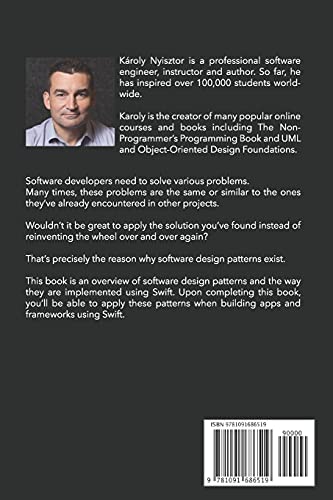
Software developers need to solve various problems. Many times, these problems are the same or similar to the ones theyve already encountered in other projects.Wouldnt it be great to apply the solution youve found instead of reinventing the wheel over and over again?Thats precisely the reason why software design patterns exist. A design pattern is a standardized way to address a recurring problem. Relying on a proven strategy will not only save you time, but you can rest assured that its indeed the right choice.Design patterns are the result of a long evolution process. It all started with a book published in 1994 yes, its that old! called Design Patterns Elements of Reusable ObjectOriented Software. Thats a quite tedious title, so we usually refer to it as the book by the gang of four. The gang consists of four renowned software engineers: Erich Gamma, Ralph Johnson, Richard Helm, and John Vlissides. They identified the most significant common issues that occurred in multiple projects and developed best practices to solve them.The best part: these solutions are (programming) languageagnostic. You can use the design patterns with any objectoriented programming language.Many modern programming languages and frameworks have integrated the GoF patterns. You dont have to write additional code to support say the Iterator or the Observer.Swift is no exception: it provides many advanced language features and constructs such as type extensions, lazy initialization, and predefined protocols that let us adopt and integrate the design patterns into our projects easily.This book covers all these topics and teaches best practices you can apply in your upcoming projects.Well talk about the benefits of understanding and applying the design patterns, the value they provide, and also about their limitations.Then, we delve into the creational design patterns:the Singleton, the Prototype, the Factory Method, the Builder, and the Abstract Factory design patternWere going to take a closer look at the structural design patterns. We discuss:the Adapter, the Decorator, the Faade, the Flyweight, and the Proxy patternIn the final part of this book, we discuss the behavioral design patterns:the Chain of Responsibility, the Iterator, the Observer, and we finish with the State design patternFor each design pattern, we discuss the following:When to use the specific design pattern? How can it be implemented using Swift 5? What are the challenges and pitfalls of using the given pattern?Throughout the book, I provide coding examples that can be applied in realworld situations.Kroly Nyisztor is a veteran software engineer and instructor.He has worked with large companies such as Apple, Siemens, and SAP. Kroly has designed and built several enterprise frameworks, and he holds twelve patents related to inventions in the field of mobile computing.After 18 years, he left the corporate world to start his own business.Since 2016, he's fully committed to teaching. As an instructor, he aims to share his 20+ years of software development expertise. Kroly teaches:Software Architecture, ObjectOriented Programming and Design Swift and iOS Programming, and other, programmingrelated topicsYou can find Kroly Nyisztor's courses and books on all major platforms including Amazon, Lynda, LinkedIn Learning, Pluralsight, Udemy, and iTunes.
⚠️ WARNING (California Proposition 65):
This product may contain chemicals known to the State of California to cause cancer, birth defects, or other reproductive harm.
For more information, please visit www.P65Warnings.ca.gov.