
Title
Designing an Efficient Management System: Modeling of Convergence Factors Exemplified by the Case of Japanese Businesses in Thai,Used
Sold by Ergodebooks, an authorized reseller.
Returns accepted within 30 days | support@ergodebooks.com
Shipping Information
- Free Standard Shipping — United States only
- Processing Time: 3–5 business days
- Estimated Delivery: 6–10 business days after dispatch
- Double-boxed, fully insured & discreetly packaged
- Tracking number sent via email once dispatched
Returns & Refund
Returns accepted within 30 days of delivery.
Damaged or Defective Item
Free return shipping + replacement or full refund
Wrong Item Received
Free return shipping + replacement or full refund
Change of Mind
Return shipping at customer's expense · 25% restocking fee applies
Payment Option

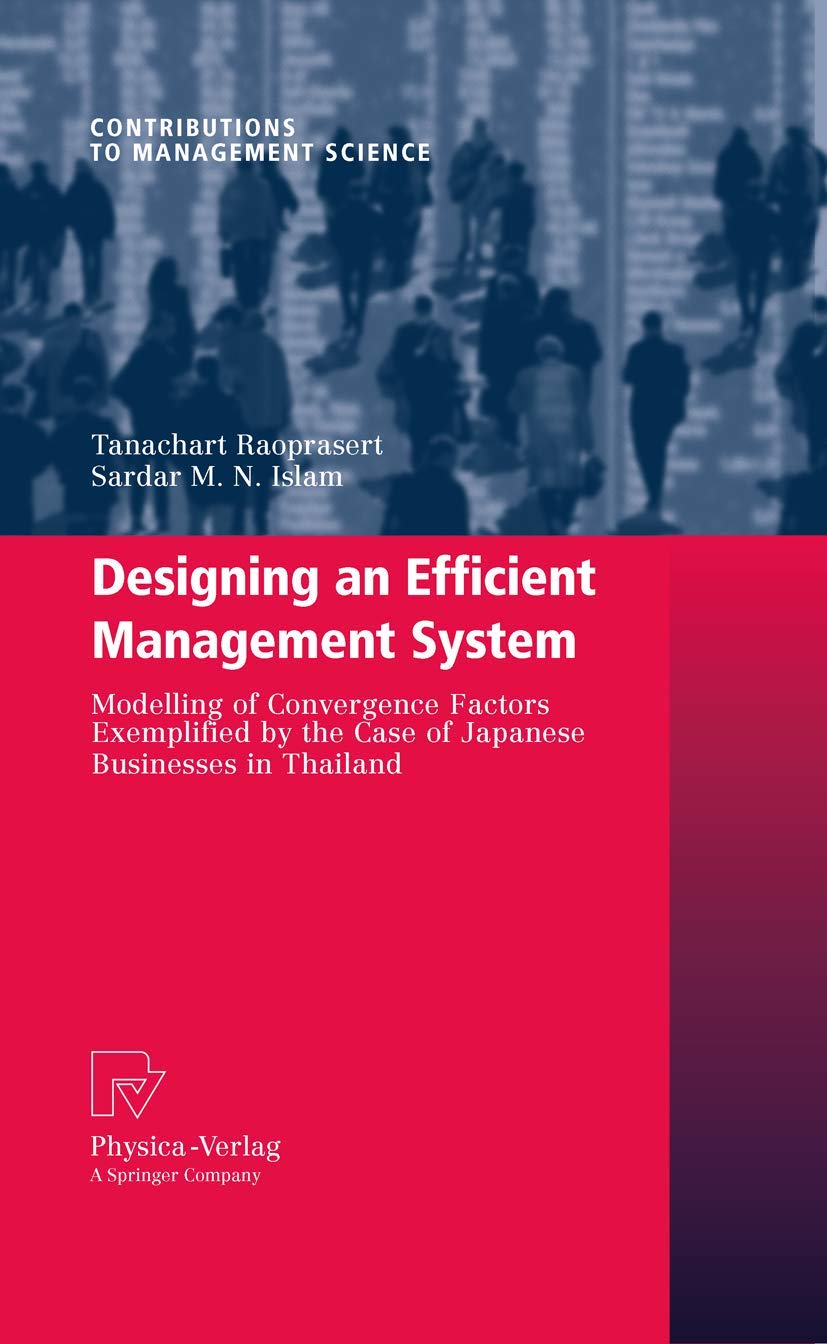
Product Description 1. 1 Background of the Study: Ef?ciency in CrossCultural International Business Management Ef?cient business management is crucial in achieving corporate (national or int national/multinational) goals such as higher value, comprehensiveness, corporate governance, etc. Ef?cient business management can be achieved by resolving agency problems existing among different stakeholders in corporations. In inter tional business, agency problems may exist between managers, owners, staff, and other stakeholders who come from different cultures. Therefore, there is a need in designing ef?cient management of international business by in?uencing the factors (the convergence factors) which cause differences in the interests and cultures of different stakeholders. International business refers to all commercial transactions between two or more nations. Because it comprises a large and growing portion of current world business practice, international business has received considerable attention in academic research (Daniels and Radebaugh 1998). International bu ness differs in important ways from business conducted within national borders, and poses additional challenges to managers and investors in foreign countries (Mahoney et al. 1998). In this context, Black et al. (1999) state that effective management is increasingly recognized as a key determinant of success or failure, arguing that the success of international business in multinational companies depends most signi?cantly on the quality of management systems (Stroh and Caligiuri 1998). As international business involves people from different cultures, every business function including managing a workforce, marketing output, and dealing with regulators, has the potential to involve crosscultural problems (Zineldin 2007). From the Back Cover This book makes a significant and valuable contribution to the literature in the fields of organisational behaviour and design, performance analysis and structural equation modelling. The subject of this book is the development of an efficient and effective management system in the globalised world in order to improve overall organizational performance to achieve good corporate governance by reducing agency costs in a crosscultural environment. Based on an empirical case study of Japanese management practices in Thailand, it examines factors that help to adapt management practices to the work culture of the host country and motivate local employees to adapt and implement unfamiliar management practices. The book provides a new methodological approach by applying structural equation modeling to psychosocial and motivational constructs of organizational performance, and thus presents an innovative behavioral framework of organizations in a contemporary crosscultural setting.
⚠️ WARNING (California Proposition 65):
This product may contain chemicals known to the State of California to cause cancer, birth defects, or other reproductive harm.
For more information, please visit www.P65Warnings.ca.gov.