If you have any questions, you are always welcome to contact us. We'll get back to you as soon as possible, withing 24 hours on weekdays.
Customer service
All questions about your order, return and delivery must be sent to our customer service team by e-mail at yourstore@yourdomain.com
Sale & Press
If you are interested in selling our products, need more information about our brand or wish to make a collaboration, please contact us at press@yourdomain.com
Help
If you have any questions, you are always welcome to contact us. We'll get back to you as soon as possible, withing 24 hours on weekdays.
Customer service
All questions about your order, return and delivery must be sent to our customer service team by e-mail at yourstore@yourdomain.com
Sale & Press
If you are interested in selling our products, need more information about our brand or wish to make a collaboration, please contact us at press@yourdomain.com
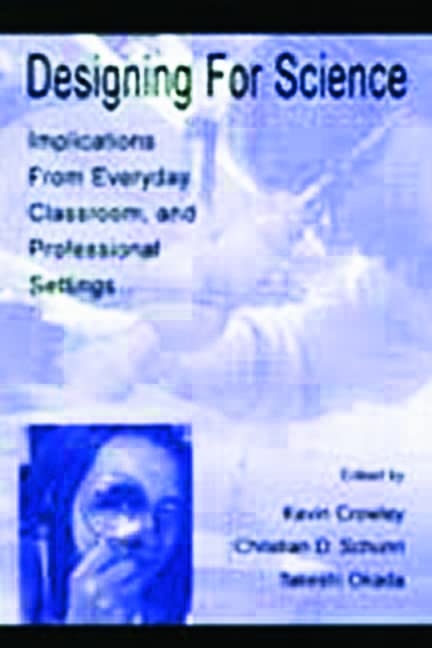
This volume explores the integration of recent research on everyday, classroom, and professional scientific thinking. It brings together an international group of researchers to present core findings from each context; discuss connections between contexts, and explore structures; technologies, and environments to facilitate the development and practice of scientific thinking. The chapters focus on:* situations from young children visiting museums,* middleschool students collaborating in classrooms,* undergraduates learning about research methods, and* professional scientists engaged in cuttingedge research.A diverse set of approaches are represented, including sociocultural description of situated cognition, cognitive enthnography, educational design experiments, laboratory studies, and artificial intelligence. This unique mix of work from the three contexts deepens our understanding of each subfield while at the same time broadening our understanding of how each subfield articulates with broader issues of scientific thinking. To provide a common focus for exploring connections between everyday, instructional, and professional scientific thinking, the book uses a "practical implications" subtheme. In particular, each chapter has direct implications for the design of learning environments to facilitate scientific thinking.
⚠️ WARNING (California Proposition 65):
This product may contain chemicals known to the State of California to cause cancer,
birth defects, or other reproductive harm.
For MAP (Minimum Advertised Price) violations and Intellectual Property (IP) or Trademark concerns, please contact:
support@ergodebooks.com
⚠️ California Proposition 65 Warning: Some products sold on this website may expose you to chemicals known to the State of California to cause cancer, birth defects, or other reproductive harm. For more information, visit www.P65Warnings.ca.gov.