
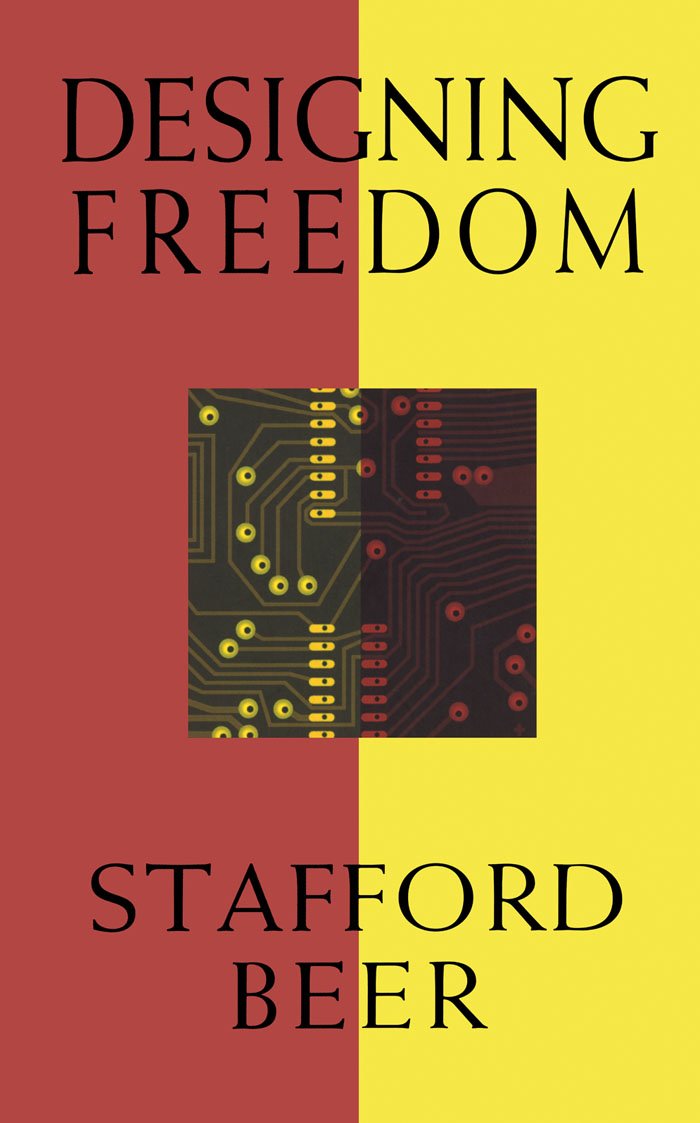
Title
Designing Freedom (The CBC Massey Lectures),New
Sold by Ergodebooks, an authorized reseller.
Returns accepted within 30 days | support@ergodebooks.com
Shipping Information
- Free Standard Shipping — United States only
- Processing Time: 3–5 business days
- Estimated Delivery: 6–10 business days after dispatch
- Double-boxed, fully insured & discreetly packaged
- Tracking number sent via email once dispatched
Returns & Refund
Returns accepted within 30 days of delivery.
Damaged or Defective Item
Free return shipping + replacement or full refund
Wrong Item Received
Free return shipping + replacement or full refund
Change of Mind
Return shipping at customer's expense · 25% restocking fee applies
Payment Option

Distinguished cyberneticist Stafford Beer states the case for a new science of systems theory and cybernetics. His essays examine such issues as 'The Real Threat to All We Hold Most Dear,' 'The Discarded Tools of Modern Man,' 'A Liberty Machine in Prototype,' 'Science in the Service of Man,' 'The Future That Can Be Demanded Now,' and 'The Free Man in a Cybernetic World.'
⚠️ WARNING (California Proposition 65):
This product may contain chemicals known to the State of California to cause cancer, birth defects, or other reproductive harm.
For more information, please visit www.P65Warnings.ca.gov.
- Q: How many pages does 'Designing Freedom' have? A: This book has one hundred ten pages. It's a concise read that delves into systems theory and cybernetics.
- Q: What is the binding type of 'Designing Freedom'? A: The binding type is paperback. This makes it lightweight and easy to carry.
- Q: Who is the author of 'Designing Freedom'? A: The author is Stafford Beer. He is a distinguished cyberneticist known for his insightful essays.
- Q: What themes are explored in 'Designing Freedom'? A: The book explores themes like systems theory, cybernetics, and societal issues. It discusses the role of science in service to humanity.
- Q: What is the size of 'Designing Freedom'? A: The book measures four point eight inches in length, zero point five one inches in width, and seven point eight inches in height. This compact size makes it easy to handle.
- Q: Is 'Designing Freedom' suitable for beginners? A: Yes, it is suitable for beginners interested in systems theory. The essays are accessible and thought-provoking.
- Q: What kind of audience would appreciate 'Designing Freedom'? A: Readers interested in management science and theory will appreciate this book. It offers valuable insights into complex societal issues.
- Q: How can I benefit from reading 'Designing Freedom'? A: You can gain understanding of systems theory and cybernetics. The essays encourage critical thinking about societal values and future possibilities.
- Q: What is the condition of the book? A: The book is described as 'Used Book in Good Condition.' It should be functional and readable.
- Q: How do I store 'Designing Freedom' to keep it in good condition? A: Store it in a cool, dry place away from direct sunlight. This helps preserve the paperback binding and pages.
- Q: Is there a warranty or return policy for 'Designing Freedom'? A: Typically, used books have a return policy depending on the seller. Check with the retailer for specific details.
- Q: What should I do if 'Designing Freedom' arrives damaged? A: Contact the seller immediately for resolution. Most retailers will offer a return or exchange for damaged items.
- Q: Can I read 'Designing Freedom' on the go? A: Yes, its lightweight and compact size makes it perfect for reading on the go. You can easily carry it in a bag.
- Q: Is 'Designing Freedom' appropriate for academic study? A: Yes, it is appropriate for academic study in fields like management science and cybernetics. It provides foundational insights.
- Q: What makes 'Designing Freedom' a unique read? A: Its unique perspective on systems theory and the intersection with societal values sets it apart. Stafford Beer's insights are thought-provoking.