
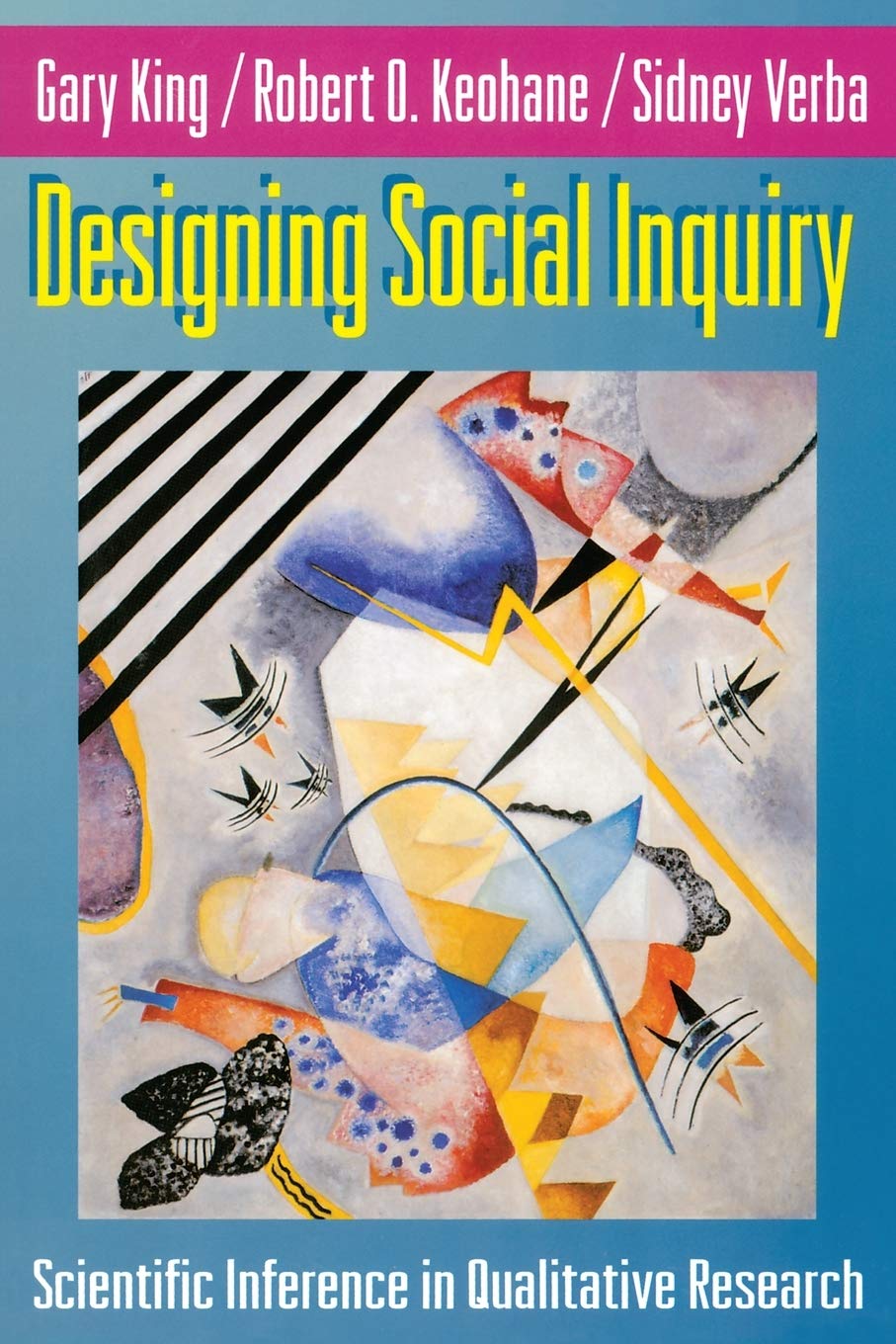
Title


Designing Social Inquiry: Scientific Inference in Qualitative Research,New
Sold by Ergodebooks, an authorized reseller.
Returns accepted within 30 days | support@ergodebooks.com
Shipping Information
- Free Standard Shipping — United States only
- Processing Time: 1–3 business days
- Estimated Delivery: 3–5 business days after dispatch
- Double-boxed, fully insured & discreetly packaged
- Tracking number sent via email once dispatched
- Orders over $250 require signature upon delivery. Taxes calculated at checkout.
Returns & Refund
Returns accepted within 30 days of delivery.
Damaged or Defective Item
Free return shipping + replacement or full refund
Wrong Item Received
Free return shipping + replacement or full refund
Change of Mind
Return shipping at customer's expense · 25% restocking fee applies
Payment Option

While heated arguments between practitioners of qualitative and quantitative research have begun to test the very integrity of the social sciences, Gary King, Robert Keohane, and Sidney Verba have produced a farsighted and timely book that promises to sharpen and strengthen a wide range of research performed in this field. These leading scholars, each representing diverse academic traditions, have developed a unified approach to valid descriptive and causal inference in qualitative research, where numerical measurement is either impossible or undesirable. Their book demonstrates that the same logic of inference underlies both good quantitative and good qualitative research designs, and their approach applies equally to each.Providing precepts intended to stimulate and discipline thought, the authors explore issues related to framing research questions, measuring the accuracy of data and uncertainty of empirical inferences, discovering causal effects, and generally improving qualitative research. Among the specific topics they address are interpretation and inference, comparative case studies, constructing causal theories, dependent and explanatory variables, the limits of random selection, selection bias, and errors in measurement. Mathematical notation is occasionally used to clarify concepts, but no prior knowledge of mathematics or statistics is assumed. The unified logic of inference that this book explicates will be enormously useful to qualitative researchers of all traditions and substantive fields.
⚠️ WARNING (California Proposition 65):
This product may contain chemicals known to the State of California to cause cancer, birth defects, or other reproductive harm.
For more information, please visit www.P65Warnings.ca.gov.
- Q: How many pages are in this book? A: There are three hundred pages in this book. This length provides a comprehensive exploration of qualitative research methods.
- Q: What are the dimensions of this book? A: The book measures six point twenty-six inches in length, zero point seventy-five inches in width, and nine point twenty-five inches in height. These dimensions make it portable and easy to handle.
- Q: What type of binding does this book have? A: This book has a paperback binding. This type of binding is lightweight and flexible, ideal for casual reading.
- Q: Who are the authors of this book? A: The authors are Gary King, Robert Keohane, and Sidney Verba. They are notable scholars in the field of social sciences.
- Q: What is the main focus of this book? A: The main focus is on scientific inference in qualitative research. The authors aim to unify approaches to valid descriptive and causal inference.
- Q: Can this book help improve my qualitative research? A: Yes, this book provides valuable insights for improving qualitative research. It covers essential topics like causal theories and measurement accuracy.
- Q: Is this book suitable for beginners in research? A: Yes, this book is suitable for beginners. It explains complex concepts in an accessible manner without requiring prior knowledge of mathematics.
- Q: How can I apply the concepts from this book to my research? A: You can apply the concepts by framing research questions and analyzing data accuracy. The book provides practical precepts to guide your research.
- Q: What topics are covered in this book? A: The book covers topics like comparative case studies, selection bias, and errors in measurement. These are crucial for conducting quality research.
- Q: Does this book provide mathematical notation? A: Yes, it occasionally uses mathematical notation. However, no prior knowledge of mathematics or statistics is assumed.
- Q: How should I store this book to keep it in good condition? A: Store the book in a cool, dry place away from direct sunlight. This helps prevent damage from humidity and light exposure.
- Q: Can I return this book if I am not satisfied? A: Yes, you can return the book if you are not satisfied. Check the seller's return policy for specific details.
- Q: What if the book arrives damaged? A: If the book arrives damaged, contact the seller for a replacement or refund. Most sellers provide options for damaged goods.
- Q: Is this book suitable for academic use? A: Yes, this book is suitable for academic use. It offers rigorous insights beneficial for students and researchers alike.
- Q: Does this book address issues of selection bias? A: Yes, it addresses selection bias among other critical research issues. This makes it a valuable resource for conducting valid studies.
- Q: What makes this book unique in its approach? A: Its unique approach lies in unifying valid inference methods across qualitative and quantitative research. This perspective is rare in academic literature.