
Title
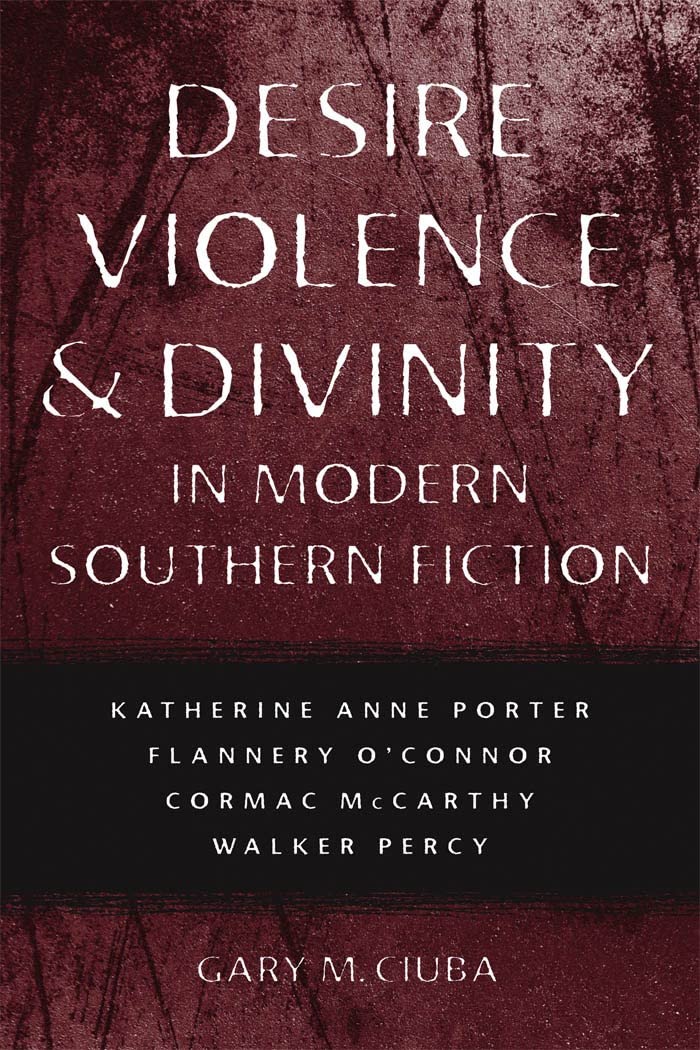
Desire, Violence, and Divinity in Modern Southern Fiction: Katherine Anne Porter, Flannery O'Connor, Cormac McCarthy, Walker Per,Used
Sold by Ergodebooks, an authorized reseller.
Returns accepted within 30 days | support@ergodebooks.com
Shipping Information
- Free Standard Shipping — United States only
- Processing Time: 3–5 business days
- Estimated Delivery: 6–10 business days after dispatch
- Double-boxed, fully insured & discreetly packaged
- Tracking number sent via email once dispatched
Returns & Refund
Returns accepted within 30 days of delivery.
Damaged or Defective Item
Free return shipping + replacement or full refund
Wrong Item Received
Free return shipping + replacement or full refund
Change of Mind
Return shipping at customer's expense · 25% restocking fee applies
Payment Option

In this groundbreaking study, Gary M. Ciuba examines how four of the South's most probing writers of twentiethcentury fiction Katherine Anne Porter, Flannery O'Connor, Cormac McCarthy, and Walker Percy expose the roots of violence in southern culture. Ciuba draws on the paradigm of mimetic violence developed by cultural and literary critic Ren Girard, who maintains that individual human nature is shaped by the desire to imitate a model. Mimetic desire may lead in turn to rivalry, cruelty, and ultimately communitysanctioned and sometimes ritually sanctified victimization of those deemed outcasts. Ciuba offers an impressively broad intellectual discussion that gives universal cultural meaning to the southern experience of desire, violence, and divinity with which these four authors wrestled and out of which they wrote.In a comprehensive analysis of Porter's semiautobiographical Miranda stories, Ciuba focuses on the prescribed role of women that Miranda imitates and ultimately escapes. O'Connor's The Violent Bear It Away reveals three characters whose scandalous animosity caused by religious rivalry leads to the unbearable stumbling block of violence. McCarthy's protagonist in Child of God, Lester Ballard, appears as the culmination of a long tradition of the sacred violence of southern religion, twisted into his own bloody faith. And Percy's The Thanatos Syndrome brings Ciuba's discussion back to the victim, in Tom Moore's renunciation of a society in which scapegoating threatens to become the foundation of a new social regime. From nostalgia for the old order to visions of a utopian tomorrow, these authors have imagined the interrelationship of desire, antagonism, and religion throughout southern history. Ciuba's insights offer new ways of reading Porter, O'Connor, McCarthy, and Percy as well as their contemporaries who inhabited the same culture of violence violence desired, dreaded, denied, and deified.
⚠️ WARNING (California Proposition 65):
This product may contain chemicals known to the State of California to cause cancer, birth defects, or other reproductive harm.
For more information, please visit www.P65Warnings.ca.gov.
- Q: What is the main focus of 'Desire, Violence, and Divinity in Modern Southern Fiction'? A: The book examines how four prominent Southern writers—Katherine Anne Porter, Flannery O'Connor, Cormac McCarthy, and Walker Percy—explore the themes of desire, violence, and divinity in their works, highlighting the roots of violence in Southern culture.
- Q: Who is the author of this book? A: The author of 'Desire, Violence, and Divinity in Modern Southern Fiction' is Gary M. Ciuba.
- Q: How many pages does the book have? A: The book contains 300 pages.
- Q: What is the binding type of this book? A: This book is available in paperback binding.
- Q: When was this book published? A: The book was published on February 4, 2011.
- Q: What condition is the book in? A: The book is listed as 'New' condition.
- Q: What themes are explored in the book? A: The book explores themes of mimetic desire, rivalry, cruelty, victimization, and the interrelationship of desire, antagonism, and religion in the Southern experience.
- Q: Is this book suitable for academic study? A: Yes, the book offers a comprehensive analysis and broad intellectual discussion, making it suitable for academic study of Southern literature and cultural themes.
- Q: What are some key features of the book? A: The book is noted for being a used book in good condition and offers insights into the works of significant Southern authors.
- Q: How does the author approach the works of the featured writers? A: Gary M. Ciuba draws on the paradigm of mimetic violence to analyze each author's portrayal of violence, desire, and their cultural implications, providing new ways to read their works.