
Title
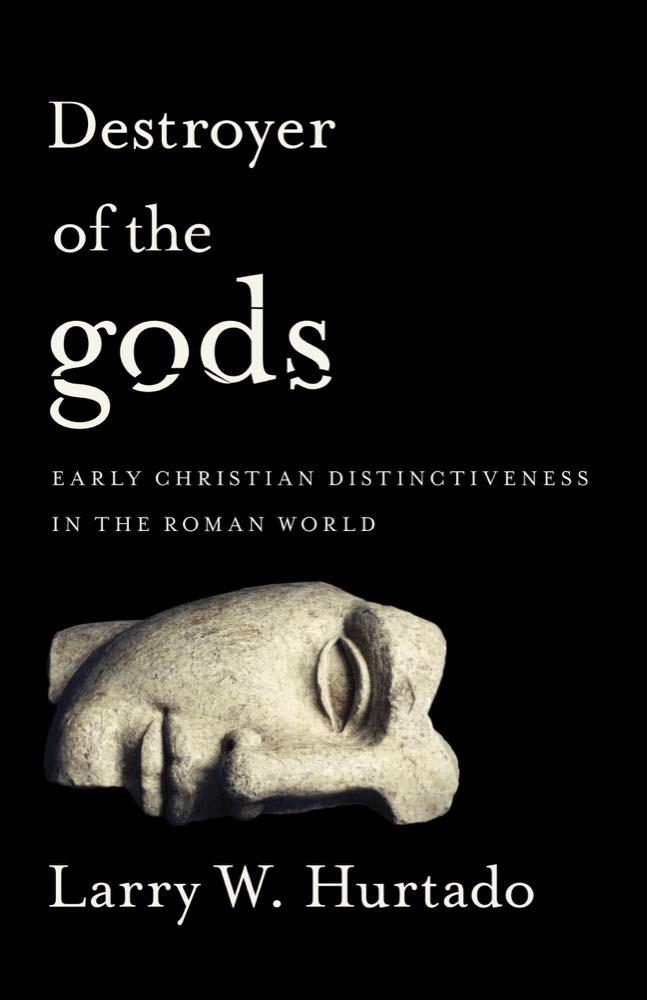
Destroyer of the gods: Early Christian Distinctiveness in the Roman World,New
Sold by Ergodebooks, an authorized reseller.
Returns accepted within 30 days | support@ergodebooks.com
Shipping Information
- Free Standard Shipping — United States only
- Processing Time: 3–5 business days
- Estimated Delivery: 6–10 business days after dispatch
- Double-boxed, fully insured & discreetly packaged
- Tracking number sent via email once dispatched
Returns & Refund
Returns accepted within 30 days of delivery.
Damaged or Defective Item
Free return shipping + replacement or full refund
Wrong Item Received
Free return shipping + replacement or full refund
Change of Mind
Return shipping at customer's expense · 25% restocking fee applies
Payment Option

Silly,' 'stupid,' 'irrational,' 'simple.' 'Wicked,' 'hateful,' 'obstinate,' 'antisocial.' 'Extravagant,' 'perverse.' The Roman world rendered harsh judgments upon early Christianityincluding branding Christianity 'new.' Novelty was no Roman religious virtue.Nevertheless, as Larry W. Hurtado shows in Destroyer of the gods, Christianity thrived despite its new and distinctive features and opposition to them. Unlike nearly all other religious groups, Christianity utterly rejected the traditional gods of the Roman world. Christianity also offered a new and different kind of religious identity, one not based on ethnicity. Christianity was distinctively a 'bookish' religion, with the production, copying, distribution, and reading of texts as central to its faith, even preferring a distinctive bookform, the codex. Christianity insisted that its adherents behave differently: unlike the simple ritual observances characteristic of the pagan religious environment, embracing Christian faith meant a behavioral transformation, with particular and novel ethical demands for men. Unquestionably, to the Roman world, Christianity was both new and different, and, to a good many, it threatened social and religious conventions of the day.In the rejection of the gods and in the centrality of texts, early Christianity obviously reflected commitments inherited from its Jewish origins. But these particular features were no longer identified with Jewish ethnicity and early Christianity quickly became aggressively transethnica novel kind of religious movement. Its ethical teaching, too, bore some resemblance to the philosophers of the day, yet in contrast with these great teachers and their small circles of dedicated students, early Christianity laid its hard demands upon all adherents from the moment of conversion, producing a novel social project.Christianitys novelty was no badge of honor. Called atheists and suspected of political subversion, Christians earned Roman disdain and suspicion in equal amounts. Yet, as Destroyer of the gods demonstrates, in an irony of history the very features of early Christianity that rendered it distinctive and objectionable in Roman eyes have now become so commonplace in Western culture as to go unnoticed. Christianity helped destroy one world and create another.
⚠️ WARNING (California Proposition 65):
This product may contain chemicals known to the State of California to cause cancer, birth defects, or other reproductive harm.
For more information, please visit www.P65Warnings.ca.gov.
- Q: What is the main theme of 'Destroyer of the Gods'? A: The main theme of 'Destroyer of the Gods' is the distinctiveness of early Christianity in the Roman world, highlighting its rejection of traditional Roman gods, its unique religious identity, and the ethical demands it placed on its adherents.
- Q: Who is the author of 'Destroyer of the Gods'? A: The author of 'Destroyer of the Gods' is Larry W. Hurtado, a recognized scholar in the field of early Christianity.
- Q: What type of binding does this book have? A: 'Destroyer of the Gods' is available in a paperback binding, making it accessible for readers who prefer physical copies.
- Q: How many pages are there in 'Destroyer of the Gods'? A: The book contains 304 pages, providing a comprehensive exploration of its subject matter.
- Q: When was 'Destroyer of the Gods' published? A: 'Destroyer of the Gods' was published on May 1, 2017.
- Q: Is this book suitable for academic study? A: Yes, 'Destroyer of the Gods' is suitable for academic study as it provides in-depth analysis and insights into early Christianity, making it valuable for students and scholars of religious studies.
- Q: Does 'Destroyer of the Gods' contain illustrations or images? A: The book does not specifically mention the inclusion of illustrations or images, focusing primarily on text and analysis.
- Q: What makes early Christianity distinct according to the book? A: According to the book, early Christianity is distinct due to its rejection of Roman gods, its emphasis on textual authority, and its trans-ethnic appeal, which contrasts with the ethnic-based identities of other religions.
- Q: Can this book help understand the historical context of early Christianity? A: Yes, 'Destroyer of the Gods' provides a historical context for understanding early Christianity's development and its impact on Roman society.
- Q: What is the significance of the book's title, 'Destroyer of the Gods'? A: The title 'Destroyer of the Gods' signifies early Christianity's challenge to Roman religious traditions and its role in transforming the religious landscape of the time.