
Title

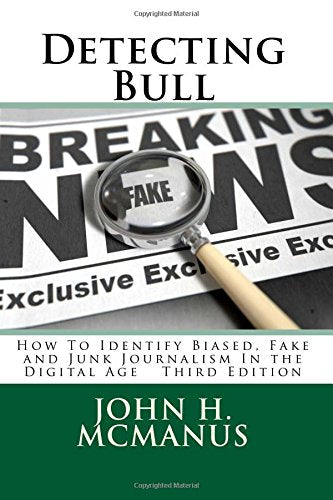
Detecting Bull: How To Identify Biased, Fake and Junk Journalism In the Digital Age,Used
Sold by Ergodebooks, an authorized reseller.
Returns accepted within 30 days | support@ergodebooks.com
Shipping Information
- Free Standard Shipping — United States only
- Processing Time: 3–5 business days
- Estimated Delivery: 6–10 business days after dispatch
- Double-boxed, fully insured & discreetly packaged
- Tracking number sent via email once dispatched
Returns & Refund
Returns accepted within 30 days of delivery.
Damaged or Defective Item
Free return shipping + replacement or full refund
Wrong Item Received
Free return shipping + replacement or full refund
Change of Mind
Return shipping at customer's expense · 25% restocking fee applies
Payment Option

American society is being torn apart by the rise of new sources of news that have no respect for facts or democracy. Coupled with politicians who cast honest journalists as frauds and enemies of the public, they are destroying the informational commons and poisoning the process of reaching consensus that democracy requires. Public trust in professional journalism has fallen to the lowest point since polls began to measure confidence in the news. That makes us prey for unscrupulous media actors who whip up resentment and hatred of fellow Americans with false and distorted news reports that are widely believed. Because each group now has its own set of ?acts,?disputes cannot be resolved logically. We are becoming a nation of warring tribes, even to the point where we no longer wish to associate with each other. As a consequence, lawmakers no longer agree on whats real, much less what to do about it. Congress can no more plot a safe course forward than a squirrel caught in traffic. The only solution that respects freedom of speech and press is to equip all citizens with some basic tools habits of mind allowing them to discern truth from falsehood in this confusing new information environment. Its vital that we learn to critically assess news and information because in a democracy a misinformed vote counts as much as a wise one. This book examines the causes of our divisions and presents a method the SMELL test for separating honest journalism from fake and misleading news. The first edition of Detecting Bull won the Society of Professional Journalists Research Prize in 2009. The author won the same research award in 1994 for MarketDriven Journalism: Let the Citizen Beware? Earlier editions of Detecting Bull have been adopted by universities across the U.S. and in Europe. In addition to the SMELL test for distinguishing reliable news and information from the rest, this book addresses: * The current revolution in communication causing so much turmoil in American politics; * The nature of truth; * Where bias comes from; * The covert bias of news organizations; * Theories of news selection relevant to the 21st century; * Realistic standards for judging news; * How to "read" photos and videos; * Common tricks of spinmeisters and fraudsters; * How to use the full power of the Web to penetrate fake and junk journalism; * How to evaluate the quality of news in any medium. This book will equip you and your students with a BS (Bald Sophistry) meter.
⚠️ WARNING (California Proposition 65):
This product may contain chemicals known to the State of California to cause cancer, birth defects, or other reproductive harm.
For more information, please visit www.P65Warnings.ca.gov.
- Q: What is the page count of this book? A: This book has three hundred thirty-two pages. It provides a comprehensive exploration of biased journalism in the digital age.
- Q: What are the dimensions of 'Detecting Bull'? A: The dimensions are six inches in length, zero point seventy-five inches in width, and nine point zero two inches in height. These measurements make it a standard-sized paperback.
- Q: What type of binding does this book have? A: The book features a paperback binding. This allows for easy handling and reading.
- Q: How can I use the SMELL test discussed in the book? A: You can apply the SMELL test by critically assessing news sources for reliability. The book provides detailed methods to identify trustworthy journalism.
- Q: Is this book suitable for students? A: Yes, this book is suitable for students. It has been adopted by universities across the U.S. and Europe as a resource for understanding media literacy.
- Q: What age group is this book appropriate for? A: This book is appropriate for adults and older teens. It deals with complex themes of journalism and politics.
- Q: How do I maintain this book in good condition? A: To keep the book in good condition, store it in a cool, dry place. Avoid exposing it to direct sunlight to prevent fading.
- Q: Is there any specific care needed for this paperback? A: No specific care is needed for this paperback. Just handle it gently and avoid bending the cover excessively.
- Q: What should I do if the book arrives damaged? A: If the book arrives damaged, contact the seller for a replacement or return. Most sellers have policies in place for damaged items.
- Q: Can I return the book if I'm not satisfied? A: Yes, you can return the book if you're not satisfied. Check the seller's return policy for specific guidelines.
- Q: How does this book compare to other journalism guides? A: This book stands out with its SMELL test method for discerning reliable journalism. It provides unique insights into modern media challenges.
- Q: Is this book focused on any particular type of journalism? A: Yes, the book focuses on identifying biased, fake, and junk journalism. It examines various sources and their reliability.
- Q: What makes this book a valuable resource? A: This book is valuable because it equips readers with tools to critically assess news. It addresses the current state of misinformation.
- Q: Does the author have credibility in journalism? A: Yes, the author, John H. McManus, has won prestigious awards for journalism research. His expertise lends credibility to the book.
- Q: Are there practical exercises in the book? A: Yes, the book includes practical exercises for applying the SMELL test. These exercises enhance understanding of media literacy.
- Q: What topics are covered in this book? A: The book covers topics like the nature of truth, bias in news organizations, and realistic standards for judging news. It provides a comprehensive overview.