
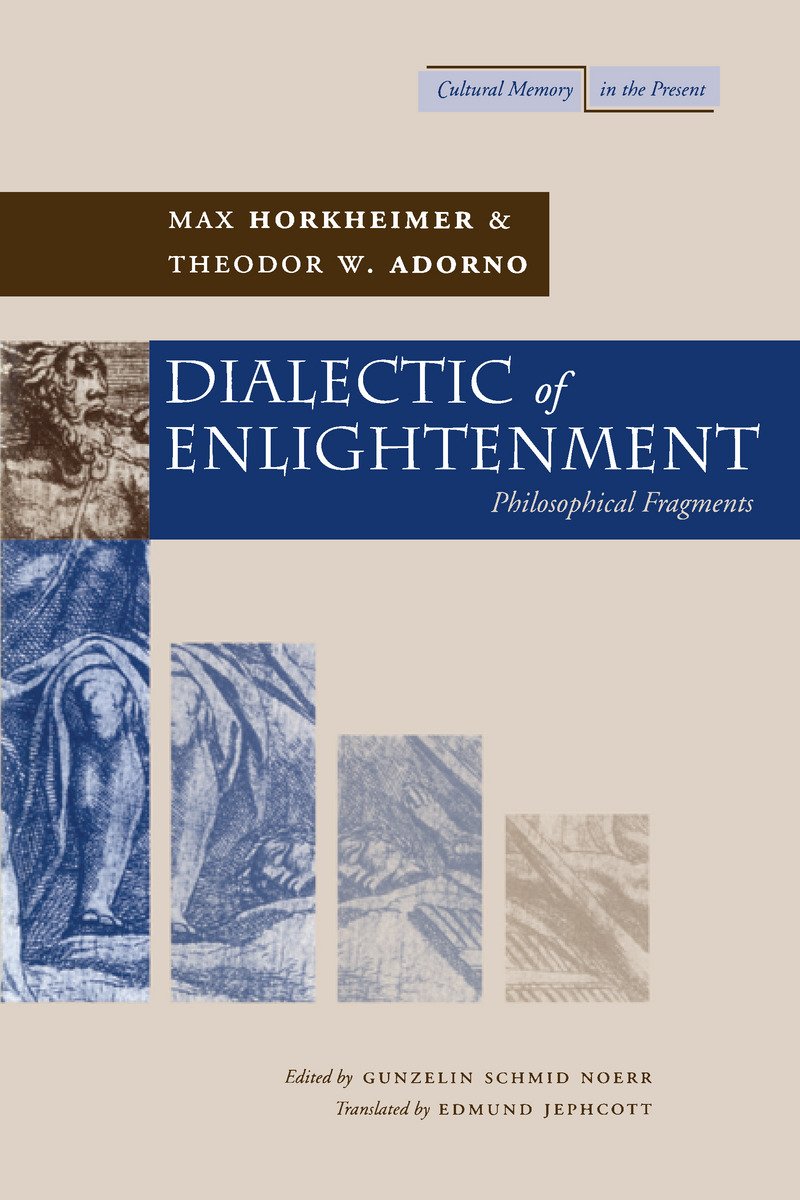
Title
Dialectic of Enlightenment (Cultural Memory in the Present),Used
Sold by Ergodebooks, an authorized reseller.
Returns accepted within 30 days | support@ergodebooks.com
Shipping Information
- Free Standard Shipping — United States only
- Processing Time: 3–5 business days
- Estimated Delivery: 6–10 business days after dispatch
- Double-boxed, fully insured & discreetly packaged
- Tracking number sent via email once dispatched
Returns & Refund
Returns accepted within 30 days of delivery.
Damaged or Defective Item
Free return shipping + replacement or full refund
Wrong Item Received
Free return shipping + replacement or full refund
Change of Mind
Return shipping at customer's expense · 25% restocking fee applies
Payment Option

Dialectic of Enlightenment is undoubtedly the most influential publication of the Frankfurt School of Critical Theory. Written during the Second World War and circulated privately, it appeared in a printed edition in Amsterdam in 1947. 'What we had set out to do,' the authors write in the Preface, 'was nothing less than to explain why humanity, instead of entering a truly human state, is sinking into a new kind of barbarism.'Yet the work goes far beyond a mere critique of contemporary events. Historically remote developments, indeed, the birth of Western history and of subjectivity itself out of the struggle against natural forces, as represented in myths, are connected in a wide arch to the most threatening experiences of the present.The book consists in five chapters, at first glance unconnected, together with a number of shorter notes. The various analyses concern such phenomena as the detachment of science from practical life, formalized morality, the manipulative nature of entertainment culture, and a paranoid behavioral structure, expressed in aggressive antiSemitism, that marks the limits of enlightenment. The authors perceive a common element in these phenomena, the tendency toward selfdestruction of the guiding criteria inherent in enlightenment thought from the beginning. Using historical analyses to elucidate the present, they show, against the background of a prehistory of subjectivity, why the National Socialist terror was not an aberration of modern history but was rooted deeply in the fundamental characteristics of Western civilization.Adorno and Horkheimer see the selfdestruction of Western reason as grounded in a historical and fateful dialectic between the domination of external nature and society. They trace enlightenment, which split these spheres apart, back to its mythical roots. Enlightenment and myth, therefore, are not irreconcilable opposites, but dialectically mediated qualities of both real and intellectual life. 'Myth is already enlightenment, and enlightenment reverts to mythology.' This paradox is the fundamental thesis of the book.This new translation, based on the text in the complete edition of the works of Max Horkheimer, contains textual variants, commentary upon them, and an editorial discussion of the position of this work in the development of Critical Theory.
⚠️ WARNING (California Proposition 65):
This product may contain chemicals known to the State of California to cause cancer, birth defects, or other reproductive harm.
For more information, please visit www.P65Warnings.ca.gov.
- Q: What is the main theme of 'Dialectic of Enlightenment'? A: 'Dialectic of Enlightenment' explores the paradox of enlightenment and myth, arguing that enlightenment thought contains seeds of self-destruction. Adorno and Horkheimer discuss how the principles of enlightenment can lead to new forms of barbarism, particularly in the context of Western civilization's historical development.
- Q: Who are the authors of this book? A: The book is authored by Max Horkheimer and Theodor W. Adorno, prominent figures of the Frankfurt School of Critical Theory.
- Q: What is the publication date of this edition? A: This edition of 'Dialectic of Enlightenment' was published on March 13, 2007.
- Q: How many pages does 'Dialectic of Enlightenment' have? A: The book contains a total of 304 pages.
- Q: What is the binding type of this book? A: 'Dialectic of Enlightenment' is available in paperback binding, making it easy to handle and read.
- Q: What condition is this book in? A: The book is listed as 'New', ensuring that it is in excellent condition with no markings or damage.
- Q: Does this book contain any illustrations or images? A: The primary focus of 'Dialectic of Enlightenment' is on text and analysis, so it does not include illustrations or images.
- Q: Is this book suitable for beginners in critical theory? A: While 'Dialectic of Enlightenment' is foundational in critical theory, it may be challenging for beginners due to its complex themes and historical context. It is recommended for readers with some background in philosophy or critical theory.
- Q: What are the key features of this book? A: Key features of 'Dialectic of Enlightenment' include its deep analysis of enlightenment thought, critique of modern culture, and connections between historical and contemporary issues. This edition also includes textual variants and editorial commentary.
- Q: What is the significance of this book in contemporary discussions? A: 'Dialectic of Enlightenment' remains highly relevant in contemporary discussions about culture, society, and the implications of enlightenment thought, particularly in understanding phenomena like consumerism and authoritarianism in modern contexts.