
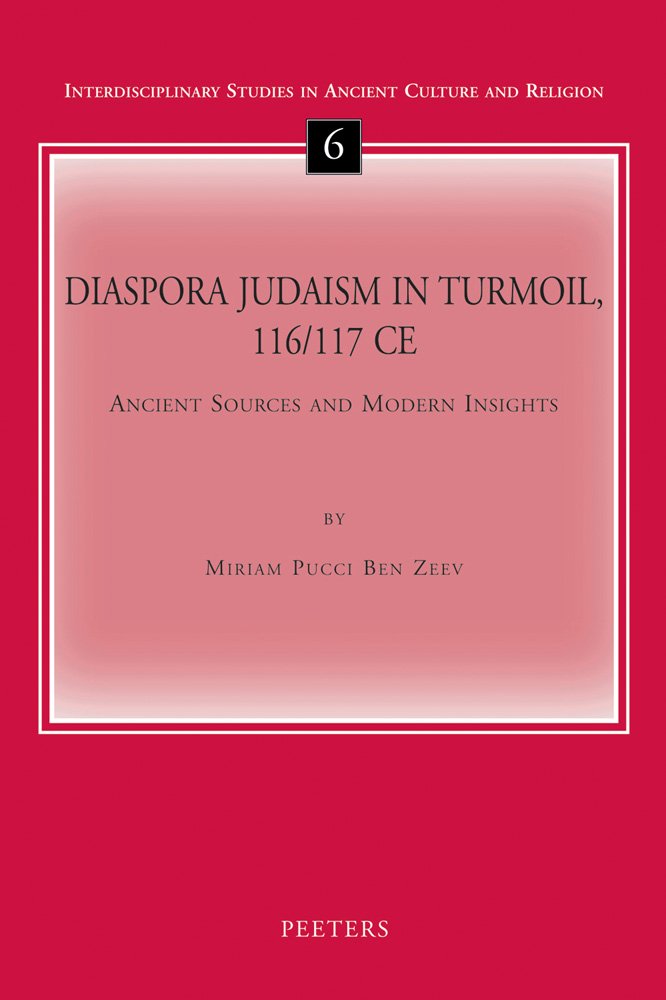
Title
Diaspora Judaism In Turmoil, 116/117 Ce: Ancient Sources And Modern Insights (Interdisciplinary Studies In Ancient Culture And R
Sold by Ergodebooks, an authorized reseller.
Returns accepted within 30 days | support@ergodebooks.com
Shipping Information
- Free Standard Shipping — United States only
- Processing Time: 3–5 business days
- Estimated Delivery: 6–10 business days after dispatch
- Double-boxed, fully insured & discreetly packaged
- Tracking number sent via email once dispatched
Returns & Refund
Returns accepted within 30 days of delivery.
Damaged or Defective Item
Free return shipping + replacement or full refund
Wrong Item Received
Free return shipping + replacement or full refund
Change of Mind
Return shipping at customer's expense · 25% restocking fee applies
Payment Option

Between The Two Wars Fought In Judaea Against The Roman Government The 'Great War' And That Of Bar Kochba The Uprisings Of Diaspora Jews Toward The End Of Trajan'S Reign Constitute A Unique Event In The History Of The Second Jewish Commonwealth. It Marks The First And Only Episode Of Jewish Violence On A Grand Scale To Take Place Outside Judaea, And At The Same Time The Only Instance Of Simultaneous Outbursts In Different Geographical Places Libya, Egypt, Cyprus And Mesopotamia, And Apparently Judaea As Well. What Happened Exactly? Where Did The Jews Get Their Arms From And For How Long Did They Succeed In Resisting The Impact Of The Roman Legions? Generations Of Scholars Accepted The Statement Of Eusebius That The Uprisings Started In 115 Ce, But The Possibility Has Been Recently Put Forward That The Revolt Broke Out, Instead, Only In 116. Moreover, What Was The Order In Which The Upheavals Took Place: The Traditional One Libya, Egypt, Cyprus And Mesopotamia As Most Scholars Believe Following The Testimony Of Eusebius, Or, Rather, Is The Correct Order The Opposite? If, In Fact, The Jews Of Mesopotamia Were The First To Take Up Arms, The Events That Took Place In The East Would Have Been Determinant In Fomenting The Uprisings In The Western Mediterranean Region. An Assessment Of The New Theories Is A Must And Involves A Reconsideration Both Of The Literary Accounts And Their Own Sources And Of Other Kinds Of Information Available, Including The Ostraca Found In Egypt And A Number Of Papyri Either Recently Discovered Or Only Now Ascribed To The Events Of These Upheavals. The First Part Of This Work Presents Here, For The First Time, A Full Collection Of The Epigraphical, Papyrological, And Historical Sources Of Pagan, Christian And Jewish Origin Dealing With These Events, In Their Original Language And In English Translation. In The Second Part, A Fresh Reading, Both Of The Sources And Of Scholarly Views, Leads Miriam Pucci Ben Zeev To New Interpretations Of Events In Egypt, Mesopotamia And Judaea And To A New Chronology, Which Enables Her To Reach Surprising Conclusions Concerning A Possible Interrelationship Between The Upheavals In The Different Countries.
⚠️ WARNING (California Proposition 65):
This product may contain chemicals known to the State of California to cause cancer, birth defects, or other reproductive harm.
For more information, please visit www.P65Warnings.ca.gov.
- Q: What is the page count of the book? A: This book has three hundred fourteen pages. It offers an in-depth exploration of Diaspora Judaism during a tumultuous historical period.
- Q: What is the binding type of this book? A: The book is paperback bound. This makes it lightweight and easy to handle for reading.
- Q: Who is the author of the book? A: The author is Miriam Pucci Ben Zeev. She provides modern insights into ancient Jewish history.
- Q: What are the dimensions of the book? A: The book measures six point three eight inches in length, zero point six seven inches in width, and nine point four one inches in height. These dimensions make it a convenient size for reading.
- Q: What historical events does the book cover? A: The book covers the uprisings of Diaspora Jews during the Roman era. It focuses on the unique events between the Great War and the Bar Kochba revolt.
- Q: How do I read this book? A: You can read this book at your own pace. It is suitable for anyone interested in Jewish history or ancient cultures.
- Q: Is this book suitable for beginners in history? A: Yes, this book is suitable for beginners. It presents complex historical events in an accessible manner.
- Q: Can this book be used as an academic resource? A: Yes, it can serve as an academic resource. The book includes original sources and scholarly analyses relevant to studies in ancient cultures.
- Q: How should I store this book to keep it in good condition? A: Store the book in a cool, dry place. Avoid exposure to direct sunlight to preserve its quality.
- Q: Is this book safe for children? A: Yes, the book is safe for older children and teens. However, it is recommended for readers with an interest in historical topics.
- Q: How do I clean the book if it gets dirty? A: To clean the book, gently wipe the cover with a soft, dry cloth. Avoid using liquids that could damage the paper.
- Q: What if I receive a damaged book? A: If the book arrives damaged, contact customer support for a return or exchange. Most retailers offer a return policy for such cases.
- Q: What makes this book different from other history books? A: This book offers a unique perspective by combining ancient sources with modern insights. It provides a fresh interpretation of Jewish uprisings.
- Q: Does this book include translations of original texts? A: Yes, the book includes both original texts and their English translations. This makes it accessible for a wider audience.
- Q: Is there a specific reading age for this book? A: While there is no strict age limit, it is recommended for readers aged twelve and up due to its complex themes.
- Q: What genre does this book belong to? A: This book belongs to the genre of historical scholarship and interdisciplinary studies. It focuses on ancient culture and religion.