
Title
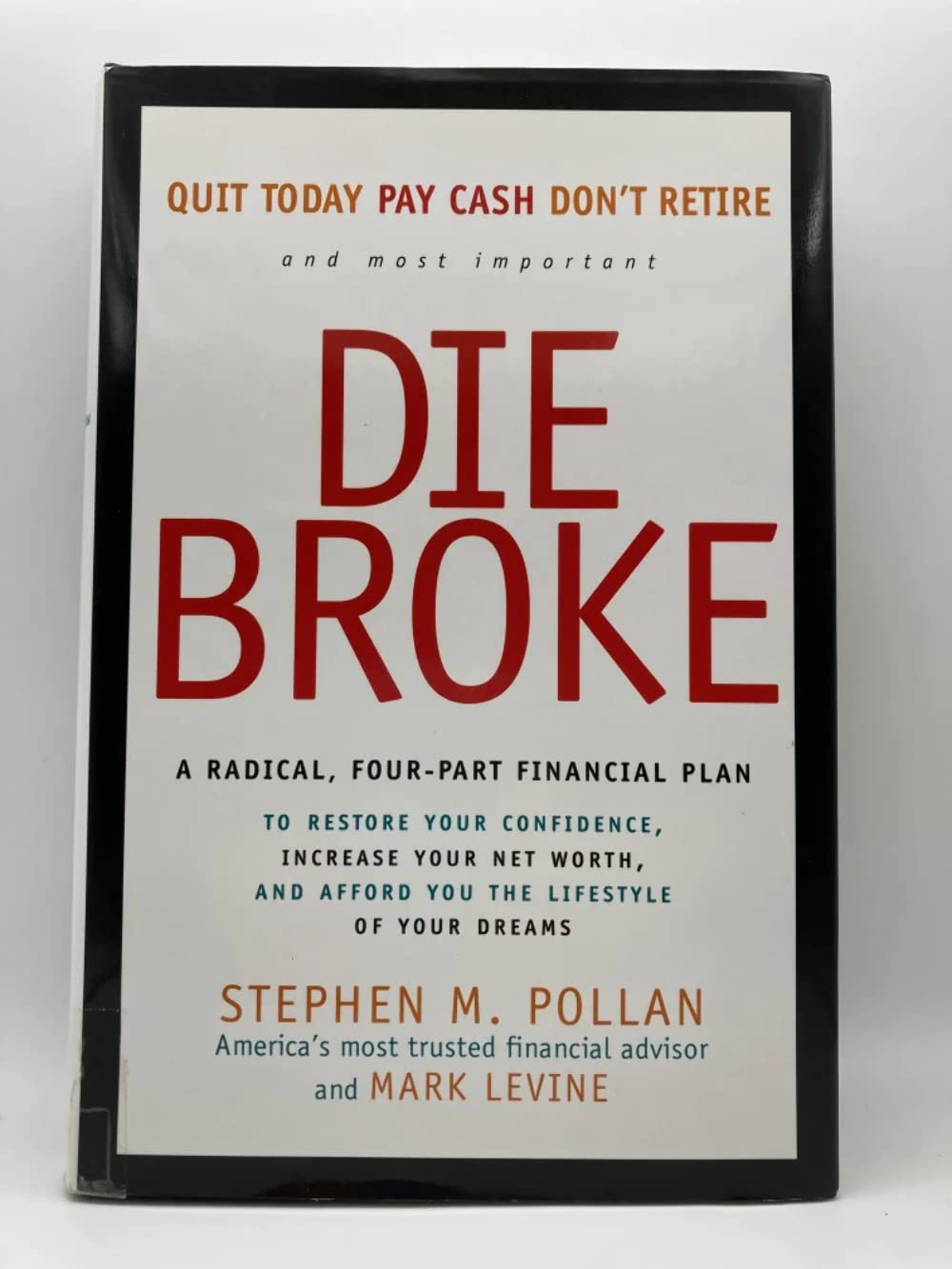
Die Broke: A Radical FourPart Financial Plan,New
Sold by Ergodebooks, an authorized reseller.
Returns accepted within 30 days | support@ergodebooks.com
Shipping Information
- Free Standard Shipping — United States only
- Processing Time: 3–5 business days
- Estimated Delivery: 6–10 business days after dispatch
- Double-boxed, fully insured & discreetly packaged
- Tracking number sent via email once dispatched
Returns & Refund
Returns accepted within 30 days of delivery.
Damaged or Defective Item
Free return shipping + replacement or full refund
Wrong Item Received
Free return shipping + replacement or full refund
Change of Mind
Return shipping at customer's expense · 25% restocking fee applies
Payment Option

Exit Life as You Came in It: Penniless!And Other Heretical Hints For Living Well In The New Economic Age'If you don't read this book, you're going to die stupid!' Dr. Laura SchlessingerThe Baby Boomers are a generation of achievers: They earned college and professional degrees and are scampering up the corporate ladder or starting entrepreneurial enterprises that boost their egos and their bank accounts. They buy sensible 'starter homes' and plan to parley them into impressive dream houses through smart real estate deals, all the while deftly juggling their home, family and business lives. If two incomes don't cover all life's necessities and necessary luxuries their credit cards serve as readily available genies to make wishes reality. If their ultimate rewards have always been clear an early and comfortable retirement and a healthy estate to leave for the children why are they now facing the future with fear and trepidation?In Die Broke: A Radical FourPart Financial Plan (HarperBusiness; November 1997; $25.00), financial advisers Stephen M. Pollan and Mark Levine explain the economic realities that have rendered the old rules obsolete and offer an innovative approach to financial planning that focuses on getting the maximum use out of your income and your assets during your lifetime and renouncing the foolish (and futile) quest for financial immortality. From the startling recommendation, 'quit now,' to the heretical 'die broke,' Pollan lays out the details of a complete financial revolution.'Viewing yourself and your work as one,' Pollan writes, 'is a tremendous financial and emotional risk.' To prove that the 'SelfFulfillment Ethic' and the false belief in careers must give way to a new work ethic, Pollan cites a ready role model the professional athlete. Free agents in the sports world know their tenure with any team is temporary and concentrate on getting the best financial deal they can. Adopting their attitude is the key for anyone who doesn't want to remain on the sidelines in the next century. Pollan advises that work is not a holistic pursuit. The only way to increase satisfaction and/or income is to job hop with a constant eye toward a work setting that will increase skills (and therefore marketability) and improve quality of life with immediate advantages like premium health insurance, company day care, parental leave and telecommuting and flex time options. 'Long term benefits, like pension plans,' Pollan reminds readers, 'are worthless. Most of you will be fired long before you are fully vested.'What else is keeping people locked in the 20th century? Two little pieces of plastic: ATM cards and credit cards. The convenience is irresistible; the costs are mindboggling. Offering a strong dose of reality, Pollan insists that spending should be difficult and uncomfortable: 'You must resolve to no longer reach beyond your grasp. If you don't have the cash on hand or in your checking account to buy something... don't buy it.'Pollan issues an equally important warning about the biggest purchase most people make in their lives real estate. Homeownership remains an excellent tax shelter and a desirable form of enforced savings that can help generate income in later years. But with the unpredictability of the real estate market, the benefits of 'serial ownership,' or 'trading up,' have become less likely. Pollan's solution is to save your money until you can 'buy your second home first,' by purchasing a residence that is large enough to accommodate a growing family, aging parents and even a home business in short, a home designed for a lifetime.Along with demanding a new perspective on work, credit and real estate, the new economic age lays to rest the American 'dream' of retirement. Not only are traditional sources of retirement money (government assistance and private pensions) drying up, but people have discovered that longterm leisure isn't all it's cracked up to be. Pollan encourages
⚠️ WARNING (California Proposition 65):
This product may contain chemicals known to the State of California to cause cancer, birth defects, or other reproductive harm.
For more information, please visit www.P65Warnings.ca.gov.
- Q: What is the main premise of 'Die Broke: A Radical Four-Part Financial Plan'? A: 'Die Broke' presents a financial strategy that encourages individuals to focus on maximizing the use of their income and assets during their lifetime rather than seeking financial immortality.
- Q: Who are the authors of this book? A: The book is authored by financial advisers Stephen M. Pollan and Mark Levine.
- Q: What topics does the book cover? A: The book covers various topics including financial planning, the importance of liquidity, home ownership, and the changing nature of retirement.
- Q: What type of readers would benefit from this book? A: This book is ideal for individuals, especially Baby Boomers, who are looking to reassess their financial strategies in light of modern economic challenges.
- Q: Is 'Die Broke' suitable for beginners in finance? A: Yes, the book is written in an accessible style, making it suitable for readers new to financial concepts as well as those familiar with finance.
- Q: What is the significance of the book's title? A: The title 'Die Broke' signifies the authors' radical approach to financial planning, advocating for the idea that it's better to use your resources while alive rather than trying to leave a legacy.
- Q: How does this book approach the concept of retirement? A: The authors challenge traditional views on retirement, suggesting that the desire for long-term leisure may not be as fulfilling as once thought.
- Q: What are some key financial strategies mentioned in the book? A: Key strategies include maintaining a liquid reserve, investing in equity, and prioritizing immediate benefits like health insurance and job satisfaction.
- Q: What is the book's publication date and edition? A: 'Die Broke' was published on November 7, 1997, and is available in its first edition.
- Q: What is the book's page count and binding type? A: The book has 320 pages and is available in hardcover.